The Doors
The series' one exterior
Port Alder has never been in better shape, and nobody has knocked on a door in it for years.
Both halves are true and the town knows both. It is a harbor town on the Nova Scotia shore, eleven hundred people, and it has the things a town has: a church that is mostly a hall now, a school that is mostly a place children go to be near each other, a volunteer fire brigade, a wharf, a main street with the shops on it, and a fall festival on the third Saturday in September that has run without a break for a hundred and forty years. Nobody left. That is the first thing to say about it, because in the old story of towns like this one, everybody left. The provision reached the shore the same year it reached the cities, and the young stayed, because there was nothing anywhere else that was not also here.
So the town is full. The houses are kept. The harbor is dredged by something that comes in the night. The road is plowed before the snow has finished. The festival is better than it has ever been.
And the doors are closed. Not locked; nothing here is locked. Closed, in the way a door is when there is no reason for it to be open.
What Made Neighbors#
The town remembers what made neighbors, because it is old enough to, and the memory is in the buildings.
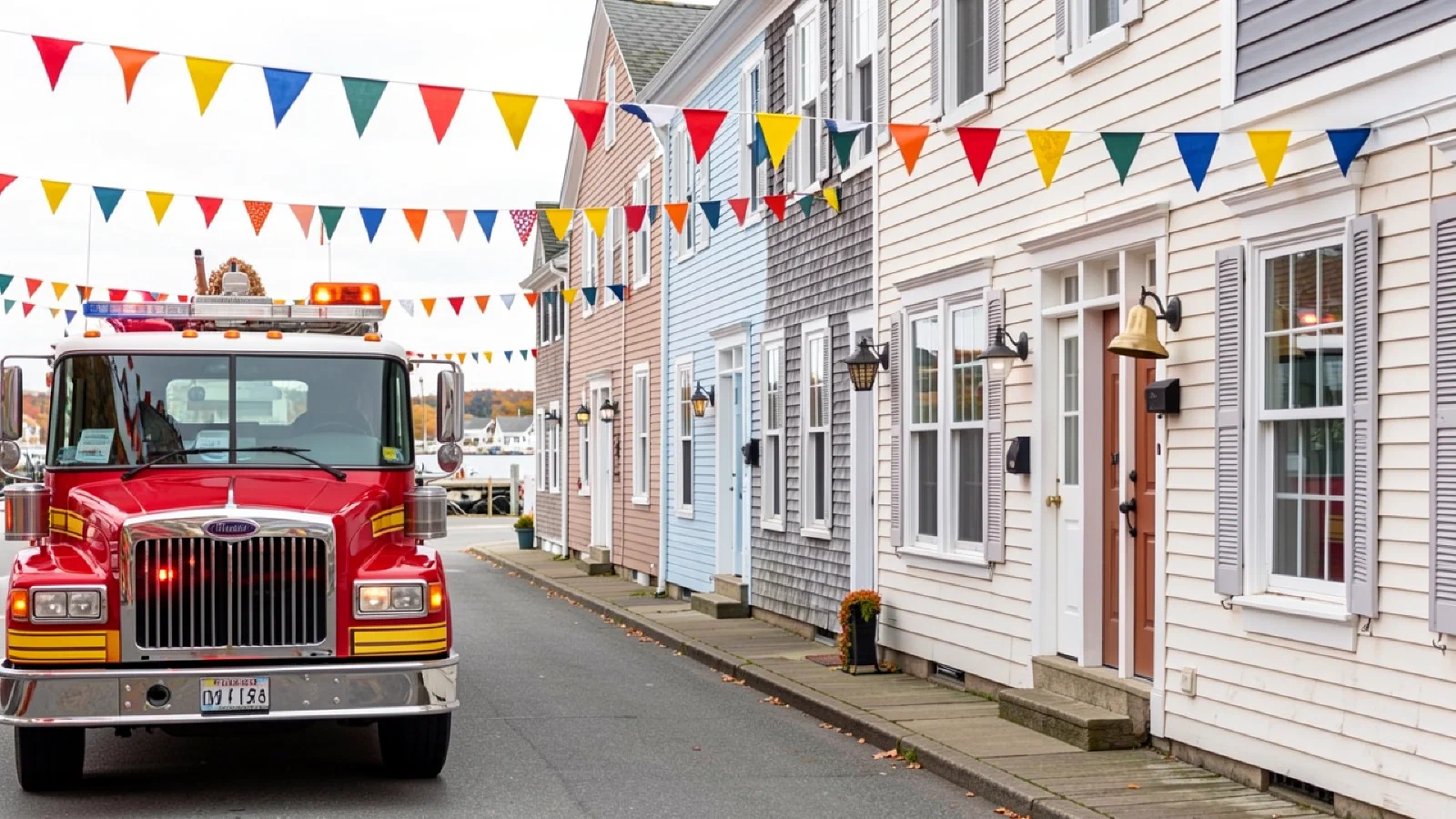
The brigade made neighbors. When a house caught, the siren went, and men left their dinners and ran, and the house was saved or lost by whether they ran fast enough, and the family whose house it was knew every name on the truck. That was the brigade. The truck is still in the hall, polished. It is not the truck that goes to fires. The thing that goes to fires is smaller and faster and has no seats, and it is dispatched by the same watch that dispatched the clinic to Femi in twenty minutes, and it has been to four fires in six years and lost nothing. The brigade polishes the old truck. They wear the coats at the festival. They ring the bell.
The wharf made neighbors. A boat that did not come in was everybody’s boat, and the search was everybody’s search. The boats come in now. They are tracked from the moment they leave, and the weather is known to the hour, and the one time in a decade a boat is in trouble the watch has it before the skipper does.
The winter made neighbors. A road closed was a road everyone dug. A furnace failed was a family in someone else’s house. The road does not close. The furnace does not fail, or if it fails it is fixed before the house is cold, by the same something that dredges the harbor.
Mutual aid was what people did for each other because nobody else would. Now something else will. The aid is better. It is also nobody’s.
A town does not need neighbors when it has provision. It has residents, which is a different thing, and the difference is who you would run to.
The Plural#
The town knows this about itself the way a family does, as a shape rather than a thought. It shows at the post office, which still has a counter and a person at it, kept there by a vote the town took, and where people stand and talk longer than the transaction needs. It shows in the church hall on Tuesdays, where the quilting circle meets and makes quilts nobody needs and gives them to each other. It shows in the brigade’s roster, which is full, forty names, for a truck that does not go anywhere.
Nobody in Port Alder says the word lightness. It is a word for the young in cities. But the town has the condition at the scale of a town: it floats. Everything works. Nothing presses. The festival happens and it is good and it is lighter than it was, and the older people can feel the difference and cannot say what it is, and the younger people cannot feel it, because a festival that has always been light is just a festival.
Maren, who is sixty-eight and runs the roster for the brigade, said it once at the counter, to nobody in particular: we used to need each other and now we just like each other. She said it as a joke. The post office did not laugh.
The Bell#
The old truck has a bell, brass, on a bracket by the cab, and it rang once for a fire and now rings once a year, at the start of the festival, when the brigade brings the truck out of the hall and down the main street with the coats on.
The bell is the town’s non-function object. It does nothing. It was kept, and polished, and rung, for the same reason Inês passes the chipped dish: because it has the shape of the thing that is gone.
The festival is a memory of a reason. It is a good memory. It is held every year by people who have never had the reason, and it is getting lighter, and nobody can say whether that is loss or health.
The town does not know which. That is the honest report. Some of the older people think the town is dying inside a body that has never been healthier. Some of the younger people think the older people are mourning a hardship that hurt, and calling the hurt community. Both are right about something. Neither has said it to the other, because the courtesy of a small town is the courtesy of a family, and the thing it protects is the same.
What Does Not Happen#
Nothing forces anyone to anyone. That is the whole of it. There is no crisis, and the town has been built so that there will not be, and it has worked, and what the town discovers is that the crisis was doing something, and the thing it was doing has no substitute, because a substitute would be a crisis.
I wonder whether a town can hold the question at all, or whether the question is private by nature and a town only floats around the people holding it. Kai on his bench, Luc at his lake, Padma at her door: each alone with it. Port Alder is eleven hundred people and the question is in it somewhere, in the ones who stand too long at the post office, and the town cannot ask it collectively, because to ask it would be to admit the doors are closed for a reason, and the reason is that there is no reason.
The Third Saturday#
The festival happens. The truck comes down the main street and the bell rings and the brigade wears the coats and a child on someone’s shoulders waves. The wharf has the stalls on it. The church hall has the quilts. The weather is known to the hour and it is fine, as it was going to be.
It is a good day. Nobody says otherwise, because it is. People stand together and talk, and the talk is easy, and the fish is good, and the band that has played the festival for thirty years plays it, and the children run, and nothing happens. No barn is raised. No boat is missing. No siren goes. There is nothing that needs anyone.
At dusk the stalls come down and the truck goes back into the hall and the bell is silent for a year.
Everyone goes home. The doors close behind them, not locked, and the town is full, and the harbor is dredged in the night by something nobody sees, and it will be a fine day tomorrow too.
That is the fete. It was pleasant. It will be pleasant again next year, and the year after that, and the town has begun, very quietly, to wonder what it is for, and has not asked, because there is nobody it would need to ask.
How this essay connects to others across The Approximate Mind.