The Chair Between
Two crafts, one room, and the chair that faces neither
Teodor is fluent in two languages and has no country.
The languages are not languages. They are conditions. In the first he worked eleven years at a bench, making teeth for people whose mouths he never saw, and the work pressed on him the way work did then: a deadline, a dentist on the line, a crown that had to seat by Thursday. In the second he wakes when he wakes, in a house that keeps itself, with the month’s provision arrived before he has thought about it, and nothing due by Thursday or ever.
He is forty. He was twenty-nine when the lab closed. He has lived long enough in each condition to dream in both.
His daughter is nine and speaks only the second. His father is seventy-four and speaks only the first. Teodor sits between them at dinner and translates, and neither of them knows that is what he is doing.
The Two Benches#
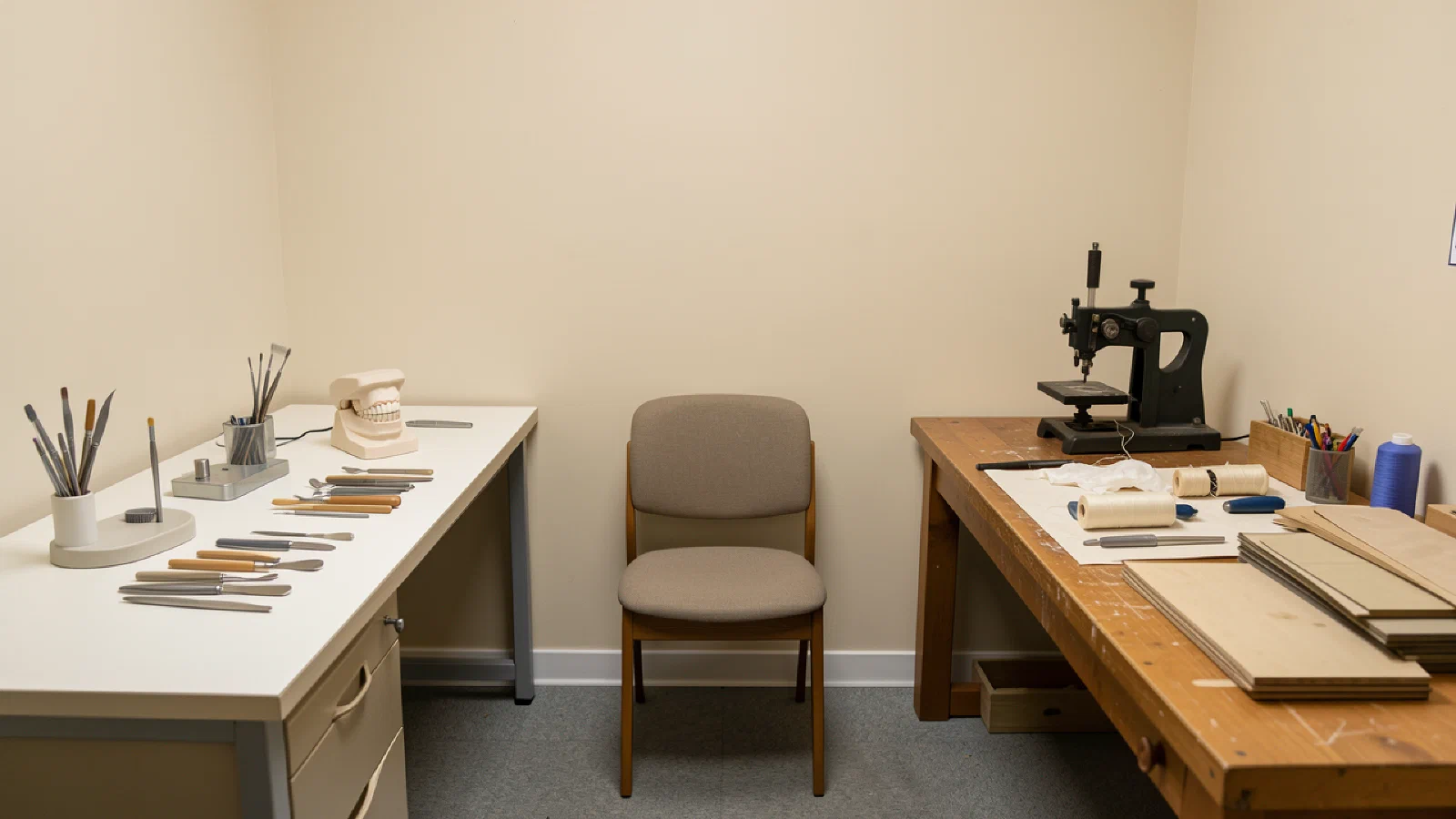
The room at the back of the house has two work surfaces and a chair.
The first bench is the old one. He brought it from the lab when the lab closed, over the objections of no one, since by then nobody wanted a dental technician’s bench. On it, in order, are the tools: the wax knives, the carvers, the small brushes, the articulator that holds a plaster jaw and lets it bite. He cleaned them the week he left and has kept them clean since. He does not use them.
The second bench is new. The companion suggested it, in the second year of provision, when it had learned enough about him to know what his hands missed. On it are the tools of a different craft, one the companion chose for the overlap: bone folders, a nipping press, linen thread, boards. He binds books. He is good at it. Nobody needs a book bound by hand, and the companion did not say otherwise, and he has bound perhaps sixty.
Between the two benches is a chair, and the chair faces neither.
The house does its work around the room. The temperature moves a degree at four in the afternoon because the sun comes onto the back wall then and the house has learned this. The lights follow him from bench to bench. He has never once turned to see which one came on.
The Eleven Years#
At the lab he made crowns. A dentist sent an impression; he poured it, mounted it, built the tooth in wax on the plaster, cast it, finished it, sent it back. The mouth it went into was a stranger’s. He knew the stranger by the bite, by the wear on the neighboring teeth, by the space left. He knew, for instance, that a certain patient ground her jaw at night, and he built the crown for that, and never met her, and she never knew he had thought about her sleep.
That was the weight. Not the deadline. The stranger.
The scanners came first, then the mills, then the printers that made the crown in the surgery while the patient waited, and the whole craft went from a bench to a cabinet in the space of four years. The lab had eleven technicians. It closed on a Friday with a speech and a cake, and the provision was already arranged, and the transition had by then been under way long enough that nobody in the room was surprised, and several were relieved.
Teodor was not relieved. He was twenty-nine. He had carried something and been told he could set it down, and setting it down felt like being told he had been holding it wrong.
To have carried weight and set it down is different from never lifting it, and different again from carrying it still. He is the third thing, and there is no word for the third thing.
The generation before his has a word. They say worked, in the past tense, and it means a whole life. The generation after has a word. They say lightness, and it means the only life they know. Teodor’s generation says nothing, because what they would have to say is that they knew both, and were cut in the middle, and it does not compress to a noun.
Fluency#
His father comes on Sundays and talks about the works. He was a fitter at a plant that made pumps, and the plant made pumps for forty years, and then it made them without him, and then it made them without anyone. He speaks of it the way men once spoke of a war. Teodor understands every word, because he carried eleven years of the same thing, and his father does not know this, because eleven years to a man with forty is a season.
His daughter, Mila, comes into the back room while he binds and sits on the floor and reads. She does not ask what the first bench is for. It has never occurred to her that a bench could be for something. She is a Human, in the sense Kai’s generation gives the word: the ones born after, for whom survival is infrastructure and the building is done. She floats, and does not know it, and is happy, and Teodor watches her float with a feeling he cannot name and would not name if he could, because the feeling is not fair to her.
He understands her too. He has lived eleven years in her condition. He wakes when he wakes. He knows what it is to have a day with nothing in it that must be done, and he knows that it is not bad, and he knows that his father would not believe him.
So he is fluent. He can speak weight to his father and lightness to his daughter, and neither of them can speak to each other, and he is the only one at the table who hears both sides of the conversation they are not having.
Fluency is not belonging. A translator has no country. He goes home to a room with two benches in it.
The Suggestion#
The companion has never suggested that he go back to the first bench.
This is correct. There is nothing to go back to. A crown made by hand would seat as well as one from the cabinet and cost forty times as much in a currency nobody spends, and the companion knows this, and so does he.
What the companion has suggested, at intervals, is that he find a new weight. It does not use that word. It says purpose, or project, or direction, and it says these things carefully, with a sensitivity to his profile that he finds almost unbearable, because the profile is accurate. It knows he needs to be needed. It has offered him the ways a person can be needed in a world that does not need anyone: the restoration work, the governance seats, the mentoring of Humans who have never held a tool. He has tried two of them.
The trouble is not that the suggestions fail. Some of them half succeed. The trouble is what the suggestion says underneath.
A man told to find a new weight has been told the old one was optional.
His father was never told this. His father’s weight was taken by history, and history does not suggest alternatives; it just stops. Mila will never be told this, because she has nothing to replace. Only the cut generation gets the suggestion, kindly, at intervals, from a system that knows them well enough to know exactly what they lost, and offers them something in the same shape, and cannot understand why the shape is the insult.
The Chair#
On a Tuesday afternoon, with the light on the back wall and the house adjusting for it, he sits in the chair between.
He has bound a book that morning, a good one, quarter leather, the spine tight. It sits on the second bench drying. On the first bench, the articulator holds a plaster jaw that has been biting nothing for eleven years.
He picks up a wax knife. He does not build anything. He turns it in his hand, feels the balance, puts it down in its place. He picks up a bone folder from the other bench, feels the balance, puts it down.
I wonder whether the cut generation is the one that will answer the question or the one that cannot, because they are the only people alive who can compare, and comparison may be the thing that makes an answer impossible. Kai cannot compare. Teodor’s father will not. Teodor can, and does, every day, and it gets him a chair facing neither bench.
Mila comes in and sits on the floor with her book. She reads. She does not ask why he is sitting there. The lights hold on him because he has not moved.
Nothing happens. She turns a page. After a while he gets up and checks the spine on the new book, and it is fine, and he says so, to nobody, and she looks up and smiles because he has said something.
He is good at both. That is the trouble. It is also not the kind of trouble anyone counts.
How this essay connects to others across The Approximate Mind.