The Window
A night shift pharmacist outside Dayton, Ohio discovers that what the profession left behind is what the 2 AM counter was always for.
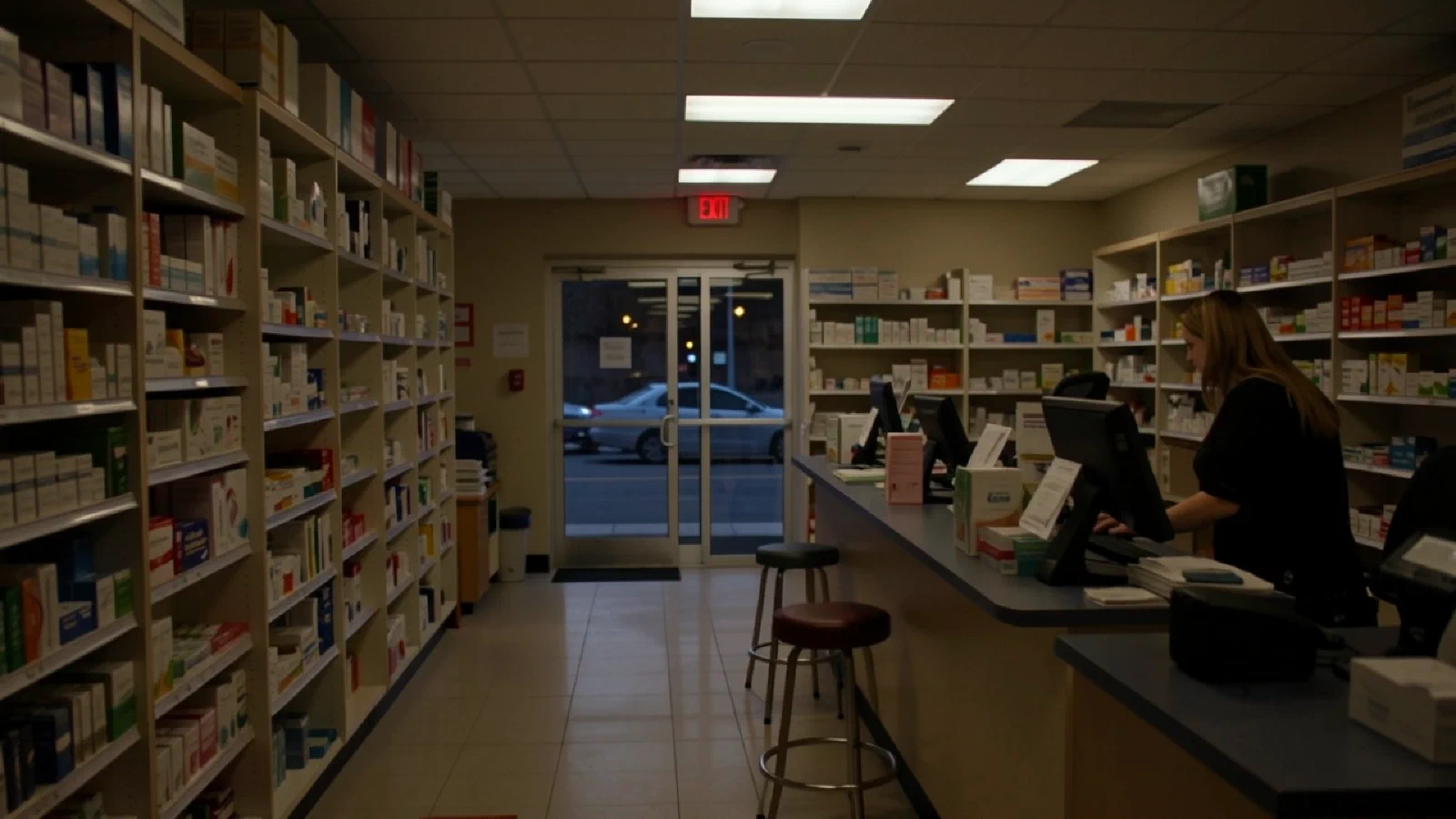
The automatic door sounds different at night.
During the day it is a swoosh in a stream of swooshes, unremarkable, lost in the ambient noise of a Walgreens doing its ordinary business: the register beeps, the overhead music, the shuffle of customers through aisles stocked with things they came for and things they did not come for but will leave with anyway. The door opens and closes forty, fifty, sixty times an hour. Nobody notices.
At 2:14 AM on a Wednesday in March, the door opens and Grace Dao notices.
She notices because she has been standing behind the pharmacy counter for three hours without hearing it. The store is not empty. Marcus, the security guard, is on a stool near the front entrance, reading something on his phone with the concentration of a man who has found a way to make eight hours of nothing into something. A stock clerk is somewhere in the back, restocking shelves with the quiet efficiency of someone who prefers the night shift specifically because it does not require interaction with customers. But the door has not opened since the woman who bought Tylenol PM at 11:40, and the silence between then and now has the particular quality of a building that is open when everything else is closed.
Grace has a Pepsi she bought from the cooler at 11:30. It is warm now. She drinks it anyway. She has been a pharmacist for nineteen years, the last six on the night shift at this Walgreens on the commercial strip outside Kettering, south of Dayton. She chose nights originally because the pay differential helped with her daughter’s tuition at Wright State. She stayed on nights after the tuition was paid because she discovered something about the 2 AM counter that nobody had told her in pharmacy school and that she has not been able to fully explain to anyone since.
What the System Does#
The pharmacy fills itself now.
This is not precisely true, but it is close enough that the gap between the statement and the reality is narrower than it was last year, and narrower than it will be next year. The auto-fill system receives electronic prescriptions, verifies them against the patient’s medication history, checks for interactions, confirms insurance coverage, prints labels, and queues the physical count. Grace’s role in this process is verification: she reviews what the system has prepared, confirms the count, checks the label against the prescription, and releases the medication for pickup.
Between midnight and 6 AM, she performs this verification for maybe eight prescriptions. Sometimes fewer. The prescriptions arrive electronically at all hours because the system does not sleep, but the patients who pick them up are mostly daytime people. The night prescriptions are the ones called in from emergency rooms, the pain medications and antibiotics and anti-nausea drugs that accompany a 1 AM visit to the ER at Kettering Health. These arrive with urgency but not complexity. The system handles the complexity. Grace handles the pill bottle and the label and the bag and the stapler that attaches the receipt.
She is, by the metrics the company uses to evaluate pharmacist productivity, profoundly underutilized.
She knows this. Her district manager knows this. The spreadsheet that tracks prescriptions-per-pharmacist-hour knows this with mathematical clarity. The night shift at this location is, by every operational measure, a resource allocation problem waiting to be solved. A pharmacist costs the company more than a technician. A technician could handle the eight prescriptions. The auto-fill system could, with a modest regulatory adjustment, handle the eight prescriptions without any human at all.
Grace has read the industry publications. She knows that 24-hour pharmacy locations are closing across the country, consolidating night operations into centralized fulfillment, replacing the window with a kiosk, replacing the counter with a locker. She knows that the argument for keeping a pharmacist behind a counter from midnight to six, in a store that fills eight prescriptions in that window, is an argument the spreadsheet will eventually win.
She also knows that the spreadsheet does not see the door.
2:14 AM#
The man who comes through the door at 2:14 is in his early fifties. He is wearing a coat that is too heavy for March, which Grace has learned to read as a person who dressed in the dark and grabbed whatever was nearest. He did not plan this trip. He decided to come, got in the car, drove here. The coat is evidence of the speed of the decision, not the temperature.
He walks past the greeting cards, past the vitamins, past the seasonal display that is still Valentine’s Day because nobody has changed it, and arrives at the pharmacy counter with the posture of a man who is embarrassed to be here and committed to being here in equal measure.
“I have a question about a medication.”
“Of course.”
He puts a pill bottle on the counter. It is his wife’s. Sertraline, 100mg. Grace can see from the label that it was filled here, three weeks ago, at the regular pharmacy during regular hours. The man could have called during the day. He could have asked the daytime pharmacist, who filled it. He could have looked it up on his phone. He drove twenty minutes at 2 AM to ask a stranger.
“My wife’s been on this for about a year. Her doctor says it’s working. She says it’s working.” He pauses. “I don’t think it’s working.”
Grace waits. She has learned that the space after the first sentence is where the real question lives, and that filling it too quickly with professional competence closes the door the person just opened.
“She’s not, I mean, she functions. She goes to work. She picks up the kids. She does everything she’s supposed to do. But she’s not.” He stops again. “She’s not there. She’s doing all the things, but she’s not there while she does them.”
“Has she talked to her doctor about this?”
“She says she has. The doctor says the medication is doing what it’s supposed to do. Her levels are normal, whatever that means. Everything is by the numbers, working.”
“But you see something the numbers don’t.”
He looks at Grace. For a moment the embarrassment drops and what is underneath is not confusion or complaint but fear. The fear of a man who is watching someone he loves comply with a treatment that by every clinical measure is succeeding and who knows, with the knowledge that comes from sharing a bed and a kitchen and a life, that something is being missed.
“I don’t want to go against her doctor. I don’t know medicine. I just know her.”
Grace picks up the bottle. She does not need to look at it. She has filled sertraline a thousand times. She knows its mechanism, its side effects, its therapeutic range, its interactions, its contraindications. She knows everything the system knows about this drug, and the system knows it better than she does, faster, with fewer errors and no gaps in recall.
What the system does not know is this man’s face at 2:14 in the morning, the coat grabbed in the dark, the twenty-minute drive to ask a question he could not ask in front of his wife because the question is not really about the medication. The question is about whether his wife is still his wife inside the competent, functioning, medically stable person who comes home from work and picks up the kids and does everything she is supposed to do and is not there while she does it.
“You’re not going against her doctor by paying attention,” Grace says. “You’re seeing something. That matters.”
She talks to him for nine minutes. She does not diagnose. She does not contradict his wife’s physician. She explains that SSRI response is not binary, that there is a range between not working and fully working that clinicians sometimes call partial response, that what he is describing, functional but flat, present but not present, is something physicians hear about and take seriously when it is reported. She suggests he write down what he is seeing, specific observations rather than feelings, and bring them to his wife’s next appointment. She suggests he consider being in the room when the conversation happens, if his wife is comfortable with that.
He listens with the focus of a person who has been carrying a question for months and has finally found a counter to set it down on.
“Thank you,” he says.
“You drove here at two in the morning because you’re paying attention to someone you love. That’s not nothing.”
He picks up the bottle. He leaves. The automatic door opens and closes. The parking lot swallows his headlights. The hum of the refrigerator case resumes its authority over the silence.
The Others#
Grace does not keep a list, but she keeps a count. Not formally. In her head. The number of people who come to the counter between midnight and six for reasons that are not prescriptions.
Three or four per night. Sometimes two. Rarely more than five. Some weeks, one will come every night. Other weeks, the counter stays empty and Grace stands behind it reading continuing education modules on her tablet and drinking Pepsi and listening to the refrigerator hum.
The people who come are never in a hurry. This is the thing Grace noticed first, years ago, before she understood what it meant. They drove here. They parked. They walked through the automatic door that announces them into the fluorescent quiet. But once they are at the counter, they have all the time in the world. As if getting here was the hard part, and now that they are here, they can breathe.
The woman who comes in most Thursdays around 3 AM to ask about interactions between her mother’s medications. She has a list. The list is always the same. The interactions have not changed. Grace answers the same questions each time, with the same care, because the questions are not about the medications. They are about a daughter who is managing her mother’s decline and has found the one place where someone will stand still and listen to her describe it.
The teenager who came in twice in January, both times after midnight, both times buying nothing, both times standing near the pharmacy counter until Grace asked if she needed help. She did not need help. She needed a lit room with an adult in it who was not her parent and not asleep and not asking her why she was awake. Grace does not know what was happening at home. She knows the girl came back a second time, which means the first time gave her something she needed.
The man who picks up his Suboxone prescription every Monday at 5:30 AM because the morning pickup is part of his structure, the first act of each week, the ritual that means the week has started and he is in it. He could pick it up during the day. He comes at 5:30 because 5:30 is the time that means he is still trying.
The toll booth dissolved when the algorithms took over the verification and the counting. The window stayed open because someone still stands behind it.
4 AM#
The store is at its emptiest. Marcus has shifted from reading to a state Grace recognizes as awake-sleeping, the specific skill of security guards and night-shift workers everywhere: conscious enough to respond to a crisis, unconscious enough to make the hours bearable. The stock clerk has finished the back aisles and moved to the front, where the seasonal display is finally being changed from Valentine’s Day to something involving pastel eggs.
Grace stands behind the counter. The auto-fill system has queued two prescriptions for the morning rush. The verification takes her four minutes. She could do it in two, but she has learned that rushing through the night’s only pharmaceutical task leaves a longer empty stretch on the other side, and the empty stretches are where the quiet becomes heavy.
She thinks about the man with the sertraline bottle. She thinks about his wife, who she has never met and will probably never meet, who is functioning and flat and medically stable and not there. She thinks about the doctor, who is probably a good doctor, who is probably seeing normal values on the screens and hearing adequate answers to the standardized questions and concluding, correctly by every metric available, that the treatment is working.
She thinks about the word “working.”
A profession is a structure built around a problem. When the problem changes, the profession faces a question about what it is for. Pharmacy was built around the problem of safe medication dispensing: the right drug, the right dose, the right patient, no interactions, no errors. This was a hard problem that required knowledge and precision and judgment. The auto-fill system now performs most of this function with fewer errors than any human pharmacist has ever achieved. What remains, the verification, the final check, is not nothing. It is important. But it is not what Grace went to pharmacy school for, and it is not what keeps her standing behind this counter at 4 AM.
What keeps her is the window.
I wonder whether the spreadsheet will find a way to see it. Whether anyone will think to measure what the 2 AM counter provides before they decide it provides nothing. Whether the man with the sertraline bottle would have driven to a kiosk, stood in front of a screen, asked a chatbot whether his wife is still his wife inside the medication that is working. Whether the Thursday woman would come back if the counter had no one behind it. Whether the teenager would have come into an empty store.
The window is the simplest architecture of human contact: a counter, a person behind it, a door that opens. The window does not require a relationship. It does not require an appointment. It does not require the person walking through the door to know what they need or to be able to name it. It requires only that someone is there, and that the someone is willing to stand still.
5:47 AM#
The sky through the front windows is changing. Not yet light, but no longer the absolute dark of 2 AM. The gray that precedes dawn in Ohio in March, flat and noncommittal, the sky deciding whether to commit to the day.
Grace’s replacement, Dave, arrives at 5:55. He is a morning person in the way that Grace is a night person: the preference is constitutional rather than circumstantial. Dave likes the rush. The volume. The line of people at the counter, each with a problem that has a solution he can provide in the time the system allows. He is a good pharmacist in the daylight hours.
Grace gives him the handoff. Two prescriptions queued. No flags. She does not mention the man with the sertraline bottle, because the man is not in any system that Dave needs to know about, and because what happened at the counter at 2:14 AM is not a pharmacist’s note. It is not clinical. It is not billable. It is not anything that the company or the board of pharmacy or the continuing education system recognizes as part of what a pharmacist does.
It is the thing a pharmacist does when everything the system calls pharmacy has been absorbed by the system, and what remains is a person behind a counter in the middle of the night, and someone walks through the door.
She drives home in the early light. The commercial strip is beginning to stir. The Dunkin’ Donuts is lit. The gas station has a line of two cars. The road that was hers alone at 11 PM is becoming everyone’s again, and the particular solitude of the night pharmacist, the solitude of being the last person standing behind the last window that is open, dissolves in the daylight the way it always does.
The automatic door will open and close six hundred times today. None of them will sound the way the door sounds at 2:14 AM, when the building is quiet and the door is an announcement and someone has driven twenty minutes in a coat grabbed from the dark to ask a question they could not ask anywhere else.
How this essay connects to others across The Approximate Mind.