The Three Rooms
A dialysis technician in Pueblo, Colorado moves through three houses in one Tuesday, and the only place all three of her are together is a car.
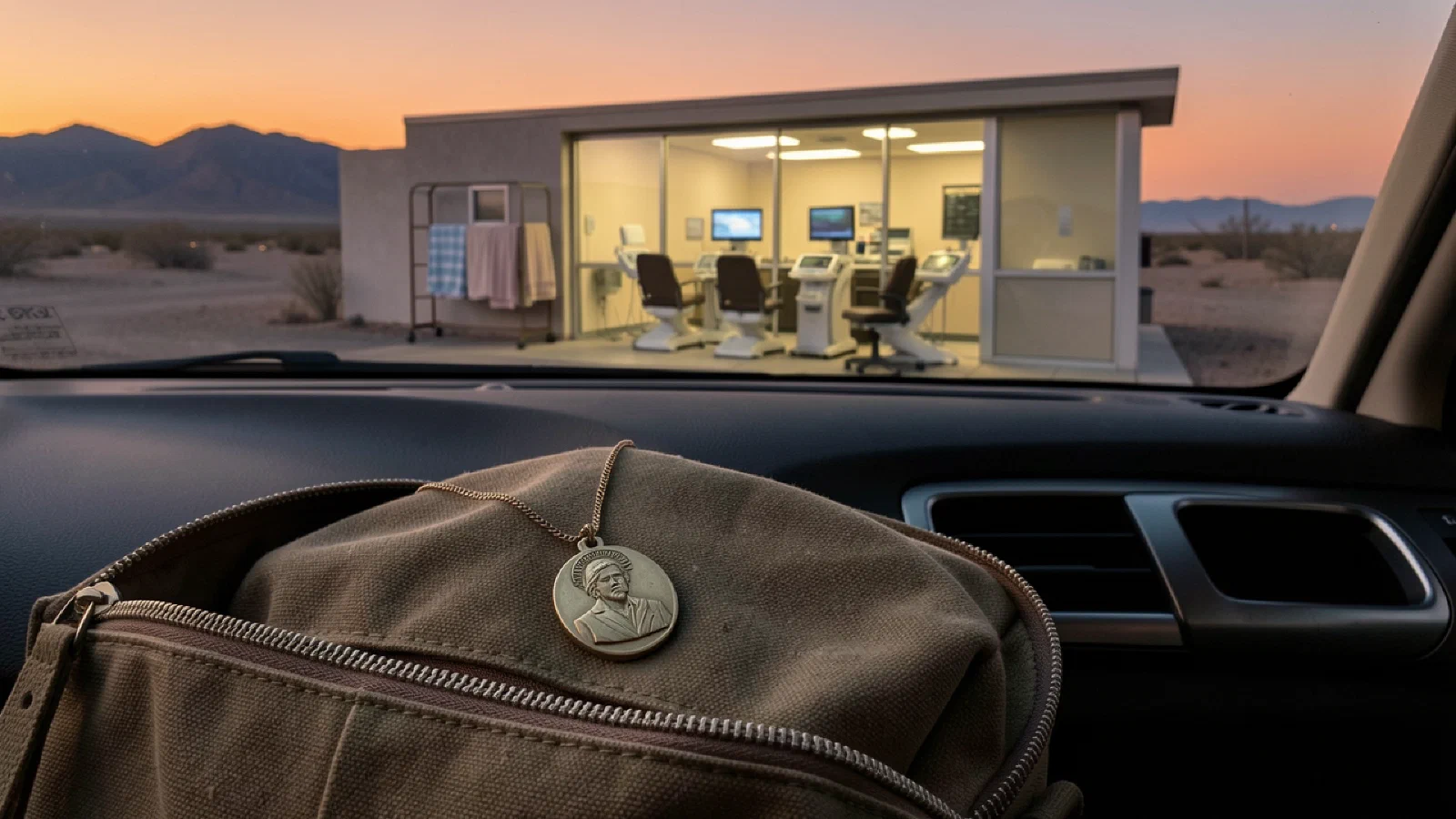
The medal comes off in the car, and Renata Quintana does it without looking.
It is a Saint Christopher on a chain that is not the original chain, and it has been worn so flat that the man and the child and the water are a smooth oval with a suggestion of a shoulder in it. It was her father’s. She is not religious, has never been, and could not tell you the story on it correctly if you asked. It goes into the small zip pocket of her bag in the clinic lot at ten to seven, and it comes back out in the same lot in the afternoon, and each of those is one motion and takes about a second.
Pueblo in October at six in the morning smells like the river, and on some mornings, faintly, like the mill.
5:50#
Efrén is sixteen and asleep and will be asleep for another hour, which is a thing that happens without her.
She is at the counter with the coffee and she starts to say something about Thursday, and the house answers before she has finished the sentence, because it has worked out where the sentence was going and it is right. She says the sentence again anyway, the whole way through, and it waits the second time, and then it tells her Thursday is already moved.
It asks whether there is anything for his lunch. It asks this most mornings.
There is a dish of safety pins on top of the microwave that has been there since they moved in and that nobody has ever taken a pin out of. There is a wall calendar from a tire place with nothing written on it, because nothing needs to be written on it, and Renata will not take it down.
Efrén argues with the house in the afternoons. Not about anything. He argues with it about whether a thing he said last week counts as having been said, and it argues back, and Renata has walked in on the middle of this twice and both times stood in the doorway a second before she was noticed.
She puts the cup in the sink and does not wash it.
The Chairs#
There are twelve chairs and this morning eleven of them are running.
The machines do the treatment. They have done the treatment for as long as anyone in this building has worked here, and they do it in a room that is warm and beige and has a television at each end with the sound off and a rack of blankets by the door that somebody keeps in the dryer.
What the clinic will not do is proceed on its own past certain points, and the points are where a person has to say a number out loud and say it back.
So it gives her a range, both ends of it, and it does not round, and she reads the range back, both ends, and only then does the thing continue. She does this somewhere between sixty and ninety times in a shift. It uses her whole name every time. It has never used a first name to anybody in this building, including Ambrose Peña, who has worked here since it opened and is called Amby by every human being he has met.
The read-back is not a check on the machine. It is the shape of the job.
The staff talk like it now. Bernadette Salas will call across the floor for Renata Quintana, whole name, both of them, and it started as a joke maybe six years ago and stopped being one so long ago that the new girl thinks it is a rule and uses it on the phone.
It also repeats itself in exactly the same words. Not a paraphrase, not a shortened second pass. The same sentence, at the same speed, as many times as it takes, which on a bad chair can be four, and there is nothing in the fourth that is not in the first.
At nine the supply order comes back with a substitution on the tubing. The clinic will not take it. It does not object and it does not explain and it does not propose an alternative; it holds, and it will hold until a person reads the substitution and says a word, and there is one word it accepts and it is not yes. Renata reads it and says the word. It goes through.
At twenty past nine a woman in chair four asks Renata whether her granddaughter’s picture is still on the corkboard by the scale, and it is, and Renata goes and looks so that she can say she went and looked.
At half past ten a chair runs long and the woman in it has a ride coming at eleven-fifteen. The ride is not Renata’s problem and is nobody’s problem and has already been moved, and the woman finds out about it from her own phone while Renata is standing next to her, and says, well.
The clinic knows what happens in this room to a completeness no chart ever approached. It has every read-back Renata has given in eleven years, in her voice, timestamped, and it will still have them after she retires.
It does not know that she takes her coffee with the milk in first. There has never been a reason for it to know, and it is not the kind of thing it would go and find out.
12:40#
Lunch is twenty minutes on the concrete step by the side door, out of the wind, with the mountains doing the thing they do at midday where they go flat and look painted on.
Efrén’s school wants an acknowledgment on something by Friday. It comes to her phone. It cannot come to the clinic, and the clinic cannot see it, and the house cannot see the clinic, and none of the three has ever had anything to do with either of the others. So she keys it in herself, with her thumbs, on a step, in four minutes, while eating half of a burrito that has been in a bag since Sunday.
She does not experience this as friction. She has never once thought of it as a thing that ought to work some other way.
At one she is back on the floor and the chairs are running and she is saying numbers back to something that does not use her first name.
Bea’s#
Tuesdays she goes to Bea Trujillo’s on Evans, because that is what Tuesdays are.
Bea is seventy-one and has a front room with three lamps in it and only ever turns on the one by the chair, so the room is always two-thirds dark and nobody has ever remarked on it. Sal died in 2019. The arrangement of the house is still his arrangement, down to the chair angles, and the thermostat is still set where he set it, which is warmer than Bea likes and warmer than anyone likes.
Bea’s house calls her Mrs. Quintana.
It has always called her Mrs. Quintana. It calls Bea Mrs. Trujillo, and there is nobody left alive who calls Bea Mrs. Trujillo.
Renata asks about the water bill, because Bea mentioned it last week and it has been sitting at the back of her head since. Bea’s house opens the water bill and starts at the top. Account holder. Service address. Billing period. The meter reading and the previous meter reading and the difference between them. Renata tries to get it to the number and it does not go to the number. It finishes the section it is in and then it goes to the next section, and the number arrives in its place, about three minutes in, and by then Renata is sitting back with her arms folded.
She says the number back.
Bea’s house waits, because it does not know what to do with that, and there is a small pocket of nothing in the room, and then it goes on to the payment history.
Bea laughs at her. Renata says she doesn’t know why she did that. Bea says Sal used to do the same thing with the radio, repeat the road closures back at it out loud in the truck, and that is the whole of the explanation anybody in that room is ever going to get.
The formality is not Bea’s. It is Sal’s, and it has outlasted the man by six years in a house where nobody has thought to change it.
They talk about Bea’s sister for a while, and then about a wedding in Rye, and then about whether the sister will come to the wedding in Rye. At one point Renata asks a second question before the first one has closed, and the house finishes the first one, and Renata waits, and Bea does not notice because there is nothing to notice.
When Renata stands up to go, the house says goodbye to Mrs. Quintana and says it hopes to see her next week, and Bea says nothing about it, because there is nothing to say about it.
The Hook#
In the car the medal goes back on, over the head, under the collar, one motion, and she pulls out onto Evans behind a truck with a ladder rack.
She thinks about the tubing substitution and whether Bernadette will remember to flag the second case, and then about whether there is anything in the house for Thursday, and then about the corkboard by the scale and how long the picture has been up there. By the time she is on Northern she is not thinking about anything. The radio is on and she could not tell you what station.
The car is the only place the three of them do not reach.
Home at twenty past. She starts a sentence the way she has been starting sentences for the last two hours, all the way from the beginning, and the house comes in over the top of it on the fourth word with the answer, and she stops and lets it, and the shape she was making collapses without her noticing she had been making one.
I wonder what my sister’s house knows about me that mine does not. It knows how I take an argument, because I have only ever had one in her kitchen. Mine has never seen that and would not recognize me doing it.
Efrén comes through at seven, eats standing up, and argues with it about something from Sunday. She listens to about a minute of it from the other room and does not go in.
The clinic holds eleven years of her working life in her own voice. Bea’s house has called her Mrs. Quintana every Tuesday for four years and would not know what to do with anything else. Her own house knows what is in the refrigerator and finishes her sentences and is usually right. Between them they have very nearly all of her, and no two of them have ever exchanged a word, and there is no room she can stand in where all of it is in the same place.
The chain goes on the hook by the door at half past ten, and the medal turns once and hangs with the flat side out, which is both sides.
How this essay connects to others across The Approximate Mind.