The Third
A twenty-four-year-old in Sioux Falls spends a day making one room on the ninth floor the only unlogged volume in nine city blocks.
The tape measure has a bent hook and reads three-sixteenths long, and Cory Aalbers stopped correcting for it two years ago because her hands correct for it.
It is a twenty-five-foot Stanley with the blade scarred at the eleven-inch mark from something she does not remember. It lives in the right pocket of a canvas apron that also holds two sticks of blue chalk, a mason’s line, a folding rule she almost never uses, and a roll of masking tape.
She takes the stairs at the Bellamy because the elevator works and she does not trust a thing whose maintenance nobody is paying for.
The Bellamy#
Nine floors on Phillips, brick over steel, put up in 1971 for a bank and rebuilt inside in 1998 for card processing, which is what it did until it stopped. Two through eight are open plan and full of nothing. The carpet is still down, mottled blue-gray, eighteen thousand square feet a floor, and where the workstations were there are darker rectangles in it in rows, so that from the stairwell door each floor reads as a diagram of itself.
The building is not neglected. It is metered and modeled and watched continuously by the people who insure it, and it reports its own temperature and humidity and the state of every riser to a system that has never been inside it. Nine floors of nothing, fully instrumented, is a normal condition for a building in this city.
The ninth is different because the ninth got the executive fit-out: a long room at the south end, windows on three sides, a floor built to carry a conference table for thirty and the people who came with it.
Duane Prill, who works for whoever owns the Bellamy now, pays Cory two hundred and forty dollars a month to run every riser once a week so the traps do not dry, clear the roof drains, walk the floors, and send photographs. What Duane wants is for the building not to rot on his ledger. What Cory wants is the ninth floor. The arrangement is one page and has held two years.
She does the risers. Nine floors, four risers, twenty-two minutes. The roof drains are clear. She photographs the stain in the northeast corner of six that has not grown since May and sends it, and Duane’s thumbs up comes back inside a minute and was not necessarily Duane.
Then she goes up to nine and gets out the tape.
Load#
The long room is sixty-one by twenty-eight. The joists run east to west. She knows the span and she knows what is under them because she went down to the eighth ceiling with a borescope in her first month and looked.
The original drawings exist. They are two clicks away and they are complete, and any system she asks will read them and give her a live load rating for that room in a fraction of a second and will be more accurate than what she is about to do. It will also decline to sign it, because nobody has surveyed the 1998 rebuild and the model says so, plainly, every time, in the same words.
So she brings up six bags of sand from the loading dock, forty pounds each, two trips on a hand truck, and stacks them at midspan, and pulls the mason’s line tight across the span at floor level, and reads the gap at midpoint before and after. It closes by a hair under a sixteenth, which the tape will not resolve and her feeler gauges will.
Two hundred and forty pounds is not a crowd. The number is an extrapolation from a measurement, and Cory has read enough to know exactly how much she is guessing and where. She learned the reading in about a year, off a system that marked her wrong four or five times an evening until she stopped being wrong, and she has never met a structural engineer.
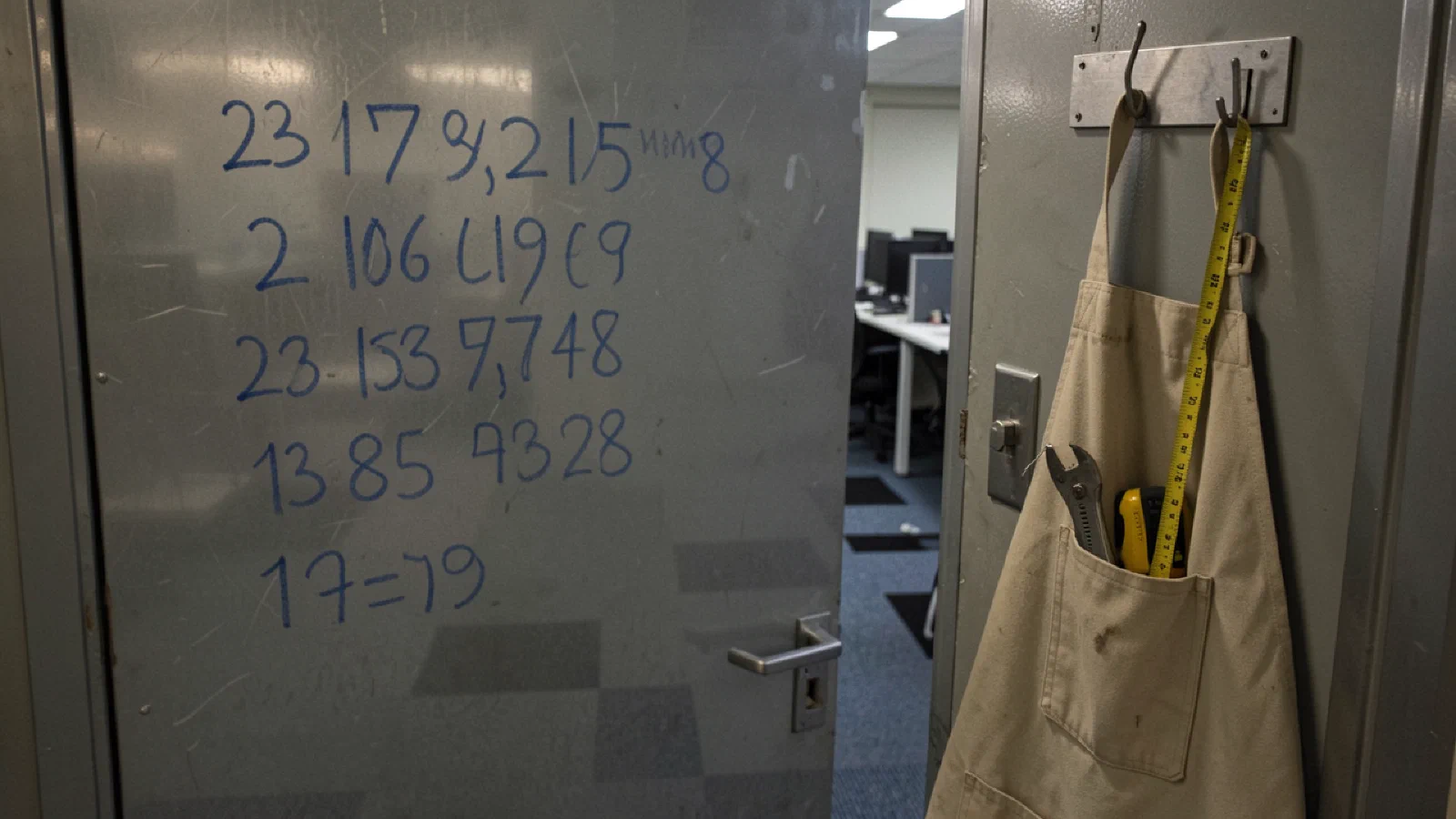
She guesses low. She writes 84 on the door in blue chalk.
The number is not a permit. It is a promise about a floor.
Eighty-four is fewer than will come. Eighty-four means somebody stands in the stairwell counting, usually her, and at eighty-four the door closes and there are people on the landing who drove from Brookings and do not get in. That has happened twice. Both times were bad and neither was complicated.
The Rule#
A floor is one night in one building. Whoever is making something makes it once, in the room, and nothing is recorded.
Outside the room, everything is. Phillips Avenue is captured continuously from four directions and has been for as long as Cory has been alive. The Bellamy’s own exterior reports itself. The Kirby across the street has occupancy sensing on every floor including the empty ones. Every person coming up the stairs tonight is arriving from somewhere that logged them leaving and will go home to somewhere that logs them arriving, and in between there will be about four hours that nothing holds.
There is no technical way to do this and Cory has never pretended there is. Everything on every body in that room can record, most of it is not visible, and none of it can be checked. What there is instead is a bin inside the stairwell door, and the fact that everyone puts everything in it, and the fact that everyone can see who did not.
She papers the four west windows because the Kirby’s fifth floor has a sightline down the length of the room. She checked the sightline herself first, from over there, standing in a stripped office with the tape in her apron, and marked which panes matter. Nine panes get brown builder’s paper. The rest do not, because covering all of them makes the room a box and the room being a room is the point.
The rule is not a protest. It is a floor load. It is the constraint the form runs on, the same as fourteen lines, and Cory could no more argue for it than a sonnet can.
The Third Book#
There are three books at the Bellamy. The first two are full. The third is a green cloth ledger from a stationer in Sioux City, on a steel desk in the northeast corner of nine, with a chain through the drawer handle and around a column, which is theater and everyone knows it is theater.
A date, a building, names, and under each name one line, written by somebody who was there and never by the person it is about. There are eleven books across four buildings in this city and about forty more elsewhere, and no copy of any of them exists anywhere, which makes them close to the only text Cory has ever touched that is not also somewhere else. Marlys Hovden keeps the Bellamy’s book and has since the first one. She is sixty, worked on four for nineteen years, does not come to floors, and comes for the book.
At two Ivo Bardhi arrives, which Cory has known since Tuesday and has not been looking forward to.
Ivo recorded a floor in June. Not from inside. From the Kirby, from the fifth floor, from the sightline Cory papered this morning, which he found before she did, and he did it for reasons that were not commercial and are not interesting. He has been struck from three books. The rule is that he strikes his own lines, in person, at each building, with a witness. Today is the second and Cory is the witness because Marlys asked her.
Marlys unlocks the drawer. Ivo finds the page. His line is from a floor in April, in Tou Vang’s handwriting, about the fourth thing he played and how long the room stayed quiet after. He reads it. He draws one line through it with a ruler, because a ruler is required, and initials the margin, and Marlys initials under that, and Cory under that.
Ninety seconds. Nobody says anything the whole time and then everybody says something at once, all of it logistical: the drawer sticks, the pen is dying, there is a chair.
Ivo did not lose a night. He lost three lines, and the third is in Fargo and he has to drive.
Cory walks him down. On four he stops and looks out at the parking structure and says he used to like this floor, which is not an appeal and is not going anywhere, and she says the risers on four are the worst ones, and he says that figures, and they keep going down. At the door she gets him water out of the cooler and he takes it and says thanks and goes.
8:40 PM#
By eight the stairwell is a column of noise, nine flights of it, and Cory is on the landing at nine with a clicker in her left hand and the tape in her apron and the door open.
Sixty-one, sixty-two, sixty-three. The bin is full and has been emptied twice into a second bin. Somebody brought a sheet cake for no reason anyone can establish. Tou is inside setting up and it is taking too long. A woman who drove from Yankton got the last of the good spots against the north wall and is being told about it by three people.
Cory does not go in. She holds the door and counts, and past seventy the counting is the whole job.
I wonder which evenings of my own I could produce, if somebody asked me to produce one. Nearly all of them. They are dated and in order and searchable and I have not once gone and looked.
At eight forty the room goes quiet in the sudden accidental way a room does, and then it is not quiet, and Cory hears it through a door she is holding open six inches with her boot. The count stands at seventy-eight. She has six left. Nobody comes up. She lets the door go at nine fifteen and stands with her back against the block wall for a while, in the noise, on the landing, outside it.
Nine Floors Down#
At half past midnight the room is stacked and swept, the paper is off the west windows and back in the roll for Thursday, and the bin by the door is empty.
Marlys writes in the book at the steel desk with her coat on. Six names. Cory has not read any of it and will not until Sunday, a discipline she keeps for no reason she has examined.
The last thing is the number on the door. She wipes the chalk off with the heel of her hand and the 84 comes off in a smear and leaves the ghost of itself, so that the door at eye level is a gray fog of every number she has ever written there.
Thursday is the Kirby, where the joists are worse and the number will be smaller.
She goes down the nine flights with the apron over her shoulder and the tape in the pocket of it, blade scarred at eleven inches, hook bent, reading three-sixteenths long.
How this essay connects to others across The Approximate Mind.