The Second Opinion
A weekly editor in Marion, Virginia comes in on a Tuesday to find that a decision has been built for him overnight by two things that do not agree.
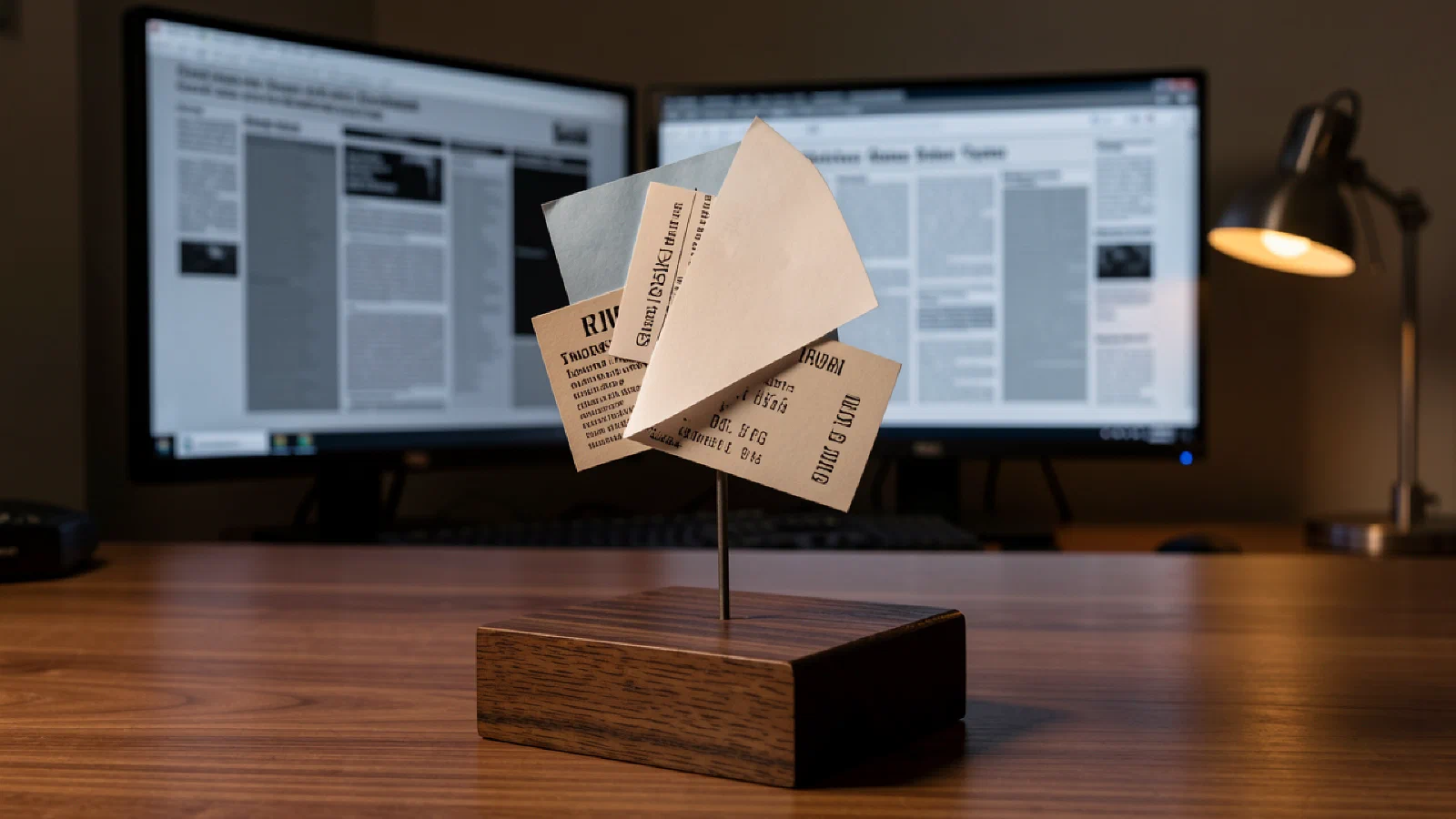
The spike is a sixteen-penny nail driven up through a block of walnut, and the walnut is a piece of somebody’s stair tread.
You can still see the nosing on it. It came out of a house on Chatham Hill that a pressman’s brother tore down in the sixties, and the nail was set by somebody whose name is not written anywhere, and it has been on this desk through four editors. What is on it this morning is a dentist’s appointment card from 2023, a raffle ticket for a gun the Ruritans gave away in April, and a receipt for two tires.
Marion at six is one traffic light working and the rest of them blinking, and a smell off the bakery that is not a bakery anymore and has not been since March and still smells like one on cold mornings, which nobody has explained.
Wade Rasnake is forty-nine and has had the desk eleven years. The paper comes out Wednesdays. There are two and a half people in the building, and the building is too big, and the back half of it is a pressroom with no press in it and a basketball hoop somebody put up in 1988.
6:12#
The delinquent tax list arrives at six, assembled, reconciled against the treasurer’s roll, alphabetized, and formatted to the column width the paper has used since it went from eight columns to six.
The county has to publish it. The paper is where it gets published. This has been the arrangement since before anybody.
At 6:12 the paper holds one line.
It does not remove the line and it does not object. It holds it, in place, at the point in the page where it sits, and it puts a note against it, and the note says the name in that line has appeared in this paper sixty-one times since 1981 and that four of the last five were the hospice benefit at the Rich Valley fire hall in June.
The hold is not a judgment about the tax. It is a paper that has printed the man’s name sixty-one times.
Emory Sluss is seventy-one. He drove a milk route, then a school bus, then he was on the rescue squad nineteen years, and there is a photograph in the 1994 flood coverage of him standing in water to the middle of his thigh holding somebody’s dog, and the dog is looking at the camera and Emory is not.
Wade reads the note at twenty to seven with his coat still on and the room still cold, because the heat in this building comes on at seven whatever anybody does to it.
7:40#
Bluefield releases the line at 7:40.
The group has eleven papers and this is one of them, and what comes out of Bluefield does not object either. It puts the line back where it belongs in the alphabet and it puts a note of its own against it, and the note says the list prints as received, and it says this paper omitted names from the list in 1997 and again in 2004, and what came of both.
It says something else, which is that the paper cannot leave one name off without having decided which hardships are the kind that get you left off, and that in a county of thirty thousand it will be asked to make that decision again in November and every year after, and that the decisions will not fall evenly, because nowhere has anybody’s ever fallen evenly.
Wade has made a version of that argument himself, out loud, at a press association thing in Roanoke, to a man who disagreed with him.
The paper holds it again at 7:52.
By nine the line has moved four times and nobody in the building has touched it once. Josie Whitt, who is twenty-six and does sports and legals and the layout and most of the phone, watches the page refresh with her coffee and says that they are at it again, and starts on the volleyball.
The Wednesday Page#
They are at it every week. Nobody in the building would call it anything.
The obituaries come in from the two funeral homes, and survivors run long here, because they do, and this week Elva Ketron’s runs to nineteen with three of the home and a great-grandson in Kuwait. Bluefield trims survivors at ten. The paper puts them back, all nineteen, and it has never once shortened one, and by Tuesday afternoon they are back and they stay back, and Josie stopped watching that happen about two years ago.
The volleyball writes itself off the scoring feed and it is fine. Bluefield names the Chilhowie girl who served eleven straight in the third and gets her class year right. The paper’s version will not name a freshman in a losing set, any freshman, ever, and Wade has known that about it for eleven years and could not tell you which of the four of them put it there or when.
The legals go through with two errors caught, both in a boundary description, both real, both found in Bluefield, and if either had run somebody would have paid a surveyor to sort it out in March.
There is a letter about the new turn lane at the Route 16 junction, six hundred words, from a man who writes one about every third month. Bluefield cuts it to the length in the policy and it reads fine at that length. The paper runs letters whole or not at all, and it has been running this man whole since 2013, including the one in February that had a sentence in it about the board of supervisors that Wade had to think about for a while.
At eleven a man comes in about a subscription he says he canceled and did not, and the renewal went out on its own in August and again this month. Wade fixes it in about ninety seconds and then stands there another twelve minutes while the man tells him about his brother’s knee and the VA in Salem and a dog that got into somebody’s chickens. Josie takes two calls over the top of it.
At half past noon the page is a page. Ads placed, everything paginated, everything correct, the fair schedule in the box it goes in every year.
The line is out. It went out at 12:19.
1:15#
Tuesdays at a quarter past one he takes the truck through the wash on Route 11, the one with the cloth, and sits in it.
There is no reason for this. The truck has a hundred and six thousand miles on it and the inside of it is full of newspapers and a jack he has never used. He has done it for years. It is four and a half minutes, it is dark for most of it, the noise is enormous, and nobody can reach him.
The list has been public since six.
It went up on the county’s side at six, and two other places pulled it and put it up before seven, automatically, the way they do every October, and nobody at either of those places has heard of Emory Sluss or of Rich Valley or of this paper. Whatever runs tomorrow is not the disclosure. It is a statute with a print date on it.
And the other thing, which is that if both of them had said print, it would have printed. Wade would have read the list Wednesday morning at that desk with coffee, the way three thousand other people in this county will read it, and he would have felt something about Emory Sluss for about nine seconds and gone on to the classifieds.
The decision is not one he went looking for. It is one that got built for him before he was awake.
The brushes come off the back window and the light comes back and he pulls out and sits at the light at Main with the wipers going on a dry windshield.
4:10#
He calls Danette Sluss at ten past four from the parking lot, because the office has Josie in it.
She already knows. She saw it Saturday on one of the other places, when the preliminary went up, and she has known for eleven days this was coming, and she says so before he has finished his second sentence.
He says it is going to run.
She says she figured. She asks whether it runs with the amount and he says it does and she says all right. Then she tells him her father wants to know what happened to the paper’s Friday edition, which the paper has not had since 2016, and she says it the way a person says a thing that is funny inside a family, and Wade laughs at it, and it is the only easy part of the call.
There is a dog barking on her end the entire time and at one point she puts her hand over the phone and says something to it that Wade cannot make out.
She thanks him for calling, and it is clear she does not think the call did anything, and she is right, and neither of them says so.
Between them, the two of them have the whole of it. The statute, the roll, the reconciliation, the sixty-one appearances, the two years the paper left names off and what came of both, the November argument and why it will not fall evenly, every word this paper has printed since 1937. What neither of them has is the other one’s note. They passed that line back and forth eleven times today and not once did either one read what the other had written against it.
I wonder how many things I have decided not to say and then found somewhere else by Thursday, and whether the deciding was ever the part that mattered, and whether knowing would change how long I took over it.
The Spike#
The list runs entire.
He does nothing clever with it. He does not put a story beside it. There is no story: a man owes eleven hundred and forty dollars in real estate tax on a house on Nicks Creek, and the county is required to say so in the paper of record, and the paper of record is this one, and it comes out tomorrow.
At six he prints the 6:12 note, the one about the sixty-one times, on a half sheet, which is a thing he does maybe five times a year and could not explain to anybody who asked.
Josie has gone. The building makes the noise it makes at six, which is a compressor somewhere under the pressroom floor that has outlasted the press.
He puts it on the spike, under the raffle ticket, and pushes it down with his thumb until it is flat against the dentist card.
The block is walnut and somebody planed it by hand a hundred and forty years ago for a stair in a house that is not there, and the nail is still holding, and there are two inches of it left before anybody has to think about the spike being full.
How this essay connects to others across The Approximate Mind.