The Second Morning
A thirty-four-year-old in a river town writes cuttings into a notebook whose first eighteen pages are about something else.
The notebook has eleven pages in her mother’s handwriting and seven in her own.
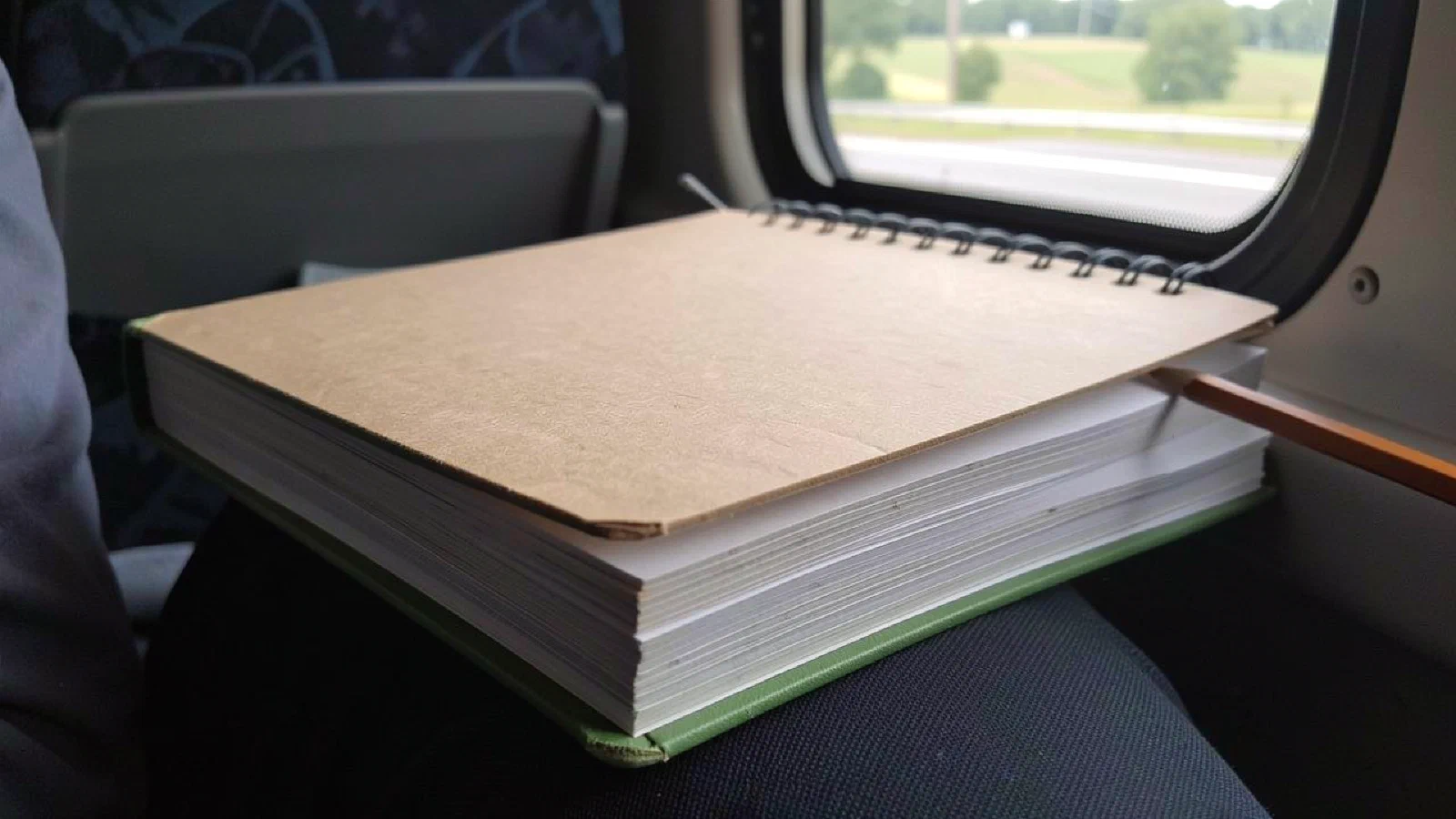
It is a fifty-sheet spiral, the cardboard kind, wire bent at the top corner and one loop sprung so that it catches on the inside of a bag. The cover is green and gone soft at the edges. The first eleven pages are small and level, written in a pen that pressed hard enough to show through. The next seven are Alma Reyes at twenty-three, and they slope, and she does not close her a’s, and they are about the same thing her mother’s pages are about.
Page nineteen is where the cuttings start.
6:40#
She is up four minutes before the alarm and does not use the four minutes.
The apartment is over a driveway and the light comes in orange off the brick across the way. Her father is asleep on the couch with the television going low, the local channel that runs weather on a loop. He came off shift at three. She turns the sound down two notches and not off, because off wakes him.
His pills are in the dish by the sink in the two he takes at seven and the one he takes at noon, sorted overnight, and the noon one is different this week because something in his numbers moved and the change went through without anybody being told about it in a way that required an answer. She looks at the dish. She counts three. She goes on.
She eats standing at the counter, two eggs from Sunday, cold, and takes the coffee with her because she will want it at seven fifteen.
The bag is by the door and has been packed since last night. Boots, gloves, second gloves, knife, the bottle that leaks unless the cap is seated a particular way, the notebook.
7:15#
The bus is every thirty-five minutes on this route.
It is on the corner at 7:15 and forty seconds, which she knows to the second and has known to the second for years, and it is still every thirty-five minutes. Nothing about knowing has made it come more often. She gets the seat over the wheel well because the vibration is worse there and nobody fights her for it, and the ride is thirty-eight minutes to the county road.
She opens the notebook on her knee and turns past eighteen pages without reading any of them.
She has turned past them several thousand times. The gesture is not respectful and it is not avoidant. It is the gesture of a person getting to page nineteen.
What she writes on the bus is a column of what she will do in the order she will do it, and then, under a line, yesterday’s numbers.
Willow, gray dogwood, ninebark, the thing from Kelso Street.
The thing from Kelso Street is a shrub with opposite leaves and a hollow stem that she has not identified and will not identify from a photograph. A photograph gives her a name in well under a second and the name is not the part she is missing. What she is missing is why the two she took in June struck and the four she took in July did not.
The Rows#
Behind the building there is a strip of packed dirt between the parking pad and the fence, nine feet by about forty, and it is full of Alma’s pots.
There are a hundred and six of them, gallon nursery pots, mostly black, a few green ones that mean they came from the outfit in Dubuque, arranged in rows of eight with a gap she can walk. Each has a plastic tag with a number in grease pencil. The numbers run to 214, which means a hundred and eight are gone: dead, given away, or planted somewhere she can go and look at.
The notebook is the numbers. Number, where it came from, whose yard, when she cut it, what she cut it with, what she stuck it in, whether it had a heel, then a date and a mark. A dot means alive. A dot with a circle means rooted, confirmed, because she tugged it. A slash means dead. A slash with a date after it means dead and she thinks she knows why.
Nobody asked for the rows. Nothing is being sold off them. The landlord knows and has decided he does not mind, which took a conversation in April that Alma won by pointing out the strip had been gravel and cigarette ends.
Number 61 is a redbud out of the yard of a woman on Kelso Street named Dorothy Vance who is dead now. It is four feet tall and it goes in the ground on the north side of the building in November, where the building will shade it after two, which redbuds like and most people do not know.
8:00 to 12:50#
The nursery is on the county road and grows woody stock for municipalities and a few landscape outfits. It is not a garden center and does not want to be. Alma is on the early shift because the early shift is water.
The irrigation runs itself and has for as long as anyone there can remember. Zone by zone, adjusted overnight for what the weather did and what the weather will do, and there is no reason to check it. Alma checks the north block anyway, because the north block has a head that clogs, and the system reports the zone and not the head. She walks it, finds it, pulls it, clears it, reseats it. Six minutes.
At nine forty she is potting liners with Bev, who has worked here nineteen years and does not talk in the morning, and they do four hundred and twenty without a word except when Bev says hold, and Alma holds, and Bev pulls a liner with a girdling root and shows it to her and drops it in the bucket.
At eleven a landscape guy comes to look at serviceberry. His quote assembles itself while the two of them walk out to the block, priced against four yards inside two hundred miles, and it is on his screen before they get there and neither of them refers to it. Alma tells him the multi-stems on the east end are better and the ones he is looking at are better looking. He says he needs them to look good on Saturday. She says then take the ones you are looking at. She does not soften it. Bev, forty feet away, does not look up and is amused.
At twelve twenty she eats a sandwich on an upturned crate in the shade of the pole barn. At twelve fifty she clocks out, because the early shift is five hours and the early shift is water.
10:40#
At 10:40 her father’s annual re-determination opens, answers itself, and closes.
It draws the wage record and the treating physician’s file and the two things that changed in March. It generates the certification, files it, receives the acknowledgment, and puts a line in a log. The whole of it takes about four seconds and happens while Alma is carrying a flat of ninebark liners forty feet from the bench to the truck bay.
Her phone buzzes once against her leg. At the truck bay she sets the flat down and turns her wrist over and reads four words and puts it away.
What she thinks about, walking back, is number 204, which she is fairly sure she lost by cutting too far above the node, in a hurry, in the rain.
The system holds the wage record and the physician’s file and every date and every determination and the name of every person who ever touched the file. It holds all of it correctly and it will hold it for as long as anybody wants it held. It does not hold anything about the rows, because nobody has ever asked it to, and Alma has not thought of it as the kind of thing you would ask.
The rows are not a hobby. They are a count of a town that nobody is keeping.
1:15#
Home by one fifteen. Her father is up and has made coffee and left half of it, which is what he does.
She changes out of the boots and works the rows until four. Nothing happens. Number 138 has aphids and she runs a thumb down the stem and does nothing else about it. Number 190, from a spirea on Ninth, has put three inches on since Sunday, which she tugs to confirm and then writes down. Number 204 is a slash. She dates it.
The neighbor from the ground floor comes out to smoke and stands in the gap between the rows and asks what the tall one is. Alma tells her. The neighbor says her mother had one of those. Alma says she can have one in the spring and the neighbor says she has nowhere to put it, and they leave it there, and the neighbor goes back inside.
I wonder what happened to the notebook I kept for two years and then did not. I could not tell you the day I stopped. I know it was not a decision, and that seems worse to me rather than better.
At four the light comes across the strip at the angle that makes the whole nine by forty look, for about ten minutes, like something.
She writes the day in on the hood of her father’s car, standing up, because sitting down to write it would make it an evening thing and it is not an evening thing.
Then the notebook goes back in the bag by the door. Green cover soft at the corners, one loop of the wire sprung and catching on the way in, eighteen pages about something else and thirty-one that are hers.
How this essay connects to others across The Approximate Mind.