The Route
A school bus driver in central Ohio keeps a laminated card on the visor that no one asked her to make, for fourteen children whose names are not on any spreadsheet that will decide her future.
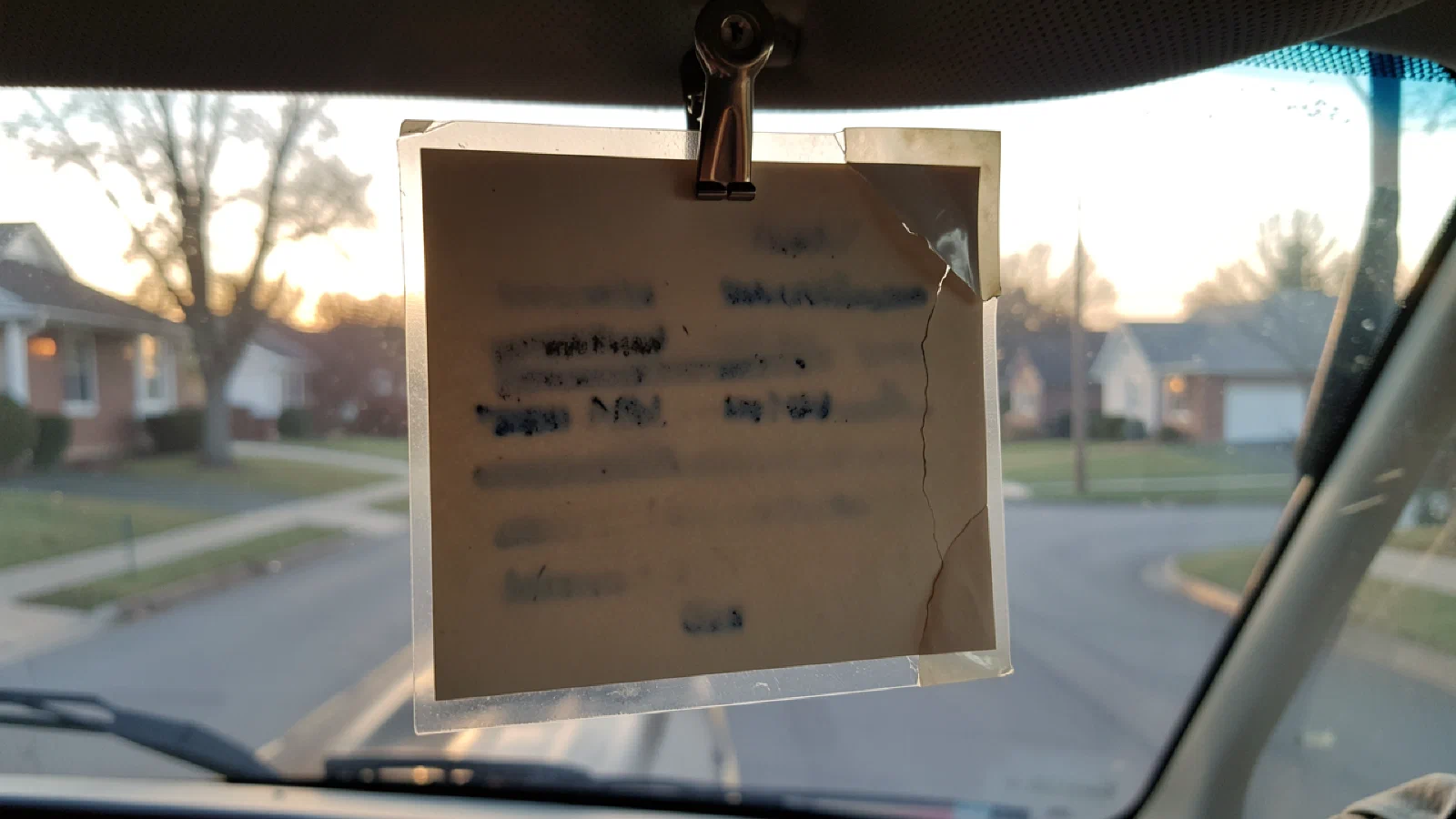
The card is the size of an index card, laminated at the Staples in Marion twelve years ago, and it is dying. The lamination has cracked along the left edge where Charlene folds it when she cleans the visor. The handwriting is layered: original names in black ink, updates in blue, corrections in whatever pen was in the console at the time. Some names have been crossed out and replaced. Some have small arrows pointing to annotations in the margin that are too small to read from more than six inches away. The card is twelve years of children, condensed onto a surface that was never meant to hold this much.
Charlene Oakes does not replace it. She has thought about replacing it, the way you think about replacing a map you have used so long that the routes are in your hands and the map is a formality. The information is not on the card anymore. It is in her. But the card stays on the visor because the spatial memory of where each name sits, Caleb in the upper left, Amara below him, DeShawn on the right near the crease, is part of how she holds the route in her head. The card is not a reference. It is a diagram of her attention.
Caleb: backpack grip. Amara: left side only, window seat. DeShawn: will not board if the interior light is off. Jaylen: needs to be last on, first off. Sophie: count to three before closing the door; she waves to her mother twice.
These are the annotations. Each one is a sentence fragment that contains a year of mornings.
5:15 AM#
The alarm is redundant. Charlene has been waking at 5:12 for eleven years, the body’s clock set three minutes ahead of the device’s, because eleven years of the same departure time has calibrated something deeper than habit. She does not feel tired at 5:12. She feels ready. The readiness is physical: her feet are on the floor before the alarm, her hand is reaching for the phone to turn it off before it sounds, her mind is already on Route 7.
Coffee in a travel mug. The mug is from the Ohio Education Association and has a chip on the rim that she drinks around without thinking. She drives to the bus lot in the dark. The lot is behind the district maintenance facility on Marion-Williamsport Road, eight buses parked in a row, yellow shapes in the sodium lights. Her bus is third from the left. She set the heater timer last night, so the interior is warm when she boards. This matters. It matters because DeShawn will not board a cold bus. Not because of the temperature. Because the cold means the bus has been sitting empty, and empty spaces unsettle him. The warm bus is a bus that has been prepared. Someone was here before him. The warmth is evidence of care, and DeShawn needs the evidence before he can step on.
Charlene learned this in DeShawn’s second week. She did not learn it by asking. She learned it by watching a six-year-old stand at the bottom of the steps with his fist closed around the handrail, not moving, not crying, just not boarding. She tried encouragement. She tried his name. She tried stepping down to his level. Nothing worked until the next morning, when she happened to have arrived early enough to run the heater, and DeShawn boarded without hesitation. She tested it. Cold bus: hesitation. Warm bus: no hesitation. Three mornings of testing, and she knew.
This is not in any system. The transportation office knows DeShawn’s name, his address, his stop number, his IEP accommodation code, his emergency contact. They do not know about the heater. They do not have a field for it. The knowledge lives in Charlene’s body, in the sequence of actions she performs each morning without consulting any reference, the way a pianist’s fingers know a piece the conscious mind has stopped tracking.
The Four Routes#
The district approved autonomous buses for Routes 1 through 4 last spring.
The decision was presented at a school board meeting Charlene did not attend because it was on a Tuesday evening and Tuesday evening is when she visits her mother at the assisted living facility in Delaware. She heard about it from Phil, who drives Route 2 and who told her in the lot the next morning with the specific tone of a man delivering news he does not want to believe.
Routes 1 through 4 are the main routes. Residential neighborhoods, predictable stops, regular children, the word regular used here the way the district uses it, meaning children without IEP designations, without behavioral plans, without the constellation of needs that place a child on Route 7 instead of the others. The autonomous buses handle these routes well. The buses are clean, punctual, smooth-riding, climate-controlled, monitored by cameras that see everything and by an attendant in a jumpsuit who is present for regulatory compliance and who does not drive.
The district saves $188,000 per year on the four routes. This number was in the board presentation. Charlene knows it because Phil told her, and because she did the math on her own route afterward, not because she was asked to but because she wanted to know the number that her job would be weighed against. One driver, one bus, Route 7: $47,000 per year plus benefits. The benefits are the expensive part. The benefits are always the expensive part.
Route 7 was not included in the autonomous transition. The board’s language was careful: “specialized routes require individualized student support that the current autonomous platform is not designed to provide.” Charlene read this sentence several times. She parsed it the way she parses IEP language, which she has become fluent in through eleven years of transporting children whose documents describe them in clinical vocabulary that bears no resemblance to the children she knows.
“Not designed to provide” is not the same as “cannot provide.” It is a temporal statement. It means not yet.
6:45 AM#
Twenty-two stops. Fourteen children. The route begins on the east side of town, where the streets are older and narrower and the houses have the compressed look of homes built when families were larger and expectations were smaller. Charlene knows every driveway, every curb cut, every low-hanging branch that requires her to adjust the mirror angle at Stop 4 and readjust it at Stop 7.
Stop 1: Marcus. He is nine. He has Down syndrome. He boards the bus every morning with the enthusiasm of a person who believes that the bus is going somewhere wonderful, which, in his experience, it is. Marcus sits in the second row on the right side and immediately begins narrating what he sees out the window. The narration is continuous, detailed, and frequently inaccurate. “There’s a horse,” he will say, pointing at a dog. “There’s a airplane,” pointing at a bird. Charlene does not correct him. She learned early that Marcus’s narration is not a request for factual verification. It is a broadcast. He is sharing his experience of the world, and the sharing requires only that someone is present to receive it.
Stop 3: Caleb. He is seven. He is nonverbal. He boards the bus with his mother standing behind him on the porch, watching, her coffee mug in both hands. Charlene watches Caleb’s backpack.
Two straps, gripped in both fists, knuckles white: hard morning. One strap, slung over one shoulder, body loose: fine morning.
This morning it is two straps. Charlene registers this as she registers the weather, as information that will shape everything that follows. A two-strap morning means Caleb will not tolerate Marcus’s narration. It means she will need to adjust the seating, move Marcus forward so there is a buffer row between them. It means the radio should stay off. It means, at the school end, she will tell Mrs. Patterson, the aide who meets the bus, that Caleb needs a quiet entry. Mrs. Patterson will nod, because Mrs. Patterson also reads Caleb, and the two women have developed a vocabulary of nods and gestures that conveys information no form captures.
The backpack grip is not data. It is knowledge. The difference is that data can be entered into a system and knowledge requires a person who has watched a child hold a backpack seven hundred times.
Stop 8: Amara. She is eleven. She uses a wheelchair. The bus has a lift. Operating the lift is the mechanical part, and the mechanical part is simple. The part that is not simple is knowing that Amara will only sit on the left side, window seat. Not because the right side is physically different. Because the right side is where Jaylen sat last year before he moved to a different district, and Jaylen was unkind to Amara in ways that were not overt enough to generate an incident report but were persistent enough to make the right side of the bus a place where Amara’s body stiffens and her hands grip the armrests of her chair.
Charlene does not explain this to the district. She does not file a report. She parks Amara on the left side, window seat, every morning, and Amara’s hands rest on her lap instead of gripping the armrests, and this is the measure of whether the decision is correct.
The Afternoon#
The afternoon route is the morning route in reverse, with the addition of exhaustion. The children are tired. Some are overstimulated. Some are understimulated. Some are both, which sounds contradictory but is accurate for children whose neurological profiles make a school day a sustained act of negotiation between what the environment demands and what the nervous system can provide.
Caleb boards the afternoon bus with his backpack dragging on the ground. One strap, but not the fine-morning one-strap. This is the end-of-day one-strap, which means spent, which means do not require anything of me. Charlene knows the difference. The distinction is not in the strap. It is in the shoulders, the angle of the head, the speed of the walk. Two grips look the same to someone seeing Caleb for the first time. They look entirely different to someone who has seen him board a bus fourteen hundred times.
She plays the song.
She found the song by accident three years ago when the radio was broken and she was humming something to fill the silence and Caleb stopped rocking. He had been rocking in his seat, the rhythmic self-soothing motion that is his response to overstimulation, and when Charlene hummed, he stopped. She tried it the next day. He stopped again. She tried different songs. Only one worked. She does not know its name. It is something her mother used to hum, and she hums it without knowing the words because there may not be words, because it may not be a real song, because it may be a melody her mother invented and passed to Charlene through the specific transmission of a mother humming to a child in a kitchen in the late afternoon.
She hums, and Caleb’s rocking slows, and then stops, and his hands release the strap, and he looks out the window at the town passing by, and for the eight minutes between the school and his stop he is calm.
On the highway that parallels her route, she can see one of the autonomous buses on Route 3, heading back to the lot. It is clean. It is white with the district’s logo. It is exactly on schedule. There is no driver visible through the windshield, just the attendant in the front seat, scrolling through a phone. The bus turns the corner and disappears.
Charlene watches it go. She feels something she cannot name. Not fear. Not anger. Something closer to the feeling of watching someone do a thing you love and do it without caring about it at all. The autonomous bus is not doing what she does. It is doing what Routes 1 through 4 required, which is moving children from point A to point B safely and on time. It does this well. It does this better than Phil, if the metrics are punctuality and fuel efficiency and incident rate.
It does not know about the heater.
What the Card Holds#
Charlene’s daughter, who is twenty-three and works in IT support in Columbus, asked her once why she doesn’t just use her phone. Put the notes in a spreadsheet. Make it searchable. Back it up.
Charlene considered this. She understood the logic. She also understood that the logic was the wrong frame for what the card does.
The card is not a database. It is a practice. Each morning, before she starts the engine, she looks at it. Not to remember, she already remembers, but to orient. The way a musician looks at sheet music she has memorized, not for the notes but for the shape. The card gives her the shape of the route, the fourteen names in their positions, the annotations that are abbreviations for eleven years of mornings. Looking at the card is the ritual that shifts her attention from Charlene-at-home to Charlene-on-Route-7, and the shift is not trivial.
The district does not know about the card. If they knew, they would not object. They might find it endearing, as institutions find workarounds endearing when the workarounds do not cost anything and do not challenge the system’s authority. If the district decided to formalize the card, to require all drivers to maintain student-specific behavioral notes, it would become paperwork. It would be entered into a system. It would be reviewed by someone who has never stood at the bottom of the bus steps watching a six-year-old’s fist around a handrail.
The card works because no one required it. The knowledge on it exists because Charlene gathered it for the only reason knowledge like this gets gathered: she was paying attention, over time, to someone specific.
Thursday#
Tomorrow is Thursday, which means Caleb has speech therapy at ten. Charlene knows this because Caleb’s mother mentioned it last September, once, in passing, while watching Caleb board on a two-strap morning. Charlene filed it in the place where she files things about her fourteen children, which is not the card and not a system but the attentional space she has built through repetition and care.
Thursday speech therapy means Caleb will be anxious at afternoon pickup. The therapy is hard for him. Not painful, not traumatic, just effortful in the way that being asked to do the thing your body resists is effortful. He will board the afternoon bus with the specific tension of a child who has been working all morning at something that does not come easily, and the regular afternoon protocol will not be sufficient.
She will play the song. The one she found by accident. The one her mother hummed. The one that has no name and may not exist outside the two of them.
Tomorrow she will pull into the school lot at 3:15. She will open the door. Caleb will board. She will look at the backpack, the shoulders, the angle of the head, and she will know what kind of afternoon it is, and she will respond with the accumulated knowledge of fourteen hundred Thursday pickups, and the bus will be warm because she made it warm, and the card will be on the visor because it is always on the visor, and the song will be ready because it is always ready.
The autonomous bus on Route 3 will be at the lot already, parked, clean, charging. It will be ready for tomorrow too. It does not need to prepare. It does not need to know. It moves children from point A to point B, and it does this well, and it does not carry a laminated card on the visor because it does not have a visor and would not need one if it did.
Charlene drives home. The card stays on the visor, cracked along the left edge, twelve years of handwriting layered in three colors of ink, sorted by something no system has a name for.
How this essay connects to others across The Approximate Mind.