The Long Haul
A long-haul trucker on I-80 keeps a logbook nobody requires, in a cab where his hands have nothing left to do.
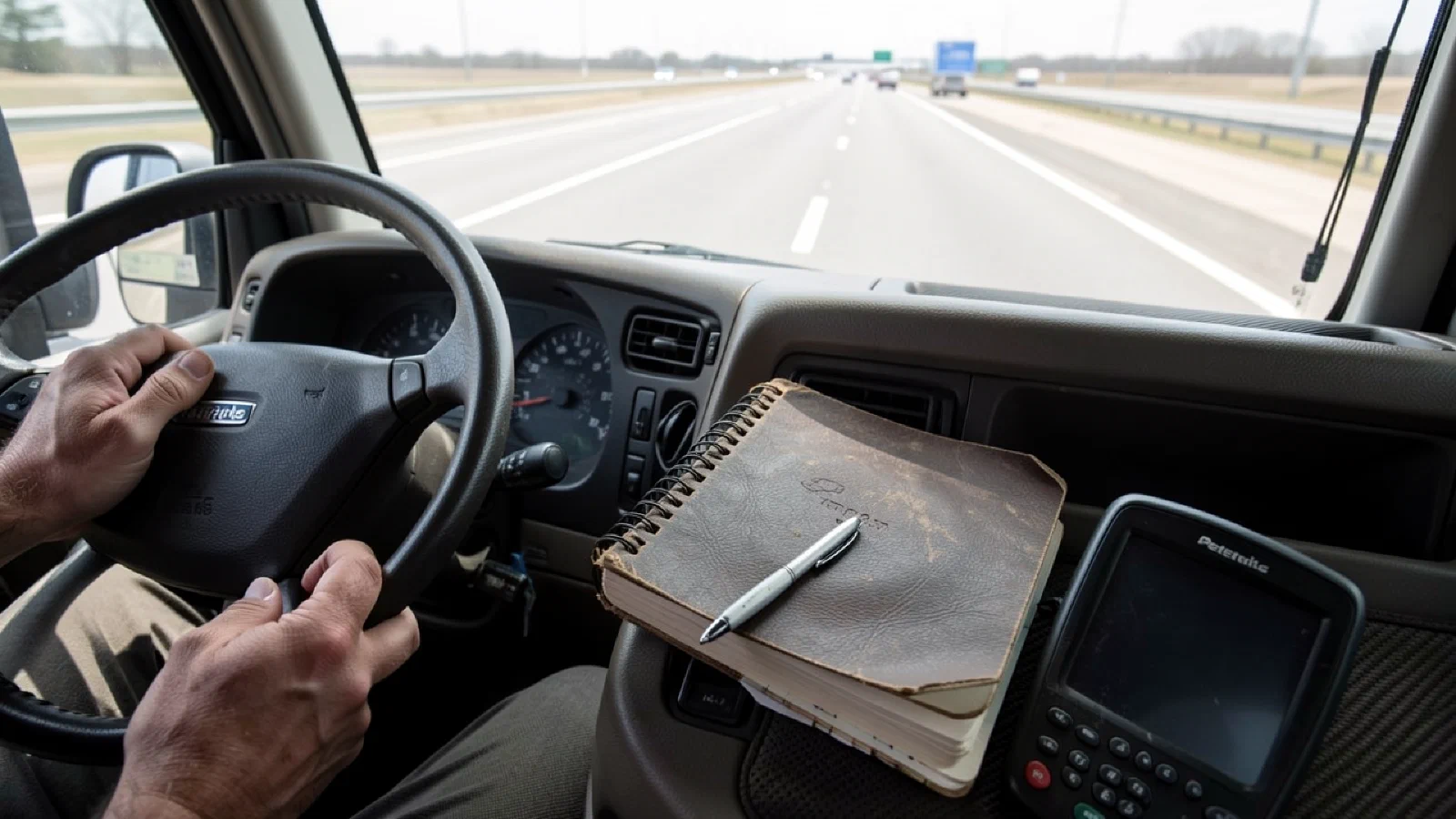
Ray Medina’s father gave him two things when he turned twenty-three: a truck and a spiral-bound logbook. The truck is gone, traded and upgraded and traded again across twenty-two years of I-80, each replacement larger, more comfortable, more capable of doing without him. The logbook is in the door pocket of the current cab, which is a Peterbilt 579 with Level 3 autonomous capability, a sleeper compartment Ray could rent as an apartment in most American cities, and a dashboard display that knows more about the road ahead than Ray will ever know again.
The logbook is not the electronic log the Department of Transportation requires. The electronic log records hours of service, miles driven, fuel consumed, rest periods, and regulatory compliance. It is a legal document. It is also a complete record of nothing that matters.
Ray’s logbook is twenty-two years of one-line entries in his handwriting, one per day, recording the weather, the road conditions, and one thing he noticed.
Elk at mile marker 342. Six of them, crossing slow.
Ice on the Laramie overpass, black ice, called it in.
Kid in a minivan waved. Waved back. She held up a drawing.
Full moon over the Platte. River looked like a road.
The entries are the residue of attention. They are what remains when a man who was trained to watch the road watches the road, day after day, year after year, and sets down one thing from each day that the watching produced. The logbook is not a journal. It is not a diary. It is a practice of noticing, maintained across two decades, by a man whose profession was built on the premise that the person in the cab is paying attention to something.
4:30 AM#
Truck stop outside Cheyenne. The lot is half full, the big rigs parked in rows with their running lights on and their APUs humming, the low mechanical breathing of machines keeping their cabs warm while their drivers sleep. Ray has been awake since four. He does not set an alarm. Twenty-two years of early departures have trained his body to wake before the alarm: the readiness arrives before the reason to be ready.
Coffee from the truck stop, which is a Love’s, which is indistinguishable from every other Love’s on I-80, which is part of the infrastructure’s design. The sameness is a service. A driver at a Love’s in Cheyenne knows where the coffee is because a Love’s in Cheyenne is a Love’s in Omaha is a Love’s in Des Moines. The franchise model applied to geography produces a landscape without surprise, and for a man who drives the same corridor fifty times a year, the absence of surprise is a form of comfort.
Ray does the pre-trip inspection. The truck’s computer already did the inspection. The computer checked tire pressure, brake wear, fluid levels, coupling integrity, and fourteen other parameters before Ray’s boots hit the pavement. The inspection is complete. It is also, by regulation, not sufficient. A human must verify. Ray verifies by walking around the truck, touching the tires with his hand, checking the fifth wheel pin by feel, pulling the glad hands to confirm the air line connections. His hands do this the way Paul’s hands hold the otoscope: from repetition so deep it has become autonomic.
The inspection takes twelve minutes. The computer’s inspection took ninety seconds. The twelve minutes are not about finding something the computer missed. Ray has not found something the computer missed in three years. The twelve minutes are about his hands needing to touch the truck before the truck drives itself across Wyoming.
The Highway#
I-80 east out of Cheyenne. The truck accelerates, merges, holds lane. The merge is smooth, the lane positioning precise, the following distance calibrated to a standard no human driver maintains consistently. Ray sits in the driver’s seat with his hands near the wheel and his eyes on the road. This is the legal requirement. He must be available to intervene. He has not intervened in four months.
Four months. The number is specific because Ray tracks it, a private counter measuring something the system does not measure. Each day he does not intervene is a day his skill was not needed. Each day his skill is not needed is a day the argument for his presence weakens. The counter does not reset. It accumulates.
He is being paid to be present in case of an event that does not occur. The regulation that keeps him in the cab is a political compromise between the trucking industry, the Teamsters, and a public that is not ready to share the highway with a cab that has no face behind the windshield. Ray is the human buffer between the technology and the politics. His role is not to drive. His role is to be visible driving, so that the car in the next lane sees a person and not an absence.
Wyoming passes. The grass. The wind turbines, which Ray remembers arriving on the ridgelines over a period of years, accumulating like the entries in his logbook, each one a single change that collectively altered the horizon. The antelope that used to graze close to the highway have moved back. Ray does not know why. He noticed it three years ago and wrote it in the logbook: Antelope further from the road. Used to see them at the fence line. Now a hundred yards back. He does not know if this observation matters. He wrote it down because he was paying attention and writing things down is what he does with attention.
The truck passes a rest area. Two other autonomous trucks are parked there, their cabs dark, their drivers in the sleepers or in the restroom or standing in the grass stretching. Ray recognizes one of the trucks, a Freightliner with a dent in the left front fender that the driver, a woman named Maria, has not repaired because the repair would require a shop visit and the shop visit would cost her two days of revenue.
The CB radio is quiet. It used to be loud. Not useful-loud, not anymore, not since the traffic apps replaced the real-time reports that drivers used to share with each other about road conditions, weigh stations, speed traps. The CB was loud with the noise of a community talking to itself, the way a neighborhood is loud with the sound of people who share a place even if they do not share anything else. The CB is quiet now because the information it carried has been absorbed by the system and the community it sustained has no other channel.
Ray leaves it on. The static is company.
North Platte#
The hour outside North Platte is when it happens.
Ray has been watching the road. He has been watching it the way the regulation requires: eyes forward, hands near the wheel, attention on the driving environment. But the driving environment is a straight line through grass. The truck is holding seventy-three miles per hour. The lane is clear for two miles ahead. The system has identified no hazards, no merging traffic, no weather, no construction. The road is the road.
Ray realizes he has been staring for forty minutes without seeing.
Not because he was distracted. Not because he fell asleep. Not because he was on his phone or reading or doing anything other than what the law requires. He was watching the road. His eyes were open. His hands were near the wheel. His attention was nowhere.
This is not meditation. Meditation is the intentional emptying of attention toward a purpose. This is the specific emptiness of a skill that is no longer needed but is still being performed. The difference matters. A monk empties his mind as practice. Ray’s mind empties itself because there is nothing for it to do, and it has been doing nothing for so long that the nothing has become its default state.
He used to narrate the drive in his head. Mile markers, weather shifts, the behavior of other vehicles, the feel of the road surface through the steering wheel. The narration was not conscious. It was the running commentary of a professional whose profession is attention, the way a pilot’s scan pattern is not a choice but a habit wired into the body by training. Ray’s narration gave him the drive. It made the highway into a story he was living inside.
The narration stopped. He does not remember when. The truck took over the attention, and the narration, which had depended on having something to attend to, went quiet. What remains is the posture of attention without its content. The shape of watching without the act. A man in a chair, facing forward, hands available, mind elsewhere, in a vehicle that is doing what it was designed to do and needs nothing from him.
He reaches for the logbook.
The Entry#
The logbook falls open to today. The pages before today are full of the one-line entries that constitute twenty-two years of paying attention to I-80. He reads a few of them, not for information but for the feel of a time when the entries came easily, when the day produced its observation and the observation went into the book and the book held the shape of a career.
The entries have changed over the past two years. They used to be about the road. Now they are about the absence of the road. Not that the road is gone. The road is there. The entries are about the gap between being on the road and driving the road, the gap between the seat and the act, the gap that widens each day the counter does not reset.
Nothing to report. Eighth day.
Sun on the Platte, nice. Didn’t need to steer around anything.
Forgot I was driving. Remembered at the Kearney exit.
He looks at the road. The grass. The sky, which is enormous in Nebraska, the specific enormity of a sky that has nothing to compete with and therefore fills everything. A hawk circles over the median. Ray watches it. The hawk is hunting. The hawk’s attention is total, focused, purposeful. The hawk is doing the thing it was built to do, and the doing is visible in every aspect of its body.
Ray writes today’s entry.
The reader does not see what he writes. The logbook closes. The truck holds lane. Nebraska continues. The hawk drops behind, still circling, still hunting, still full of the attention that the road used to require and the cab no longer does.
How this essay connects to others across The Approximate Mind.