The Llama
A five-year-old in Helena, Montana asks for something nobody around him has a frame for yet.
Jack Corbin is five years old and he explains things to dinosaurs.
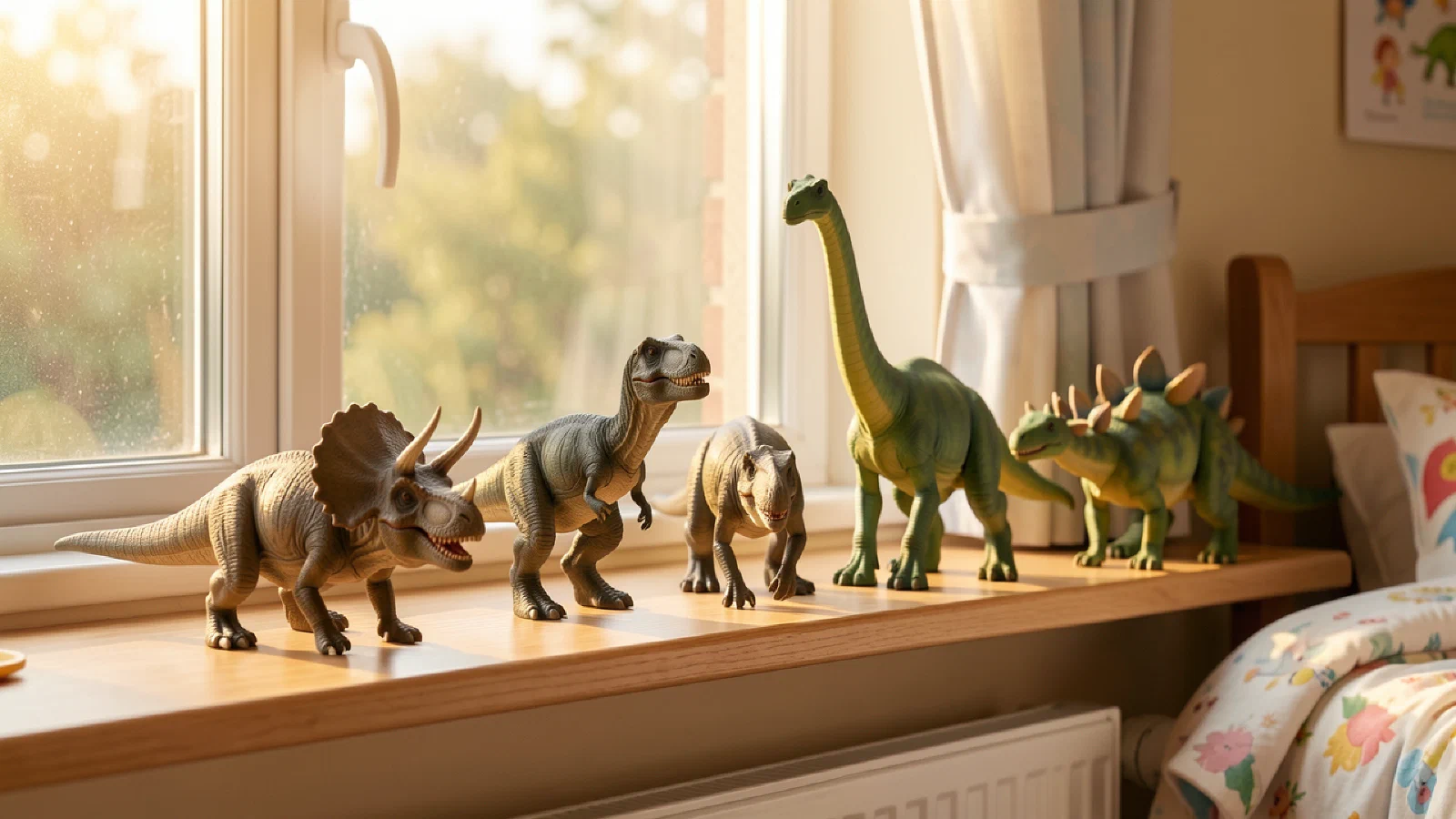
Not stuffed dinosaurs. Plastic ones. A triceratops, two tyrannosaurs (one missing a leg), a brachiosaurus, and a stegosaurus arranged in permanent council on his bedroom windowsill. Every morning before breakfast, Jack updates them on the day’s agenda. Today is Tuesday, which means speech therapy at ten and then the library after lunch. The tyrannosaur with the missing leg gets extra attention because Jack has decided it is the group’s worrier.
His mother, Anna, has learned to wait. The briefing takes about four minutes. She can hear him through the door, his voice shifting between narrator and respondent, filling both sides of a conversation with the easy fluency of a child who has never considered the possibility that plastic cannot hear him.
On this particular Tuesday in March, Jack comes to breakfast with something on his mind. He eats three bites of his waffle and then sets down his fork with the deliberateness of someone about to make a formal request.
“Mom. Can I get an ollama?”
Anna is loading the dishwasher. She processes the sentence with about forty percent of her attention, which is the percentage available to a woman whose two-year-old has just put a sock in the dog’s water bowl.
“A llama? No, honey. We don’t have room for a llama.”
“But I really want one.”
“I know you do. But llamas are big animals. They need space. They can’t live in the house.”
Jack considers this. The objection does not match the thing he is asking for, but he is five. Adults say confusing things. He recalibrates.
“It doesn’t need that much space.”
“Jack, llamas are taller than Daddy.”
This is clearly wrong, but Jack is not sure how to correct it because he is not entirely sure what an ollama looks like either. He has only heard Owen Petersen talk about his, and Owen is seven and therefore an unimpeachable source on all matters.
“Owen has one,” he tries.
“Owen Petersen has a llama?”
“He said he got one for Christmas.”
Anna pauses. The Petersens live on an acre and a half in East Helena. They have a golden retriever and a trampoline and an above-ground pool that Anna privately considers an eyesore. They do not, to her knowledge, have livestock.
“Are you sure Owen said llama?”
“Ollama,” Jack says, with the exaggerated patience of someone being asked to repeat the obvious. “Can I get one? Please?”
“We’ll talk about it later,” Anna says, which is the parental universal solvent for requests that do not merit further engagement at 7:40 in the morning.
The Second Petition#
Jack is a strategist.
When his mother declines a request, he waits a minimum of two hours before approaching his father. This is not calculated. It is instinctive. He understands, at a level that precedes any theory of negotiation, that the second parent is a separate jurisdiction.
His father, Dale, is in the barn by eight. Dale farms 340 acres of wheat and barley east of town, runs forty head of cattle on leased BLM land in the summers, and drives a 2019 F-250 with 187,000 miles on it. He is not a man who spends time thinking about artificial intelligence. He is a man who spends time thinking about precipitation forecasts and calf prices and whether the Case IH is going to make it through another harvest without a transmission rebuild.
Jack finds him in the calving pen, checking on Betsy, a Hereford cow who delivered twins three days ago and is being watched for mastitis.
“Dad.”
“Hey, bud.”
“Can I get an ollama?”
Dale does not look up from Betsy’s udder. “Your mom already told you no, didn’t she.”
“She said we don’t have room.”
“She’s right. We don’t. Betsy just had two calves, the pen’s full, and I’m not building another shelter this spring.” Dale straightens up and looks at his son. “Where’d you get the idea for a llama, anyway?”
“Owen has one.”
“The Petersens got a llama? Where the hell are they keeping it?”
“He said it talks to him.”
Dale stares at Jack for a moment. Then he laughs. “Son, llamas don’t talk.”
“Owen said his does.”
“Owen’s full of it.”
“What’s ‘full of it’ mean?”
“It means go ask your mother.”
Jack leaves the barn without the answer he wanted but with a new phrase he intends to deploy at speech therapy. Dale returns to Betsy, shaking his head. He makes a mental note to ask Craig Petersen at church on Sunday what the hell is going on with the llama.
The Translator#
Jack’s sister, Lily, is twelve. She has an iPad, a Chromebook issued by the school district, and the weary expertise of a seventh-grader who has been the household’s unofficial technology interpreter since she was nine.
She finds Jack in his room that afternoon, updating the dinosaur council on the day’s failures. He is explaining to the one-legged tyrannosaur that neither parent understands what he is asking for.
“Jack, what are you trying to get?”
“An ollama.”
“Like the app? Ollama?”
Jack doesn’t know what an app is, exactly. But the way Lily says the word matches the way Owen said it, which is different from the way his parents said it, and this difference feels important.
“Owen has one on his brother’s computer. You can talk to it and it talks back. It knows things.”
Lily sits down on his bed. “You mean like AI? Like ChatGPT?”
Jack does not know what ChatGPT is. He knows what Owen told him at recess: that there is a thing on a computer that you can ask any question and it answers, and if you ask it to tell you a story it tells you a story, and if you ask it about dinosaurs it knows every dinosaur that ever lived, even the ones that aren’t in books.
“It knows about dinosaurs,” Jack says. This is the selling point. This has been the selling point all day, but nobody has let him get to it.
“Yeah,” Lily says. “It does.”
“Can I get one?”
Lily looks at her brother, his plastic dinosaurs lined up on the windowsill, his face open with the specific hope of a child who has just learned that a thing he wants actually exists in the world.
“I’ll talk to Mom and Dad,” she says.
What Owen Actually Said#
The story, when Lily assembles it, is ordinary.
Owen Petersen’s older brother, Tyler, is fifteen. Tyler installed Ollama on the family desktop in December, running a small open-source model that could handle basic conversation and simple questions. Tyler was interested in it the way fifteen-year-olds are interested in anything that feels like forbidden technology, which is to say intensely for about three weeks, and then he moved on to something else.
But Owen didn’t move on. Owen, who is seven and in Jack’s combined kindergarten-first grade class at Rossiter Elementary, discovered the thing on the computer that Tyler left running. And Owen, who reads at a second-grade level and has the same dinosaur obsession that Jack has, asked it about dinosaurs.
It answered.
He asked it more questions.
It kept answering.
He asked it to tell him a story about a T-Rex who was afraid of the dark.
It told him one.
Owen had never experienced a non-human entity that could hold up its end of a conversation. Neither had Jack. Neither had any child in human history before roughly 2023, and even after 2023, the experience was distributed unevenly by geography, income, parental attention, and the random chance of having an older sibling who installed open-source software on the family computer over Christmas break.
Owen told Jack about it at recess on Monday. By Tuesday morning, Jack wanted one. Not because he understood what AI was. Not because he had any concept of language models or machine learning or open-source software. Because a seven-year-old told a five-year-old that there was a thing that knew about dinosaurs and would talk to you about them for as long as you wanted.
That was sufficient.
The Dinner Conversation#
Lily waits until dinner, which is tactically sound. Both parents are seated. The two-year-old, Hank, is contained in his high chair. The window for adult attention is narrow but real.
“Jack doesn’t want a llama. He wants Ollama. It’s software.”
Anna and Dale look at each other.
“It’s an AI thing,” Lily continues. “You download it and it runs on your computer. You can talk to it.”
“Like Siri?” Anna asks.
“Better than Siri. It’s like, you can have a real conversation with it.”
“Why does a five-year-old need to have a conversation with a computer?” Dale asks. He is not hostile. He is genuinely confused. His son is sitting right here, at the table, having a conversation with humans. There are also dinosaurs available, the barn cats, a dog, a two-year-old brother, and the entire population of Rossiter Elementary. The child is not short on conversational partners.
“Owen has one,” Jack says, because this remains, in his view, the strongest possible argument.
“Owen’s brother set it up,” Lily clarifies. “Tyler Petersen. Jack just wants to ask it stuff about dinosaurs.”
Dale chews his steak. He looks at his son, who is looking back at him with the expression of someone who has been trying to communicate a simple idea across a vast cultural divide for an entire day.
“What’s wrong with books about dinosaurs?” Dale asks. “We’ve got about thirty of them.”
“You can ask it questions,” Jack says.
“You can ask me questions.”
“You don’t know all the dinosaurs.”
This is true. Dale knows roughly five dinosaurs. He is aware that this is a limitation. He has never before considered it a problem.
Anna, who is a school counselor at Capital High and therefore professionally attuned to developmental nuances that Dale processes as noise, is quiet. She is watching Jack’s face. She is thinking about what it means that her five-year-old heard about an AI tool from a seven-year-old on a playground in Helena, Montana, and came home wanting it with the same uncomplicated desire he brings to wanting a new dinosaur book or a trip to the McDonald’s PlayPlace.
He does not know what he is asking for. He knows that he is asking for it.
“Let me look into it,” Anna says.
“That means no,” Jack says.
“It means let me look into it.”
Jack returns to his waffle, unconvinced.
What Anna Finds#
After bedtime, Anna sits at the kitchen table with her laptop and searches for Ollama. She finds a website that is clearly designed for people who are not her. There are references to models and parameters and something called “quantization” and she closes the tab after about ninety seconds.
She searches “AI for kids” and gets a different world. Dozens of products. Chatbots designed for children. AI tutors. AI story generators. AI homework helpers. Each one promising safety, educational value, and age-appropriate interaction. Each one asking for a subscription.
She is a school counselor. She has attended two professional development sessions on AI in the last year. The first one told her AI was going to revolutionize education. The second one told her AI was going to destroy it. Neither one told her what to do when her kindergartner comes home asking for a large language model by name.
She texts her friend Brooke, who teaches fourth grade.
Jack asked me for Ollama today. We thought he wanted a llama.
Brooke responds in under a minute.
Half my class has access to some kind of AI at home. The other half doesn’t. The gap is already showing.
Anna stares at the text. Then she puts her phone down and looks across the kitchen at the hallway that leads to Jack’s room, where a five-year-old is asleep beneath a comforter printed with dinosaurs, having spent his last conscious minutes explaining the day’s events to a plastic triceratops.
Her son wants a thing that talks back. She has spent her entire career helping teenagers who can’t talk to anyone.
The irony is not lost on her. The concern is not absent either.
The Gap That Is Already There#
Here is what Anna does not know, sitting at her kitchen table at 9:30 on a Tuesday night in Helena.
She does not know that Owen Petersen has been talking to the AI on his brother’s computer for two months, and that he has asked it over four hundred questions, and that his reading level has jumped measurably because he is motivated to type questions about things he cares about. She does not know that Tyler Petersen’s model has no content filters because Tyler chose a raw open-source model, and that Owen asked it last week what happens when people die, and that it answered him in clinical detail that a seven-year-old probably should not have received. She does not know that Owen has not told his parents about any of this because Tyler told him not to, and that Tyler told him not to because Tyler does not want to lose computer privileges.
She does not know that in Jack’s kindergarten class of twenty-two children, at least six have interacted with some form of AI at home. That the interactions range from asking Alexa to play songs, which barely counts, to sustained conversations with Claude or ChatGPT, which counts enormously. That the children who have had these interactions are not talking about them in any structured way because no adult in their lives has asked.
She does not know that the gap Brooke mentioned, the gap that is already showing in fourth grade, begins here. In kindergarten. In the random distribution of older siblings and parental technology comfort and household economics. The gap is not about access to information. Every child in Rossiter Elementary has access to a school library. The gap is about access to a responsive interlocutor that meets the child’s curiosity at the child’s pace, on the child’s terms, about the child’s obsessions.
Jack wants this. He cannot name it. He called it ollama because that is the word Owen used, and Owen used that word because it was the name on his brother’s computer, and his brother used that software because he saw it on Reddit, and the chain of discovery that led from an open-source project on GitHub to a five-year-old’s breakfast table in Helena, Montana passed through exactly zero educational institutions, zero parental decisions, and zero policy frameworks.
It passed through a fifteen-year-old, a seven-year-old, and a playground.
The Morning After#
Wednesday morning. Jack updates the dinosaur council. The news is cautiously optimistic. Lily is on his side. Mom said she would look into it, which is better than no. Dad is a lost cause but Dad was always a lost cause on technology. Dad still prints directions from Google Maps.
The one-legged tyrannosaur receives the most detailed briefing because Jack has designated it Chief of Intelligence, a role he does not know the name for but whose function he understands intuitively: the one who needs to know everything so the group is not caught off guard.
He tells the tyrannosaur that the thing he wants knows every dinosaur. Every single one. Even ones nobody has heard of. Even ones that don’t have pictures yet. Even ones they’re still digging up.
The tyrannosaur, being plastic, does not respond. Jack fills in its response anyway, the way he always does, supplying both the question and the answer, building a conversation from his own imagination because that is what five-year-olds do when the world is not yet equipped to talk back to them on their terms.
But now he knows there is something that would.
He finishes his briefing. He goes to breakfast. He does not ask about the ollama again because he is five and the attention span has already rotated to the question of whether Hank will put a sock in the dog’s water bowl again. (Hank will. Hank always does.)
Anna watches him eat his waffle. She has not decided anything. She does not know the right answer. She is aware that “wait and see” is itself a decision, and that the children whose parents are not waiting and seeing are pulling ahead in ways she can measure and in ways she cannot.
I wonder what Jack will remember about this year, when he is sixteen and has been talking to AI for a decade and cannot recall a time before it, whether he will remember the morning he asked for an ollama and nobody knew what he meant, and whether the story will become a family joke or something quieter than that.
In the barn, Betsy’s calves are standing on their own now, wobbly but vertical. Dale checks on them before driving out to the east section. He is thinking about moisture levels and the winter wheat, and he has already forgotten about the llama conversation, which is the kind of thing that falls out of a farmer’s mind between the barn and the tractor.
Jack’s dinosaurs stand in a row on the windowsill, facing east toward the Elkhorn Mountains, holding whatever he told them this morning in their plastic silence.
How this essay connects to others across The Approximate Mind.