The Lecture Hall
A history professor at a state university in the Midwest rests her thumb against a crack in the podium veneer that no one else knows about, and waits for a face to change.
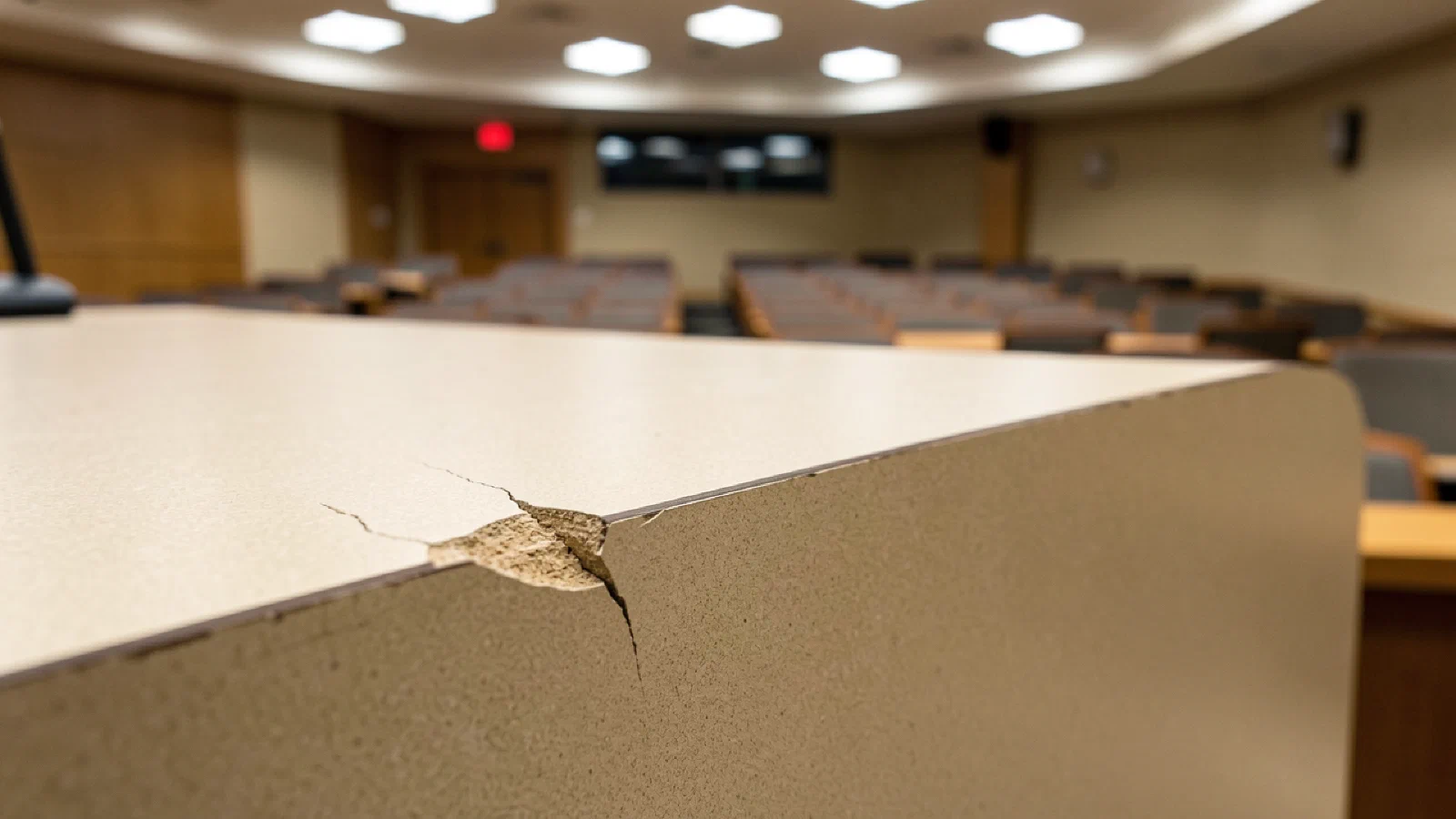
The crack is on the left side of the podium, about three inches below the top surface, where the veneer has separated from the particleboard underneath. Margaret Alderman found it her first semester, sixteen years ago, when she was gripping the podium the way new lecturers grip podiums: as a physical anchor against the vertigo of speaking to a room full of faces that have not yet decided whether to listen.
She rested her thumb against the crack. The crack held her thumb. The podium became a place she could stand without the grip.
Sixteen years later, the crack has a smooth spot where her thumb has worn the rough edge into something polished. Nobody knows this but Margaret. The podium is institutional property, beige laminate, interchangeable with every other podium in every other lecture hall on campus. The smooth spot is hers alone, the way a pew in a church holds the shape of a particular body over decades of Sundays.
8:00 AM#
Office hours. Room 314, Whitfield Hall. The door is open. The hallway is empty. Margaret sits at her desk with a cup of coffee and a stack of essays she graded last night and a browser tab open to the course management system that shows, with statistical clarity, that thirty-seven of her two hundred and twenty students have accessed this week’s reading.
Thirty-seven.
She does not take this personally. She took it personally the first year the numbers dropped below a hundred. She took it personally the year they dropped below sixty. At thirty-seven, she has passed through the stages that faculty pass through when the evidence of irrelevance accumulates: denial, frustration, adaptation, and something that is not acceptance but resembles it, the way a truce resembles peace.
Nobody comes to office hours. This is not new. Office hours have been sparsely attended for years, a scheduled availability that satisfies the syllabus requirement without producing the interaction it was designed to facilitate. Margaret sits at her desk for the required two hours. She grades. She prepares. She waits for a knock that does not come and would startle her if it did.
10:00 AM#
Introduction to American History. Hall 202. Two hundred and twenty students enrolled. Eighty present.
Margaret knows the number without counting because she has developed the spatial sense of a person who has stood at the same podium in the same room for sixteen years and can read the room’s density the way a farmer reads soil. A hundred and forty feels like a classroom. A hundred feels like a church on an off Sunday. Eighty feels like what it is: the students who still come.
She does not know why they come. The lecture is recorded. The recording is available within two hours of the lecture’s conclusion. Forty percent of enrolled students watch the recording at 1.5x speed. Twelve percent watch it at 2x. An unknowable percentage do not watch it at all and produce their coursework through AI-assisted synthesis of the assigned readings, which thirty-seven of them accessed, combined with supplementary material the AI provides from sources Margaret did not assign and cannot verify.
The students who come in person sit in a pattern she has mapped over the semester. The front three rows are the engaged. The middle rows are the present-but-uncommitted. The back rows are the physically-here-but-mentally-negotiating-with-the-decision-to-have-come.
Margaret lectures on Reconstruction.
She is good at this. She is not performing modesty by calling herself good. She has won two teaching awards. She has refined this lecture across sixteen iterations, sharpening the narrative, finding the details that land, learning where to slow down and where to accelerate and where to let the room sit with a fact before moving to the next one. She knows the material the way Paul knows the otoscope: through repetition so deep the knowledge is in the body and the performance is the body doing what it has learned.
The students have AI that can produce a better summary of Reconstruction than her lecture provides. They know this. She knows this. The contract that organized the lecture hall, the one where she possesses information and they need it and the credential certifies the transfer, is dissolving in plain sight. The information is available. The transfer is unnecessary. The credential persists because the credential is attached to a system that has not yet reorganized itself around the dissolution.
Margaret is not a bad professor confronting the limits of her competence. She is a good professor confronting the limits of the form. A bad professor could blame the students, the technology, the culture. A good one has to ask whether the lecture hall itself has failed, whether the form of one person speaking to two hundred and twenty about a subject the two hundred and twenty can access without the one is a form whose time has passed.
She asks this question while lecturing. It does not interrupt the lecture. It runs beneath it, the way the crack runs beneath the veneer.
1:00 PM#
Grading. Which now means reading essays the AI detection tool has flagged as potentially AI-generated, comparing them against essays the detection tool has not flagged, and trying to determine whether the distinction matters.
Margaret runs the detection tool because the department requires it. She does not trust it. The tool flags false positives with enough frequency to make any individual flag unreliable, and it misses AI-assisted writing that has been edited sufficiently to pass, which means it catches the lazy and misses the sophisticated, which is the opposite of what a detection system should do.
She reads the essays anyway. She has always read the essays. She reads them for the thing the detection tool cannot detect and the AI cannot produce: the sentence that sounds like a specific person thinking. Not a person writing well. A person thinking, on the page, in real time, with the roughness and surprise that thinking produces when it has not been smoothed into competence.
Most of the essays do not contain this sentence. They are competent. They are structured. They make arguments that are defensible and supported and indistinguishable from each other. They are the written equivalent of the lecture hall at 1.5x speed: the content is there, the presence is not.
Margaret grades them fairly. Competent work receives competent grades. The system does not penalize the absence of a specific person thinking. The system has no field for it.
3:00 PM#
Department meeting. The agenda item is AI policy. The department has been discussing AI policy for two years. It has not produced a policy. It has produced position papers, draft guidelines, a task force report, a revised task force report, and a faculty survey whose results were so evenly split between prohibition and integration that the survey itself became evidence of the problem it was supposed to resolve.
Margaret attends. She does not speak. She has spoken in previous meetings and discovered that the conversation circles without arriving, because the faculty is divided between those who see AI as an existential threat to the form and those who see it as a tool to be incorporated, and neither position addresses the question Margaret carries, which is whether the form was already failing before the tool arrived and the tool is simply making the failure visible.
The meeting ends at 4:15 without a policy. The next meeting is in three weeks. Margaret packs her bag.
4:47 PM#
She is walking to the parking lot when she hears the voice behind her.
“Professor Alderman?”
The student is from the fourth row. Margaret knows her face but not her name, which is a fact that used to embarrass her and now does not, because two hundred and twenty names are two hundred and twenty names and she has stopped pretending she can hold them all. She will look up the name later. For now, the face is enough. Fourth row, left side, takes notes by hand, has not spoken in class.
“I had a question about Reconstruction. I was going to come to office hours but I had lab.”
“Go ahead.”
The student asks a question about the Freedmen’s Bureau. It is not from the textbook. It is not from the AI. Margaret knows this because the question is wrong in an interesting way. The student has misunderstood the Bureau’s mandate, conflated its educational mission with its labor contract enforcement, and produced a reading of Reconstruction that is historically inaccurate and intellectually alive. The question has the texture of a person who encountered an idea and wrestled with it and lost and came to the wrestling match’s referee for help.
Margaret has not felt this specific thing in three years.
Not the pleasure of being asked a question. Students ask questions. The AI asks questions. The course evaluation form asks questions. The thing Margaret feels, standing in the hallway outside the lecture hall with her bag on her shoulder and the parking lot waiting, is the recognition of a mind working on a problem it has not yet solved, presenting its incomplete work to another mind for response. The incompleteness is the point. The student does not need an answer. She needs Margaret to see where the thinking went wrong and help her find where it might go right.
They talk for eleven minutes. Margaret explains the distinction. The student’s face changes. Not dramatically. The shift is small, the micro-expression of a person whose mental model has just been revised, the moment when the puzzle piece that was forced into the wrong space lifts and settles into the right one. Sixteen years of lecturing, two teaching awards, thousands of hours at the podium with her thumb on the crack: this is what all of it is for. This face. This shift.
“Thank you, Professor. That makes sense now.”
“Come to office hours sometime. I’m always there.”
The student leaves. Margaret stands in the hallway a moment longer than she needs to. The lecture hall is behind her, empty, the lights on a timer counting down to dark. The podium is in there, with its crack, with its smooth spot that holds the shape of sixteen years of her thumb. She will be back on Thursday. The room will be there. Eighty students will be there, or seventy, or sixty. The number will continue its decline, governed by forces larger than her teaching and indifferent to her awards.
She walks to the parking lot. The same walk for sixteen years. The campus is quiet in the late afternoon. The trees along the quad are old enough to have been here when the lecture hall was built, when two hundred and twenty was not enough seats, when the form was not a question but a given.
How this essay connects to others across The Approximate Mind.