The Last Open Door
A small-town librarian in the Mississippi Delta discovers that the building the county forgot to close has become the only place left where someone will show you how to ask.
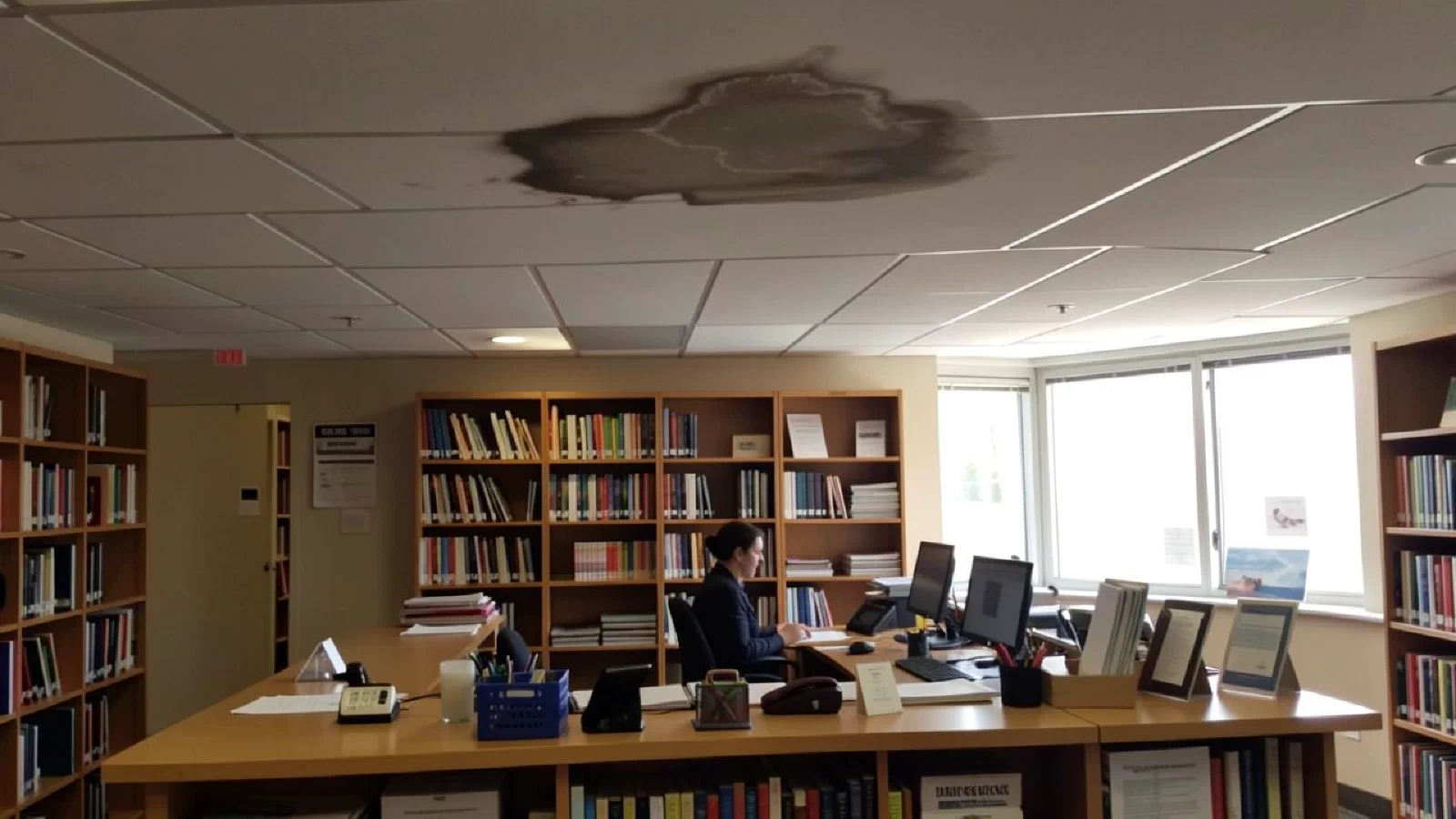
There is a water stain on the ceiling above the reference desk. It appeared in 2019. Ruth Pemberton put in a maintenance request the following week. The request is still open. The county maintenance office responds to requests in order of priority, and a ceiling stain in a building the county has not prioritized since before Ruth can remember does not rank.
The stain has become a kind of sundial. In the morning, the light from the east windows hits the discoloration at an angle that makes it look like a map of somewhere, the shape shifting as the sun moves, from something that resembles Italy at nine o’clock to something that resembles nothing at all by noon. In the afternoon, the west light makes it disappear entirely. By four, as the sun drops, it returns as a shadow, darker than the morning version, and Ruth can tell without looking at her phone that she has about an hour before closing.
She no longer sees it as a problem. It is the library’s way of marking time without a clock.
8:45 AM#
Ruth unlocks the back door. The building smells like old carpet and central air, the specific institutional smell of a place that has been climate-controlled at the same temperature for so long that the smell has become the building’s identity. The four computer stations near the reference desk are already on because Ruth never turns them off. She tried turning them off, the first year, as you would in a home, to save electricity. The boot time was losing her ten minutes each morning, and the people who arrived at nine expected the stations to be ready. So the stations stay on, running all night in an empty building, four screens glowing in the dark like the building itself is reading.
She walks through the space as she has walked through it for sixteen years, the body’s inventory: lights on, thermostat holding, bathroom stocked, children’s corner straightened, the cart of returns from yesterday’s last hour shelved. The shelving takes eight minutes. Fewer books come back now than they used to. Fewer books go out.
James is waiting at the front door. He is always first. James is seventy-four and lives alone in a house on Nelson Street that he has owned since 1986. He comes to the library every morning at nine, sits at the same table near the periodicals, and reads the Memphis Commercial Appeal online because the Greenville Delta Democrat-Times stopped printing years ago. He does not need help with the computer. He does not need help with anything. He needs somewhere to go at nine o’clock in the morning that is not his house.
Ruth unlocks the front door. “Morning, James.”
“Morning, Ruth. Hot already.”
“It’s June.”
“Doesn’t mean I can’t comment on it.”
He is at his table before she finishes turning the lock. The newspaper loads. The building has a person in it. The day has started.
What the Building Is#
The Washington County Library, Greenville Branch, is the only public building in town still open five days a week.
The post office went to three days in 2023. The community center lost its funding the year before that and now opens by appointment, which means it opens when someone at the county level approves a request, which means it opens rarely. The high school library merged with the media center and cut hours to match the school schedule, which means it is closed all summer, all holidays, and every day after 3:15. The churches are open on Sundays and Wednesday evenings. The courthouse is open but not a place you go unless you have to.
Ruth’s library is still here because the county has not gotten around to closing it. This is not a figure of speech. There is no county resolution affirming the library’s value. There is no protected line item in the budget. There is a building that the county owns, a salary that the county pays, and an institutional inertia that has carried both forward through budget cycles where no one raised the question of whether they should continue. Ruth understands that her library’s survival is a function of its invisibility. The moment someone on the county board notices what it costs, relative to what the county board believes it provides, is the moment the conversation begins.
She has prepared for this conversation. She has a folder on her desk with usage statistics, community impact narratives, state library system endorsements, and a two-page summary of the services the branch provides. She has never been asked to present it. She updates it quarterly, like an insurance policy for a disaster she can see approaching but cannot date.
The library exists because nobody has decided it should not. This is the thinnest form of institutional survival, and Ruth knows it, and she comes to work every morning at 8:45 as though it were the thickest.
The Four Stations#
Three years ago, people came to the library for books and the internet. Books for the older patrons, internet for everyone else. The internet was the draw: free Wi-Fi, four workstations, and a printer that cost ten cents a page. People came to fill out job applications, check email, print documents for appointments, and do the administrative labor that modern life requires and that you cannot do without a screen and a connection.
The internet is still the draw. But what people do with it has changed.
Ruth set up Claude access on all four stations eighteen months ago. The county refused to fund it. Ruth wrote a grant application to the Mississippi Library Commission using funds earmarked for adult literacy programs. She described the project as “AI-assisted literacy and information access for underserved populations.” This description is accurate. It is also strategic. The grant committee saw “literacy” and “underserved populations” and approved $4,200 for a twelve-month pilot. Ruth used the money for subscriptions, printed instruction cards she laminated herself, and a Saturday morning introductory session she ran three times before the word of mouth made the sessions unnecessary.
She tells herself it is a literacy program. She is not entirely wrong.
What she has built, without using the phrase and without any institutional support for the concept, is the closest thing Greenville has to a Universal Basic Intelligence floor. Four terminals where anyone can walk in and access cognitive capability that would cost them hundreds of dollars in professional fees if they sought it through the market. Legal questions. Benefit applications. Medical explanations. Tax preparation. Letter writing. Appeal drafting. The same capabilities that a person with resources accesses through lawyers and accountants and advisors, available here for free, between nine and five, Monday through Friday, in a building with a water stain on the ceiling and carpet that smells like 1994.
Dolores#
Dolores Watkins arrives at 10:15. She is sixty-three. She retired from the catfish processing plant on Highway 1 four years ago, not by choice but because the plant reduced shifts and her body had been telling her for a decade that standing on a processing line was a young person’s work and she was no longer a young person. She lives on Social Security and a small pension that the union negotiated before the union lost its bargaining power. She has diabetes, controlled. She has hypertension, mostly controlled. She has a Medicare denial letter in her purse.
The denial is for a continuous glucose monitor her doctor prescribed. The letter explains, in language that is grammatically correct and substantively opaque, that the requested device does not meet the criteria for coverage under her current plan. The letter provides a reference number, a regulation citation, and instructions for filing an appeal that include a mailing address, a deadline, and a list of documentation requirements that would challenge a person with a law degree.
Dolores has been denied three times. Each denial letter is slightly different in its wording and identical in its effect. Each one communicates, without saying so directly, that the system’s patience is greater than the applicant’s. The letters are designed, by structure if not by intent, to make the recipient give up.
Dolores has not given up. She has come to the library.
“Ruth, I got another letter.”
“Let me see.”
Ruth reads the letter. She has read enough of these to recognize the genus: coverage denial, regulatory citation as deflection, appeal instructions that are technically complete and practically useless. She sits Dolores down at Station 2 and opens Claude.
“We’re going to teach it about your situation, and then we’re going to ask it to help you write the appeal.”
Dolores looks at the screen the way she has looked at it every visit: with the wariness of a person who has been told her whole life that the important things are handled by people who know more than she does, in rooms she is not invited into, using language she is not expected to understand.
This is the part Ruth has learned is the hardest. Not the technology. The asking.
Dolores can type. She can read. She can follow instructions. What she cannot do easily, what sixty-three years in a world that did not invite her to ask has made difficult, is approach a system with the expectation that the system will respond to her as someone whose question matters.
Ruth does not frame this as a technology lesson. She frames it as a conversation.
“Tell it what happened. In your words. Not the letter’s words. Yours.”
Dolores types slowly. She describes her diabetes. She describes what the monitor would do. She describes the three denials. She does not use medical terminology because she does not have medical terminology. She uses the words she has, which are the words of a woman who has lived in her body for sixty-three years and knows what it needs even if she cannot name the need in the language the system requires.
Claude responds. It explains the regulation the denial letter cited. It identifies the specific criteria Dolores’s case likely meets. It drafts an appeal letter that uses the regulatory language the system requires while making the argument in terms a reviewer can follow. It suggests documentation Dolores should attach. It explains, in plain language, what each piece of documentation demonstrates and why it matters.
Dolores reads the response. She reads it again. She looks at Ruth.
“It understood me.”
“It did.”
“Nobody at that office ever understood me. I explained it three times.”
Ruth does not say what she is thinking, which is that the office understood Dolores perfectly. The office is designed to process claims, not claimants. The denial is not a failure of understanding. It is the system working as designed, processing volume, applying criteria, generating letters. Dolores’s individual situation, her body, her needs, her three attempts to explain, does not fit in the field the system provides.
The AI does not fix the system. It translates Dolores into the language the system requires. This is not nothing. It may be the difference between denial and approval. But it is also, Ruth knows, a workaround for a system that should not require translation in the first place.
2:30 PM#
The library has four people in it, not counting Ruth.
James is at his table. He finished the Memphis paper an hour ago and is now reading something on his phone, but he has not left, because leaving would mean going home, and home is a house on Nelson Street where nobody is waiting.
Dolores is still at Station 2, now looking up recipes, the appeal letter printed and in her purse, the cognitive weight of the morning’s work lifted enough that she can think about dinner.
Marcus is in the back corner. He is fifteen. He comes most afternoons after school and stays until Ruth tells him the library is closing. He does not use the computer stations. He does not check out books. He sits in the oversized chair near the young adult section, which is three shelves that Ruth maintains more out of principle than demand, and does his homework, or appears to do his homework, or sits with his homework open and his eyes on the middle distance.
Marcus is here for the air conditioning and the quiet. Ruth knows this because she asked him once, early on, whether he needed help finding anything, and he said, “No ma’am, I just like it in here.” She did not ask why. She recognized the answer for what it was: a teenager who has found a room that does not ask anything of him, that does not require a purchase or a purpose or an explanation, that is simply open and cool and quiet and has an adult in it who is not his parent and not a teacher and not asleep.
Keisha is in the children’s corner with her two-year-old, Jayden. The children’s corner is four plastic bins of picture books, a foam mat, and a set of wooden blocks that Ruth bought at a yard sale. It is the only indoor play space in Greenville that does not require a purchase. The McDonald’s on Highway 82 has a play area, but it requires buying something, and Keisha’s budget does not include daily McDonald’s. The library requires nothing. Jayden can scatter the blocks and flip through board books and make the sounds a two-year-old makes, and Keisha can sit on the floor beside him and be somewhere that is not her apartment for an hour, and no one will ask her to buy anything or leave.
Ruth stands at the reference desk and looks at the four people in her library. None of them are here for a book. All of them are here because here is here.
I wonder what the grant committee would make of this if she wrote it into her next report. Four patrons served. Zero books circulated. One Medicare appeal drafted. One teenager not on the street. One toddler playing with blocks. One elderly man reading a newspaper he could read at home but does not, because reading at home is reading alone and reading here is reading in a room where someone else is present.
The metrics the committee asks for are circulation numbers, computer usage hours, program attendance. Ruth reports them faithfully. They decline every year. The story the numbers tell is a library losing relevance. The story the room tells is a building gaining a function no one designed it for and no metric captures.
4:00 PM#
The water stain reappears as the afternoon light shifts. Ruth can see it from the reference desk, the shadow version, darker than the morning’s. An hour left.
Dolores left at three. James is still at his table. Marcus is still in the chair. Keisha packed up Jayden at 3:30 when he started getting fussy, waved to Ruth on the way out.
A woman Ruth has not seen before comes through the door. She is maybe forty, dressed in the clothes of someone who has been at work today and is now somewhere she did not plan to be. She stands inside the entrance and looks around the way people do when they have entered a building they have not been in since childhood and are recalibrating.
“Can I help you?”
“I’m not sure. Someone told me you can help with, I don’t know how to say this. Someone told me the computer here can help you understand legal things.”
“Come sit down.”
Ruth walks her to Station 3. She does not ask what the legal thing is. She has learned that the question comes when the person is ready, and that readiness sometimes takes five minutes and sometimes takes thirty and cannot be accelerated by asking.
The woman sits. She looks at the screen. Ruth waits.
“My landlord sent me a letter. I don’t understand what it means. I think it means I have to leave.”
“Let’s find out.”
Ruth opens Claude. She shows the woman how to type her question. She stays beside her while the woman types, slowly, the way Dolores types, the way people type when they are not accustomed to believing that a system will listen.
The AI explains the letter. It is not an eviction notice. It is a lease non-renewal, which is different, which has different timelines and different rights and different options. The woman did not know this. The letter did not explain this. The letter assumed knowledge the woman did not have, and in the absence of that knowledge, she heard only the loudest possible interpretation: you have to leave.
The woman reads the AI’s explanation. She reads it again. Her shoulders drop half an inch, the physical release of a fear that has been held in the body since the letter arrived.
“I don’t have to leave?”
“Not right now. You have options. Let’s look at them.”
They look at them. Ruth stays beside her, not because the AI cannot answer the questions but because the woman needs a person in the room while she learns that the letter does not mean what she thought it meant. The person does not need to be a lawyer. The person needs to be present, and patient, and willing to stand next to someone while the ground shifts under them and resolidifies in a different place.
5:00 PM#
Ruth tells James it is time. He nods, closes his phone, pushes his chair back. He has been here eight hours. He will be here eight hours tomorrow.
“Night, Ruth.”
“Night, James. See you in the morning.”
Marcus leaves without saying goodbye, which is how Marcus leaves, and Ruth has stopped taking it personally.
She walks through the space. Chairs pushed in. Stations still on, screens glowing. The children’s corner straightened, blocks back in the bin. The printer has three cents remaining on the last patron’s account, which Ruth will clear in the morning.
She locks the front door. The building is empty. The stations glow. The water stain catches the last light through the west windows, the shadow version disappearing as the sun drops below the roofline of the Dollar General across the street.
She will be back at 8:45 tomorrow. James will be waiting. The maintenance request will still be open. The building the county forgot to close will open again, because Ruth will open it, because someone should, because here is the last here that is here.
How this essay connects to others across The Approximate Mind.