The Household Voice
A small-engine man in Central Falls, Rhode Island spends a whole Wednesday inside a manner that nobody in the building remembers acquiring.
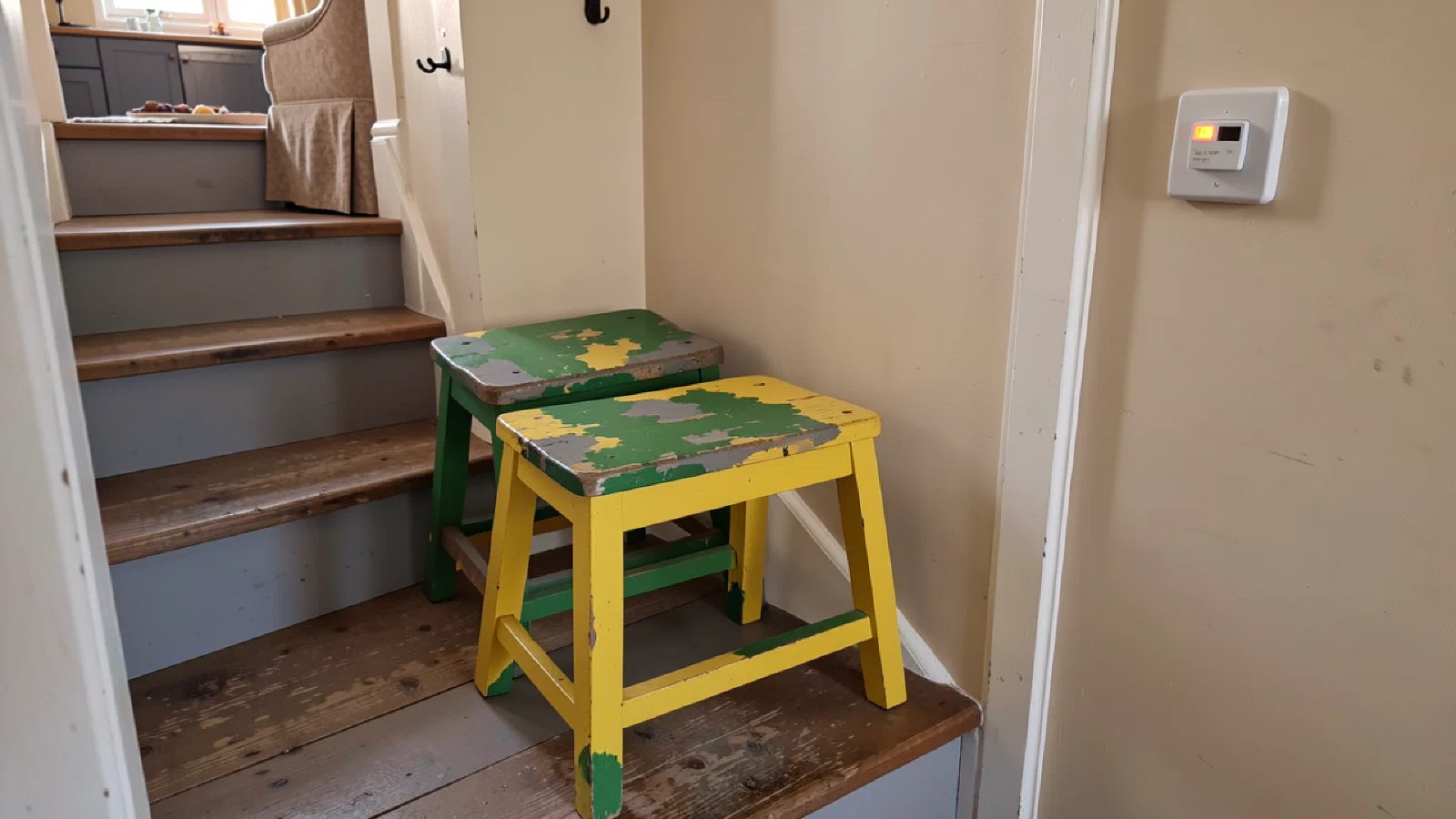
The stool has three coats of paint on it and the top step shows all three.
Gray underneath, from before anyone currently alive in the house. Then a green. Then a yellow that came out of a half can of porch paint and was never going to match anything it stood next to. Where feet have gone the yellow is worn to the green and in two places through to the gray, so the top step is a record of about seventy years of people needing to be nine inches taller.
It lives against the pantry wall on the second floor and it does not stay there.
The building is a three-decker on Rand Street with vinyl over the clapboard and a grape arbor out back that produces grapes nobody eats and that nobody will take down. Rand Street is nine hundred feet long and there are two other three-deckers on it exactly like this one and four that are close. Nuno Cabral is thirty-nine and has the second floor with his mother. The third is rented to Yaritza Cordero and her brother Emil, who are in their twenties and are almost never home at the same time. The ground floor was Cabral’s Variety until 2009 and is now where Nuno rebuilds small engines, because it has a floor drain, a door wide enough for a snowblower, and a rent nobody charges him.
6:20#
He comes up from the shop with a box of gaskets and nothing says anything to him.
He sets the box on the table. He runs the tap until it goes cold. He takes the milk out and puts it back without using it.
Then the house tells him his mother’s appointment moved from Thursday to Tuesday, that the office moved it, and it says the name of the office.
Fátima Cabral is sixty-six and has been up since five, in the chair that faces the stairs. She says she knows about Tuesday. She says it does that more in the winter, which is not true and is the kind of thing she says.
The four seconds are not a fault. They are how this house talks to somebody who just came through the door.
Then it goes through the people. Tia Rosária in Fall River first, who is not the closest relative and is not the sickest and is the one it always starts with. Then his mother’s own numbers, and it says where each one came from, the office and the day, every time, whether or not anybody has asked. Then Sabina, who is eleven and lives with her mother on Cowden Street and comes here Fridays. Then the tenants upstairs, which it puts as a question about the third floor rather than about them.
Nuno answers three of the four. He says he will call Rosária, and does not, and the house does not raise it again, because raising it again is not something it does.
Delfina Cabral had the second floor until four years ago. She kept a canary that outlived her by eight months. She watered the plant in the front window with the water off boiled potatoes, cooled, which she believed in and which nobody has ever tested, and the plant is still in the window and is enormous. Her chair is the chair Fátima sits in now, in the same place, facing the stairs, because that is where you can see who is coming up.
The Shop#
The outboard on the bench is a twenty-two-year-old Johnson off a skiff that fishes out of Wickford, and it has never been touched by anybody but Nuno.
He runs it in the tank for four minutes. The shop reads the run and puts a fault on the screen before he has the cowling off, and orders the part, and the part comes at eleven in a van, and the van is not driven by anybody. He has stopped watching for it. It comes.
The shop says nothing about anybody. It does not ask after Rosária. It logs, prices, orders, and closes, and when the Wickford man’s payment clears it clears between two systems with neither person anywhere in it, and Nuno finds out because a number on the screen has gone from one color to another.
He is good at this. He learned the four-stroke work off his father, who was not patient about it, and he learned the rest of it in the eleven months after his father died, off a system that told him what he had done wrong roughly six times an evening until he stopped doing it. If you asked him which half was which he would have to stop and think and would probably get it wrong.
At ten a woman brings a mower on a trailer. The mower reported itself last Tuesday and she has been putting it off, which she says twice. She stands in the doorway of the shop and tells him about her son in Providence and the son’s apartment and what the apartment costs, for nine minutes, while Nuno cleans a carburetor bowl and says yeah at the right places.
She does not come in. Nobody comes in. There is a line of grease on the concrete about four feet inside the door and the doorway is on the other side of it, and Nuno has never mentioned the line to anybody and could not say when it stopped being about grease.
By half past eleven there are two mowers, a pressure washer, and a generator somebody left in September and has not come back for, and the generator has been reported twice by a system that does not know its owner has moved to Woonsocket.
The Third Floor#
The radiator in the back bedroom on three has been banging since Sunday, and Yaritza has been leaving him notes about it in the stairwell, on paper, which is a thing she does.
He goes up with the stool because the valve is high.
Her place tells him about the radiator before he has crossed the room. What it did Sunday, what it did last February, what the pressure has been doing since Friday, and then it says it will have him back Thursday at four if that works, and Nuno says Thursday’s fine, and it says the thing is booked. Yaritza is putting on a coat through all of this and does not stop to listen and does not need to. On her way past she says the thing about her brother’s hours changing, which her place has already said, and which she says anyway.
He stands on the stool and bleeds the valve and gets a spit of brown water on his forearm. The room is Emil’s and there is nothing in it but a mattress, a floor lamp, and eleven pairs of shoes in a line against the baseboard, arranged by something.
Coming down he takes the stool with him and leaves it on the landing, which is where it lives most of the time, and where his mother will find it and say something about it, and where it will be again by Thursday.
12:40#
Sr. Amaral is eighty-one, lives across the street, and brings a chainsaw over about twice a year for a thing that takes six minutes.
Nuno does the six minutes. Then Sr. Amaral wants him to come over and hear about the sidewalk, so he goes over, because that is the price and both of them know it is the price and neither of them would use the word.
Sr. Amaral’s place reads the sidewalk assessment out loud. Both pages. The heading, the docket number, the boundary description with the bearings in it, the appeal window, the address for correspondence, the line about how to request a hearing and the line about what happens if you do not. It does this in Portuguese regardless of what anyone said to it, and it does not shorten anything, and Sr. Amaral makes coffee through the whole of it with his back to the room.
Nuno sits down. Sitting down is the correct response and he did not decide to make it.
The coffee comes in the small cups with the gold on the rim, four of them left out of a set, and there is a dish of the hard candies with the wrapper that is impossible to open. At the end Sr. Amaral says the assessment is wrong and that he will not be paying it, and it is not clear whether he has failed to understand the appeal window or has understood it perfectly and is telling Nuno what he thinks of it.
Nuno says he will ask around about who else on the street got one. He means it. He will ask three people at Mass on Sunday and one of them will know.
The Order#
His mother’s medication changed at some point in the last two weeks.
The house says so at two, when he comes up for a sandwich, four seconds after he puts the plate down. It says the change, and it says the office it came from, and it says the day, and it says the doctor’s name, which nobody asked for.
Then it says: have you called Rosária.
It does not call Rosária. It has never called Rosária. It could, and it does not, and there is no rule written down anywhere in this building that it should not, and it has not once occurred to Nuno that a thing which moves his mother’s appointments around could also place a telephone call to Fall River.
It is not something the house does. It is something the house tells you to do.
The house holds every date. It holds four decades of this family’s paperwork, the mortgage and both refinancings and the year the roof was done and by whom, the name of every person who has lived at this address since 1971, the canary, the exact figure the variety store took in its last full year, and the plumber they stopped using and why. It holds all of it correctly and will hold it as long as anybody wants it held.
It does not hold who decided it should wait four seconds.
Fátima, once, months ago, watching him stand in the doorway with his hands full waiting for it, said: it always did that.
That is the entire record.
I wonder how many of the rules in my own house I could name the author of. There is one about not answering the phone during dinner that I have enforced on my children for eleven years, and I have no memory of adopting it, and my mother did not have it, and I have never once asked my father.
9:20#
Sabina calls at seven because Friday is a half day and she wants to know whether that means she comes at noon.
The house says nothing during the call. It has never said anything during a call. When the call ends it says the thing about the half day in the school calendar, which it has known since August, and Nuno says yeah, I know, and it does not point out that he plainly did not.
At half past eight his mother goes to bed and the television goes with her, through the wall, low, the Portuguese channel with the volume at four.
He sits for a while with the game on and the sound off and eats the rest of the almonds out of a bowl that is not for almonds.
At nine he goes down to shut the shop and comes back up at twenty past with the stool, because he took it down in the afternoon to reach a shelf and it has been on the shop floor since, in the way. Getting it out of the way is the last thing in the day.
He puts it against the pantry wall. Three coats, the top step gone through in two places to the gray, gray and green and a yellow that never matched anything, nine inches.
Tomorrow it goes up to the landing. Nobody will carry it there, and by Thursday afternoon the stool will be on the landing, and nobody will have carried it there.
How this essay connects to others across The Approximate Mind.