The Full Room
A heat-pump technician in Mesa, Arizona carries seven keys to seven doors that would open for him without them.
Teo Salas carries seven keys and none of them open anything he owns.
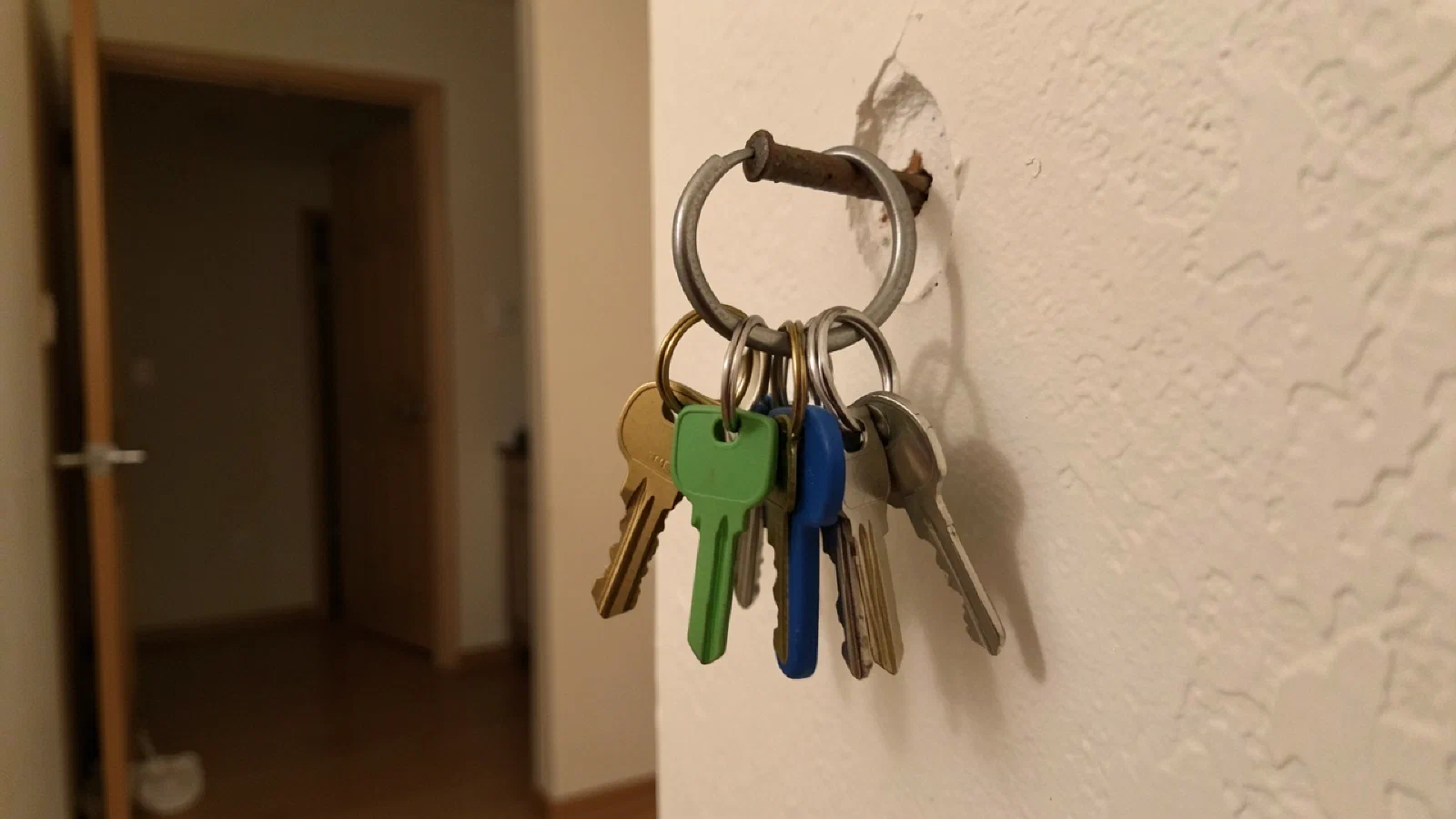
The ring is a plain split ring, the forty-cent kind, pried open and closed so often that the ends no longer meet. It rides in his left front pocket against his phone, and when he walks the two of them click, and the clicking is a sound his mother can identify through a wall.
Every one of the seven houses knows him. The doors read him from the driveway and would let him in with his hands full. The keys are cut metal for locks that are still in the doors and still work, and the reason anybody hands one over is that handing one over is what you do, and nobody involved has ever put it any other way.
The brass one with the green bread tag is his mother’s. The tag has been on it long enough that the printing has worn off, and it is a green plastic clip now, a thing whose only remaining job is to be the shape his thumb finds first.
The bright one, still unscratched, is Wes Bowen’s duplex on Emerson, cut in March.
The one with the blue rubber cap belongs to Frank and Jeanette Merrick, two streets over, given to him the week Frank had his hip done and never asked for back.
The stubby one is Nasrin’s, for the cat and for a fig she is trying to keep alive on a west-facing patio, which is not a reasonable thing to attempt in this city and which she attempts anyway.
The one with paint on it opens Kyle Pham’s garage, where four households keep one set of tools because four sets would be four sets.
The one that sticks is Rosa’s, and it does not stick if you lift the door slightly while you turn, which Teo does without noticing he does it.
The seventh is a house in Tucson the Ortegas sold two years ago. Teo has not taken it off.
6:40 AM#
The van was loaded at four in the morning without him. Twenty-two parts came off the shelf at the supply house on Alma School and went into his bins in the order he will reach for them, and eleven of those parts are for faults that have not happened yet and will happen this week in houses on his side of the county. He does not check the bins. He has never once opened the doors and found the thing missing, so the doors are a place things are.
It is a hundred and one degrees at twenty to seven and it will be a hundred and thirteen by two, and the day is built around that number the way a fisherman’s day is built around tide.
First call is a mini-split head in a converted garage off Broadway. The head reported itself on Monday: condensate pump, intermittent, drawing correctly and not lifting. Doyle, who owns the garage, learned about it when the van appeared in his calendar. The part is in the bin at chest height on the left. Head off the wall in six minutes, pump swapped in nine, and then Teo runs it a quarter of an hour with a bucket under it, because the fault is intermittent and intermittent is the word that means you stand there and wait.
He has been doing this three years. He learned it in fourteen months and he learned it from nobody. There is no man in Mesa who taught Teo Salas the trade, no shop he came up in, nobody he calls when a job goes sideways and nobody who would expect the call. What he did instead was work alongside a system that watched his hands and told him, seven or eight times a day for a year, the one thing he had gotten wrong in the last ten minutes. He is better at this than a man with twenty years would have been at three, and he could not name a single person he owes for it.
Doyle follows him out to the van and starts in on the wash behind the property and what it does in monsoon, a subject Doyle can hold for a while. Teo lets him hold it four minutes with the door open and one boot on the sill, which is a posture Doyle can read, and Doyle winds it down himself.
Second call is a ninety-two-year-old rooftop package unit over a strip building, a nail salon and a tax place and a third space empty long enough that the paper in the window has gone the color of weak tea. The roof at ten is a griddle. He works in eleven-minute pieces with his back to the sun. The invoice closes while he is still coming down the ladder, and the nail salon’s system pays it, and neither the salon’s owner nor Teo is any part of that transaction.
12:20#
Jeanette texts that the thermostat is making a noise.
The Merricks’ house knows the thermostat is making a noise. It has known for two days. A low-battery chirp does not clear the threshold for calling anybody, because the house is holding a much longer list about Frank, who is eighty-four, and it triages the way a triage works, and a chirp is at the bottom.
Teo parks behind Frank’s Buick, which has not moved since March and is washed anyway. The door opens for him as he comes up the walk. He puts the key in the lock and turns it, because that is what he does with that door.
Frank is asleep in the recliner with the television going. He sleeps hard in the afternoons now. The house is watching him sleep, in the sense that it is counting the things about Frank that get counted, and the count is fine today. Teo comes through the front room without adjusting his step, because adjusting your step is a thing you do in a house you are visiting.
The batteries are low. He has two AAs in the van and gets them and puts them in and the chirp stops, and that is all of it.
Jeanette makes him take a cookie, the hard kind with the almond, out of a tin. She has never made a cookie in her life. He eats it standing at the counter and she tells him the thing about her sister in Yuma that she told him last week and he lets it run.
Eight minutes, front door to front door. Frank does not wake up.
The key is not how he gets in. It is that he gets in.
1:40 PM#
He parks in the shade line of the Fry’s on Baseline, a strip about nine feet wide down the building’s east face, and runs the engine for the air. Lunch is two bean burritos his mother made Sunday and froze, still cold in the middle, which he does not mind.
The first four minutes are not comfortable. His hands want the phone. He has left it face down on the passenger seat, not as a rule, just as where it went, and there is a low restlessness under his sternum that asks to be answered, and answering it would take nine seconds and cost nothing and be, by any measure available to him, an improvement on sitting here.
Then it passes and he is sitting in a van.
A woman loads a cart into a Corolla with the tailgate up for shade and takes a long time about it. A grackle walks the median as though it has never once been chased off anything. Heat comes off the asphalt in a shimmer that makes the far end of the lot look wet. Teo watches all of it and none of it. At some point he is thinking about the Ortegas’ front door in Tucson, which had a doorbell that played four notes, and then he is not thinking about that either, and there is a stretch in the middle of the twenty minutes he could not give an account of afterward.
The twenty minutes are not a break. They are the only part of the day nobody is owed.
The route reshuffles itself at 1:52 and puts a filter change in Gilbert where a cancellation was. He looks at it and does not think about it.
At two he texts Wes: coming by 4.
Wes#
Wes Bowen is fifty-one. He has a duplex with a gravel yard, a mesquite the landlord will not trim, a daughter on Wednesdays and Sundays, and a lease dispute that has been going since February.
The response to the landlord is written. It was written the day Wes asked for it, it is correct on the statute, it is calmer than anything either of them could have produced in February, and it has been sitting unsent for eleven days. Wes has read it maybe forty times. It is on the table between them right now, and Wes taps it twice with two fingers in the middle of a sentence about the mediator, and then goes back to the beginning of the loop.
The loop has four subjects in a fixed order and the fourth is always what the landlord said and what the landlord said the time before. It takes two and a half hours. Wes does not want advice and turns combative when it arrives. He wants somebody in the room while he goes around.
Teo does not know what he is watching. He has never in his life had a matter. Nothing has ever been pending on him: no claim, no appeal, no notice, no window in which to respond. He has never sat across from an institution and been the one required to hold the file in his head. When he looks at the letter on the table he sees a letter that is finished, and he cannot make the leap to what Wes is actually doing, which is not solving a problem but performing, forty times, the operation of being a man who handles his own affairs, on the last piece of paper that will ever require it of him.
So he sits there. At one point Wes says something unfair about Teo’s mother, obliquely, not meaning it, in the middle of a sentence about something else. Teo lets it go past. He is aware of letting it go past. It costs him something and he does not say so.
The three hours are not a favor. They are the rent.
At six forty Wes says he should probably eat something, which is how Wes ends things. Teo stands and finds his back has locked from a low chair, and goes out into a heat that has come down to a hundred and six and feels, honestly, cooler.
7:50 PM#
Nobody called anybody about tonight.
Rosa cooks Thursdays. Twelve people come and there is food for twelve, because the order went in on Tuesday for twelve, because twelve is what Thursday has been running lately. Nasrin’s ride is not Nasrin’s problem and never was. Frank Merrick arrives at eight, and the chair nearest the door is empty when he gets there, and nobody moved it and nobody would say who did.
There is no occasion.
Brandon spends eleven minutes arguing that a call in Sunday’s match was correct. He is wrong in a way that four people at the table can demonstrate, and he does not concede, and the argument gets a second wind around minute eight. Nobody looks it up. Looking it up would end it, and ending it is not what it is for.
The heat breaks after eight and the kids go out, four of them, and the noise they make is the loudest thing in the neighborhood.
At nine forty Teo is at the sink scraping plates with his aunt beside him drying, not talking, the water going, the yard coming through the screen. It is the same silence as the parking lot. He notices this without arriving at the name of it.
Frank leaves at nine with a plate. Jeanette did not come. She is not doing stairs this month.
The Nail#
He drives home with the windows down for the first two miles because the air outside is finally worth having.
I wonder how many keys to other people’s houses are on my own ring. I know the number without going to look. It is one, it is my mother’s, I have had it eleven years, and I have used it four times.
The apartment is small and clean and largely empty, because he is not in it much. There is a nail inside the door at shoulder height that he put in himself with a claw hammer and no measuring. He empties his left pocket. Phone on the counter. Ring on the nail.
Tomorrow is Friday, which means the Merricks, because Friday is when Frank’s compressor gets looked at whether or not it needs looking at.
The ring hangs on the nail. Seven keys, none of them his, seven doors that would have opened anyway, and the split ring still does not sit flush.
How this essay connects to others across The Approximate Mind.