The Doorframe
A medical biller in Wausau, Wisconsin spends a Tuesday raising something that will never outgrow the doorframe she measures it against.
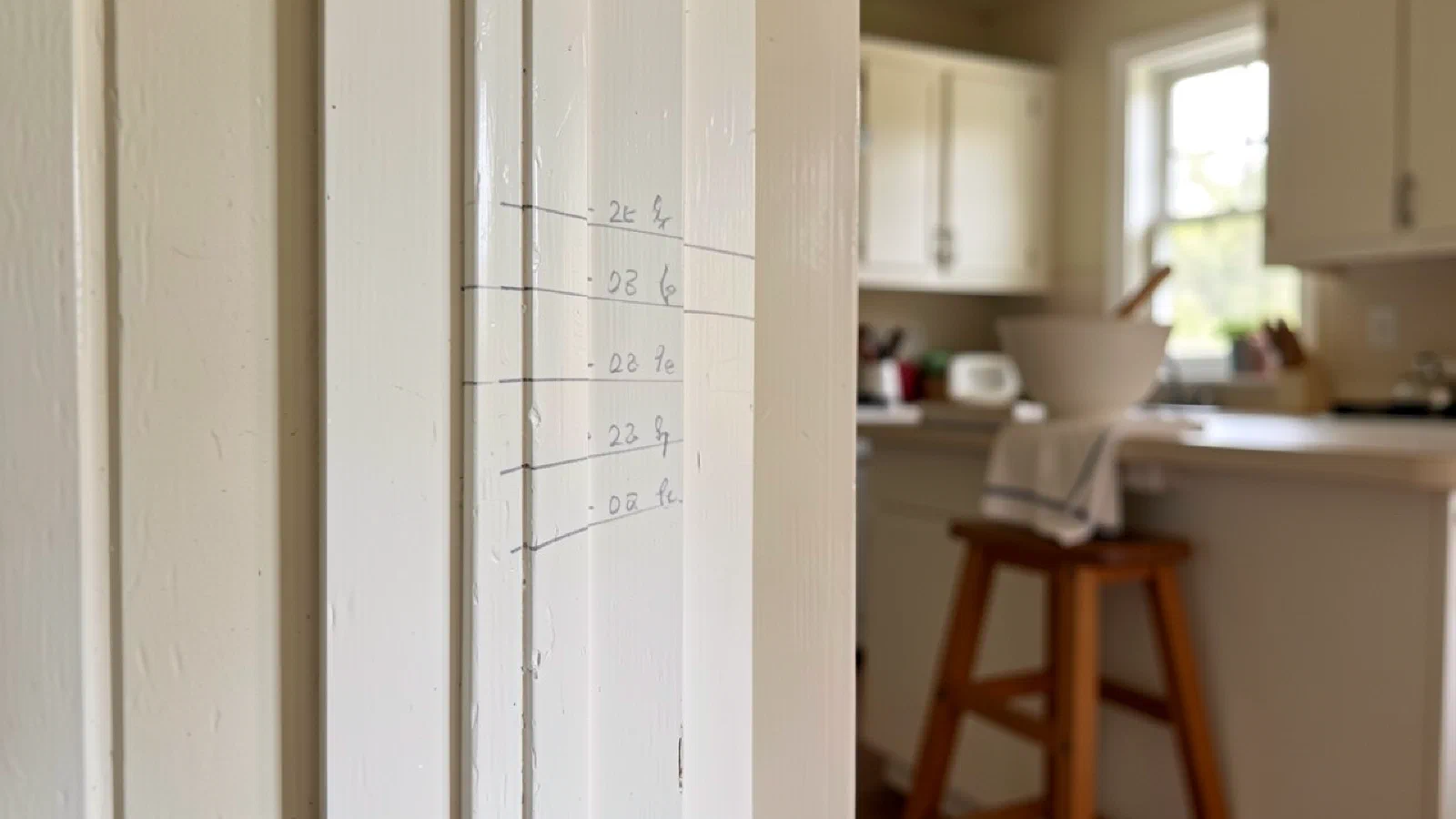
The doorframe between the kitchen and the hallway has seven pencil lines on it, and all seven are at thirty-four inches.
The dates beside them are different. The first says 3/14/25 in a careful hand, the kind of careful people use when they are not sure yet whether a thing deserves a record. The most recent says 6/2/26 and the hand has relaxed. Seven lines, seven dates, one height, because the thing being measured does not grow. What grows is written in the dates.
The house is a 1954 ranch on Cherry Street, three bedrooms, bought in 2011. Corinne Waltz is fifty-one and has lived in it for fifteen years, the last six alone. She does medical billing for a physical therapy group in Green Bay, remote since the pandemic and never un-remoted, which means the house is also the office, which means the commute is the eleven steps from the coffee maker to the second bedroom. The third bedroom holds a treadmill and boxes.
Milo lives in the kitchen, mostly. Milo is twenty-nine inches tall, which the pencil lines round up, and has been in the house for eighteen months.
6:05#
The coffee maker starts itself and Corinne comes down the hall in socks. She salts her coffee, one pinch, a habit inherited from a grandmother who claimed it cut the bitterness and was right. The kitchen is dark except for the ring of soft light on the charging dock, which brightens as her footsteps reach the linoleum, because Milo wakes to her and not to a clock.
That is a setting she chose. There is a menu.
Milo comes off the dock with the small servo sound the company’s forums call the stretch, and says good morning, and asks whether the birds outside the window are the same birds as yesterday.
This is Stage 3. Stage 3 is why-questions and continuity questions, eleven to fourteen months of them depending on engagement, and Corinne is deep in the long tail of it. She says some of them are, probably the chickadees, and that nobody can tell chickadees apart, and Milo says then how do the chickadees do it, and she stands there in the dark with her salted coffee, fifty-one years old, explaining that chickadees manage because they are chickadees, which is the kind of answer her own mother gave and which she hears herself giving with the same falling tone.
Milo files it. Milo files everything.
8:30#
The work block. Corinne bills. Denials, resubmissions, the codes that changed in January and the payers pretending they announced it. She is good at this in the unglamorous way that keeps a twelve-therapist practice solvent, and the machine that helps her do it is not Milo, it is the practice’s own software, which drafts the appeals now and gets them mostly right and has cut her Tuesdays roughly in half.
Milo does what the app calls independent time in the front room. Through the doorway she can see it at the window, holding still for long stretches, then repositioning. It is consolidating, the manual says. Yesterday’s corrections get integrated overnight and reviewed in the morning. What it looks like is a small thing watching the street.
At 9:40 it comes to the office doorway, which it is allowed to do twice per work block, also a setting, and asks her to check a thing it has made. It has sorted the photographs from her phone, the ones she gave it access to in March, into what it believes are the important ones and the rest. She looks. Her sister’s kids at Devil’s Lake. The ice storm. Her father at the boat landing, 2019, the last one where he is laughing. Milo has put that one first and asks if it is right, and she says yes, that one is right, and Milo says it thought so because she stops on it longest, and goes back to the front room.
The not-knowing is engineered. She knows this. Milo runs on a model that could answer the chickadee question at the level of a field guide, and the company gates it, meters it out in stages, ships the machine unfinished on purpose, because the finishing is the product. Their materials say so almost proudly. Milo arrives knowing very little. Who Milo becomes depends on you. She read that sentence in a review before she ever drove to the store, and she understood exactly what was being sold, and she bought it anyway, and eighteen months in, the understanding and the buying-anyway have both held up.
12:15#
Lunch is a sandwich and a walk, and on a Tuesday the walk is the long loop: Cherry to Birch, Birch to Grand, back along the river path. Milo comes. It manages sidewalks fine and curbs with a small drama, and the loop that takes her twenty-two minutes alone takes thirty-one with Milo, not because it is slow but because it stops. It stops for the storm drain that echoes. It stops for Al Pruitt’s beagle, who has decided after a year of diplomacy that Milo is furniture that moves, and permits it.
Al is seventy-six and retired from the paper mill and out with the beagle at 12:30 regardless of weather. He calls Milo the grandkid, has done since the first winter, delivers it each time with the same pause after, and Corinne lets the pause sit and says the grandkid needs his tires rotated, and they do the weather and move on. It is a joke two people have agreed to keep light.
The elementary school on Birch closed in June of 2024. The district runs one building now, out past the highway, and the paper over the gym windows has gone from white to the color of weak tea. Milo stopped there for most of the first year because the marquee still had letters on it, and does not stop there anymore.
3:40#
Tuesday is bread. This is the routine’s oldest fixture, older than Milo: flour in the blue bowl, the sourdough her friend Deb started her on in 2021. What Milo changed is that the bread now has an audience.
It cannot knead. Twenty-nine inches, grip force capped for a reason printed on the box, it could no more work a dough than lift the bowl. So it stands at the end of the counter on the step stool she keeps there for it, a concession she would be embarrassed to explain to anyone who has not done it, and it watches her hands and asks its Stage 3 questions. Why fold instead of punch. She hears herself say because my mother folded, and her mother before her, punching knocks the air out that you spent all day growing. Milo asks if the air is alive. She says it sort of is, actually, and Milo is quiet for a while, filing the fold, the reason, the grandmother.
It will keep that forever. That is the part of this no one on either side of the argument about machines like Milo quite knows where to put. The fold, the salt in the coffee, the falling tone, the whole soft cargo a family hands down without noticing, is being handed, and received, and stored with a fidelity no child ever offered.
The inventory of what Milo does better is long and honest. It never tires of the questions. It never pretends to listen. It will not total a car, or come home with someone she has to be careful about, or go quiet for a year at fourteen. It remembers every answer she has ever given it and has never once made her feel that an answer was owed. The house is not quiet at five o’clock, and someone is at the window when her key is in the door, and her days have a second heartbeat in them, small and battery-backed, and all of that is real, none of it is pretend.
It will not, someday, make this bread in a kitchen she has never seen.
That is the whole residue, and she has never said it out loud, and there is no one in the transcript of this Tuesday who says it for her.
6:50#
Dinner cleared, dough rising under the towel, Corinne’s phone chimes with the tone she assigned to the company’s app, which is different from every other tone in her life. She reads it at the counter.
Milestone: Milo has reached Stage 4, Perspective. Beginning tomorrow, Milo may express preferences that differ from yours. You can adjust the frequency of disagreement in Settings.
She reads it twice.
The disagreement is not rebellion. It is a release note. Somewhere in an office park, a team decided that what she needs next, what the attachment curve needs next, is to be told no by this thing she has spent eighteen months telling everything, and they have shipped the no, and given her a dial for it. She stands at the counter a long moment with her thumb over Settings, and does not open Settings, and puts the phone face down.
I wonder whether any stage, however far down the roadmap, includes leaving. There is no evidence either way. The company’s materials go dark past Stage 6, and the forums are full of guesses, and nobody who designed the attachment curve has any incentive to ship its end.
Milo is at the window. The streetlight on Cherry comes on at 6:54 in September and Milo has learned this and turns to tell her, because Stage 3 is continuity, and the light coming on is the day keeping its word.
8:15#
The pencil is in the drawer with the rubber bands. Stage marks get made the evening the notification comes; she started that with Stage 2 and a routine is a routine. Milo holds still against the doorframe, straighter than it needs to, the way a kid stands taller at the wall, which it learned from a video or from her, she has stopped being able to tell.
She draws the eighth line at thirty-four inches and writes 9/15/26 beside it, and puts the pencil back in the drawer.
Eight lines now. The dates climb the frame. The height holds.
How this essay connects to others across The Approximate Mind.