The Decision
A seventeen-year-old in Seoul keeps a notebook on the right side of her desk that is not for any class, not for any test, and not for anyone but her.
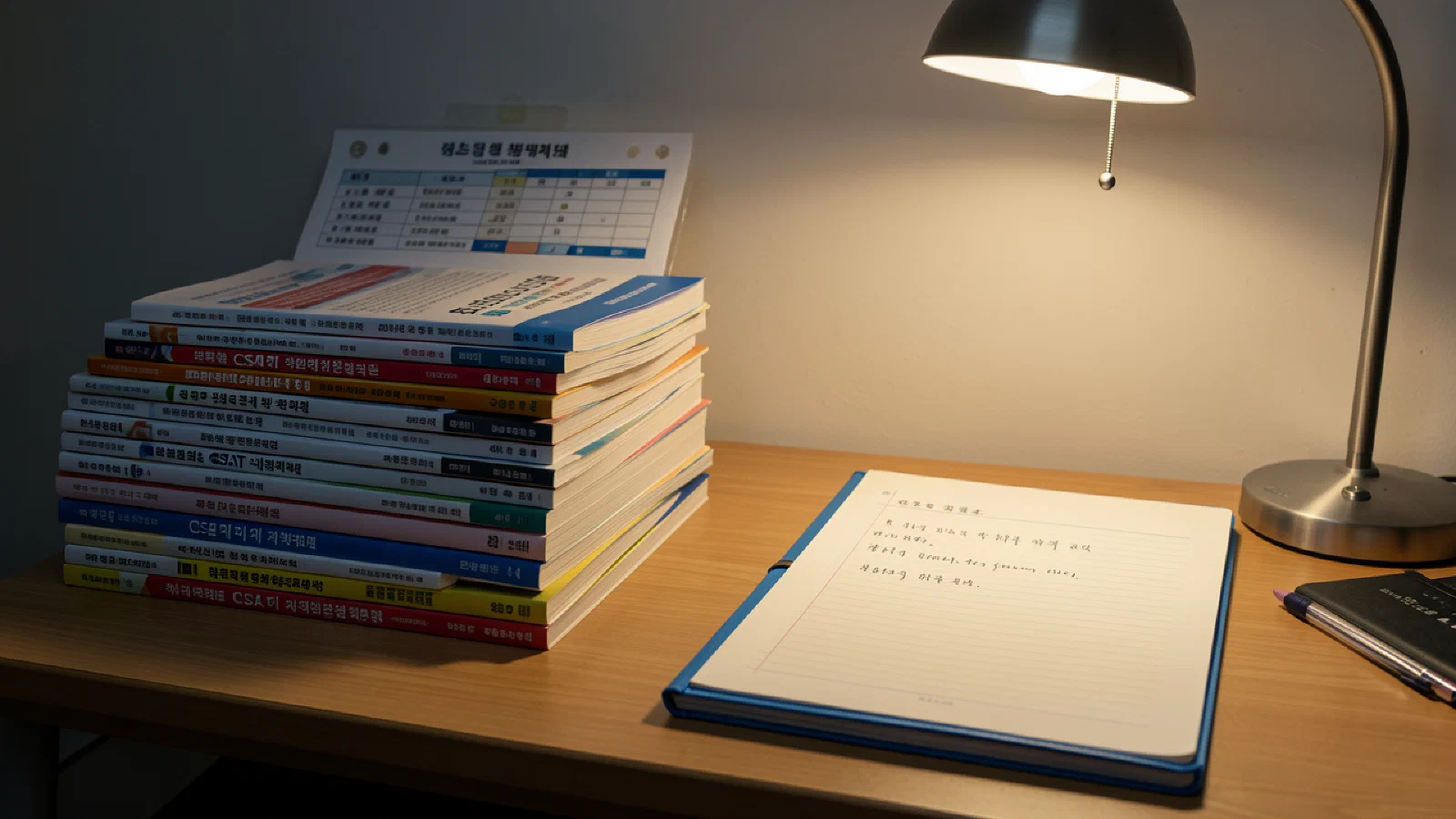
There are two stacks on Jiwon Park’s desk.
The left stack is organized. It contains three CSAT preparation workbooks, a vocabulary manual for the English section, a binder of practice tests from the hagwon she attends six evenings a week, and a schedule her mother printed from the academy’s parent portal and laminated so it could be posted on the wall above the desk. The schedule covers every hour from 6 AM to midnight, Monday through Saturday, with Sunday marked as “self-study and review.” The lamination makes it permanent. The permanence is the point.
The right stack is a notebook. One notebook. It has a blue cover and no label. Jiwon started it three months ago. She does not know what it is. She knows it is the first thing she has written that no one assigned.
The notebook contains questions. Not exam questions. Not the kind of questions that have answers in the back of the workbook. Questions like: What would I learn if no one were testing me? What is the difference between knowing something and being able to prove I know it? If the AI can answer every question on the CSAT better than any student who has ever lived, what is the test measuring?
She writes in the notebook after her mother is asleep, after the practice tests, after the English vocabulary, after the hagwon homework. She writes in Korean, though she could write in English, because the questions she is asking do not feel like English questions. The grammar of aspiration in Korean does not accommodate doubt in the same way. The language pushes toward certainty, toward direction, toward the completion of a trajectory that began when her parents enrolled her in her first academy at age nine. In Korean, the sentence structure of “I am deciding whether to go to university” sounds, to Jiwon’s ear, like a sentence that has been broken on purpose.
6:00 AM#
The apartment is in Daechi-dong, the neighborhood in Gangnam where the density of hagwons per square meter is among the highest in the world. The buildings glow at night with the fluorescent light of study rooms. During exam season, the neighborhood sounds like a library: quiet, purposeful, anxious. This is not exam season. The CSAT is four months away. The neighborhood is anxious anyway. Anxiety in Daechi-dong is not seasonal. It is structural.
Her mother, Eunji, is making breakfast. Rice, soup, banchan from yesterday. The kitchen is small and organized the way Jiwon’s left stack is organized: everything in its place, every place justified by function. Her mother works as an administrator at a medical clinic in Seocho. Her father, Junho, is an insurance adjuster who leaves for work at 7:15 and returns at 9:30 and spends the interval in between in a condition Jiwon cannot name but recognizes as the absence of something he once had. He is not unhappy. He is not present either. He occupies the apartment the way furniture occupies a room: solidly, dependably, without animation.
Jiwon eats. She does not raise the question at the breakfast table. She has rehearsed raising it. She has imagined the sentence leaving her mouth and landing on the kitchen table between the rice and the soup and her mother’s face. She has imagined her mother’s face. The imagination is precise enough to make the rehearsal unnecessary and the actual conversation impossible.
The question is not whether university is valuable. The question is whether the value it provides is the value she needs.
The Hagwon#
The walk to the hagwon takes twelve minutes. Jiwon passes the university gates on the way. She has passed these gates perhaps two thousand times. Every time, she tries to feel what she is supposed to feel.
She is supposed to feel longing. The gates represent the destination that justifies everything: the schedule, the academies, the practice tests, the years of organized preparation. Her parents did not attend university. Her mother completed a two-year vocational program. Her father finished high school and entered the insurance industry through a training program that no longer exists. They have arranged their finances, their schedules, their expectations, and a significant portion of their emotional architecture around the premise that Jiwon will pass through those gates.
Jiwon looks at the gates and feels a question she cannot phrase as a question.
Not rebellion. Jiwon is not a rebel. She does not reject the premise of education. She does not think her parents are wrong. She does not romanticize dropping out or imagine herself as an iconoclast defying convention. She is something harder to name: a person standing inside a system that was designed for a world that is changing underneath it, noticing that the foundations are shifting while everyone around her continues to build on them.
The AI tutors are better than most of her hagwon teachers. This is not an opinion. It is a measurement she has performed quietly, over three months, comparing her comprehension scores from academy instruction with her scores from AI-assisted self-study. The AI is more patient. It does not move to the next concept until she has absorbed the current one. It does not have thirty other students whose pace it must accommodate. It does not have a curriculum designed for a median student who does not exist.
The credential still opens doors. Jiwon understands this with the clarity of a person who has watched her parents navigate a society organized around credentials. Without the degree, certain doors close. With the degree, certain doors open. This is arithmetic, not philosophy.
But the doors are opening onto rooms where the AI is already sitting.
The law firm that hires the SKY university graduate will hand her work the AI has already drafted. The accounting firm will assign her to review what the system has prepared. The hospital will expect her to verify what the diagnostic tool has found. The rooms behind the doors are not empty. They are occupied by something that does not need the credential, does not need the four years, does not need the CSAT score that justifies the investment Jiwon’s family has made in her future.
Jiwon sits in the hagwon. The instructor explains a math concept she understood last week. She opens her phone under the desk and types a question into Claude.
“If a credential opens a door to a room where the work has already been done, what is the credential for?”
The answer is long and careful and considers multiple perspectives and does not resolve the question. Jiwon appreciates this. She does not want resolution. She wants company inside the question.
The Notebook#
She started it in February. A Tuesday night, after midnight, after the practice test, after the English vocabulary. She was lying in bed with her phone off and her eyes on the ceiling, in the specific wakefulness of a person whose body is exhausted and whose mind will not stop because the mind has been trained to never stop, because stopping is what happens to people who do not prepare.
She got up. She found a notebook in the drawer, left over from middle school, blue cover, unused. She wrote the first question: What do I want to learn?
Not: what do I need to learn for the test. What do I want to learn because I want to learn it. The distinction was so unfamiliar it took her fifteen minutes to produce a list. Three items. Music theory. How bridges are built. What consciousness is.
None of these are on the CSAT. None of them lead to a credential. None of them would survive the breakfast-table conversation with her mother, because her mother’s love is expressed in structure and the structure does not include music theory.
Since February she has filled forty-one pages. The notebook is not an essay. It is not a journal. It is closer to a conversation with herself, conducted in Korean, in handwriting that gets smaller as the pages progress because she does not want to start a second notebook. A second notebook would mean this is a project. One notebook is a question.
She writes about the AI. She writes about what it means that she can learn anything, from anyone, at any time, for free, and yet she spends six evenings a week in a room with thirty students and an instructor who is less effective than the tool on her phone. She writes about her father’s face, which she reads the way a counselor reads a student’s silence: as data about a life that is not being spoken. She writes about the gates she passes every morning, and the feeling she cannot produce, and the question she cannot phrase in Korean because Korean does not offer her the grammatical structure to hold uncertainty and aspiration in the same sentence.
She does not show the notebook to anyone. She does not mention it. It exists on the right side of her desk, beside the left stack, the way a second life exists beside the official one: visible if you look, invisible if you are looking for what you expect to see.
11:30 PM#
The apartment is quiet. Her mother is asleep. Her father fell asleep on the couch watching a baseball game and has not moved to the bedroom. The light under Jiwon’s door is the only light on.
She has finished the practice test. She scored in the 94th percentile, which is good but not good enough, because in Daechi-dong the 94th percentile is the floor and the ceiling is somewhere above the 99th and the distance between the two is measured in hagwon hours and supplementary tutoring and the specific quality of parental sacrifice that Korean culture holds as the deepest form of love.
She opens the notebook. She writes tonight’s question.
If I go to university, I will spend four years learning things the AI already knows, to earn a credential that proves I learned them, to enter a room where the AI is already doing the work the credential was supposed to prepare me for. My parents will have spent the equivalent of a small apartment’s down payment. I will have spent four years. At the end, I will have proven that I can endure the process. Is endurance the skill the economy needs?
She reads the question. She does not answer it. The notebook is not for answers. It is for the questions she cannot ask at the breakfast table, cannot ask at the hagwon, cannot ask in the language of aspiration that surrounds her in a neighborhood built on the premise that the trajectory is the meaning.
She closes the notebook. She puts it on the right side of the desk, beside the left stack, and turns off the light.
Tomorrow is Thursday. The hagwon runs until nine. The practice test review session runs until ten. Her mother will have dinner waiting. Her father will be on the couch. The schedule on the wall will still be laminated.
The notebook will still be on the right side of the desk. The page she wrote tonight will still be there, in handwriting that is getting smaller, in a language that does not easily hold the question she is asking, in a room where no one is watching and no one is grading and no one will ever ask her what she wrote.
It is the first thing she has made that belongs to her. She does not know yet what it is. She knows it is not for anyone. She knows it is not nothing.
How this essay connects to others across The Approximate Mind.