The Counter
A UPS driver in rural Vermont keeps a list nobody asked him to keep, on a clipboard nobody required him to carry, for reasons he has never been asked to explain.
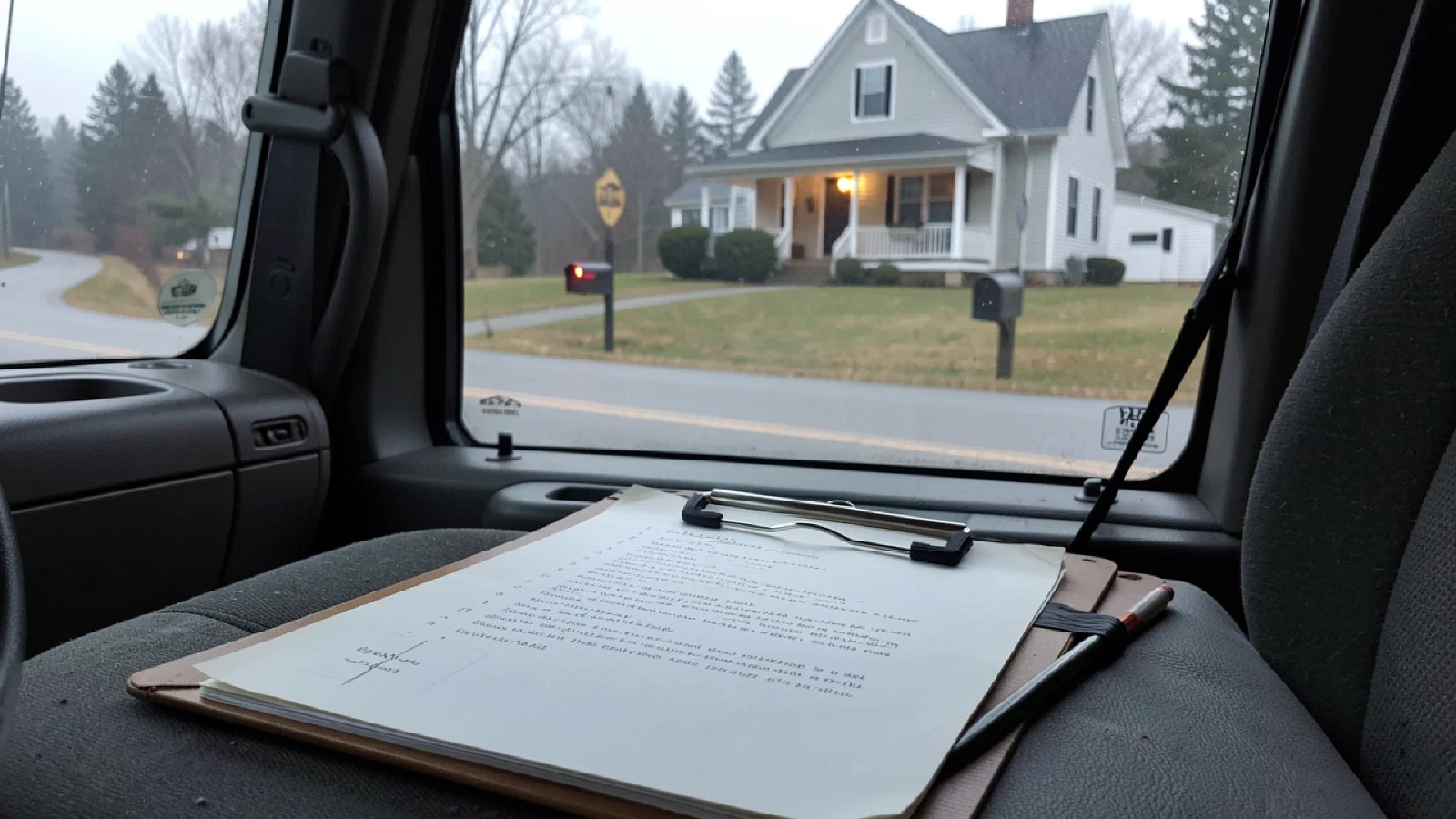
Tom Keeler’s clipboard is wedged between the driver’s seat and the center console of his package car, which is what UPS calls the brown trucks that civilians call UPS trucks. The clipboard is not required. Everything is digital now: the manifest, the route, the signature capture, the delivery confirmation. The clipboard is a legal pad in a plastic case with a metal clip, purchased at Staples in White River Junction six years ago for $4.79. Tom replaced the pad twice. The case has a crack along the left hinge that he fixed with electrical tape.
On the pad is a list, in his handwriting, of twenty-three names.
The names are not sorted alphabetically or by stop number. They are sorted by something Tom has never articulated because no one has ever asked. If pressed, he might say they are sorted by worry. The names at the top are the ones he thinks about between stops. The names at the bottom are the ones he checks on but does not worry about. The distinction is intuitive and precise and not something the system that plans his route knows about or has a field for.
Next to each name is a column of tick marks. The ticks record days since he last saw the person answer the door. Not the days since delivery. Deliveries happen whether people answer or not. The ticks record presence. Whether someone came to the door, looked out a window, waved from the yard, showed any sign that the house contained a living person who was aware that a truck had arrived.
Tom does not know what number triggers concern. He knows it when he feels it.
The Route#
His route covers forty-one miles of secondary roads in eastern Vermont, between the Connecticut River and the spine of the Green Mountains. Fifty-seven stops on a full day. Fewer in the slow months. More during the holidays, when the volume doubles and the temporary drivers who do not know the route run it like a math problem, optimizing for speed, and miss everything Tom sees.
The route optimization algorithm is displayed on his DIAD, the handheld device that tells him where to go and in what order. The algorithm is good at what it does. It calculates distance, traffic patterns, delivery windows, and time-per-stop averages to produce a sequence that minimizes miles driven and maximizes packages delivered per hour.
Tom’s actual route diverges from the algorithm’s suggested route at approximately eleven points on any given day.
The divergences are not random. They are the accumulated knowledge of fourteen years on the same roads, the same driveways, the same mailboxes, the same dogs. The algorithm does not know that the Fullers’ driveway is impassable after heavy rain and requires an approach from the Stony Brook Road side. It does not know that Mrs. Alden needs to be visited before ten or she worries. It does not know that the Beaudoin house has been empty since January but still receives packages from an auto-refill subscription that nobody cancelled because the person who set it up is in a memory care facility in Burlington and the family has not yet sorted through the digital life that continues to operate in her absence.
Tom knows all of this. He carries it the way he carries the clipboard: without being asked, without being compensated, without any formal recognition that the knowledge exists or matters.
Stop Eleven#
Mrs. Alden lives in a white farmhouse on Pomfret Road with green shutters that need painting and a porch that sags slightly on the south end. She is eighty-one. Her husband, Gerald, died four years ago. Her daughter, Cheryl, lives in Burlington, an hour and forty minutes away, and calls every Sunday at two o’clock. Her son, Mark, lives in San Diego and visits at Christmas.
Mrs. Alden orders things from Amazon.
She orders cleaning supplies she does not need. She orders vitamins she already has. She orders books she will not read and kitchen gadgets she will not use and seasonal decorations she will put on the porch for two weeks and then store in the basement with the others. Her ordering pattern is consistent: two to three packages per week, with occasional spikes around holidays when she orders gifts for grandchildren she sees twice a year.
Tom knows why she orders. Mrs. Alden knows he knows. Neither of them has said it. The transaction has a surface and a subtext, and the subtext is the entire point.
The package is the excuse. The three minutes on the porch is the reason.
Tom pulls into her driveway at 9:47. He always comes before ten. The algorithm would place her at stop thirty-four, geographically efficient in the afternoon loop. Tom overrides this every day. He has been overriding it for six years, since Gerald died and Mrs. Alden’s ordering frequency tripled and Tom understood what was happening without anyone explaining it.
She is at the door before he reaches the porch. She has been waiting. Not anxiously, she would never admit to anxiety, but with the focused attention of a woman whose day has a limited number of events worth attending to and this is one of them.
“Morning, Mrs. Alden.”
“Tom. I wasn’t sure you’d come today, with the rain.”
“Rain doesn’t stop UPS.”
“It stopped Gerald.”
Tom laughs. He heard this joke when Gerald was alive. Gerald hated rain the way some men hate certain sports teams: personally, irrationally, with a commitment that exceeded any reasonable explanation. Gerald would stand at the window on rainy mornings and narrate his grievances to anyone in earshot. The rain was malicious. The rain was specifically targeting his plans. The rain was in league with the weather service, which Gerald considered unreliable on principle.
“Package today,” Tom says, holding up a box that weighs almost nothing. He knows without scanning it that it is probably paper towels or dish soap or one of the other household items that arrive with the regularity of a subscription Mrs. Alden does not remember setting up, or does remember and has not cancelled for reasons she would not articulate.
“Oh good. I was hoping that would come.”
She was not hoping the package would come. She was hoping Tom would come. The package is the mechanism that produces Tom. Without the package, there is no reason for a brown truck to pull into her driveway, and without the brown truck, Tuesday is a day with no events between the morning coffee and the evening news.
They talk for three minutes. Sometimes four. Never more than five, because Tom has forty-six stops remaining and the system tracks his time-per-stop and a sustained average above the threshold generates a conversation with his supervisor that Tom would prefer to avoid.
Today Mrs. Alden tells him about the fox she saw in the yard on Sunday. She describes it with the detail of someone who has had four days to refine the description: red, smaller than she expected, unafraid, standing near the compost bin with an expression she describes as “businesslike.” Tom listens. He asks whether she called Fish and Wildlife. She says she did not because the fox was not doing anything wrong, it was just standing there, and she does not believe in reporting creatures for the crime of existing.
Tom agrees with this position. He picks up the empty Amazon box she has left on the porch from the previous delivery, which she leaves there specifically so he will take it, which gives him a reason to walk to the recycling bin at the side of the house, which gives her an additional ninety seconds of human presence on her property.
He has never calculated this. She has never calculated this. The choreography is unconscious and precise.
“You take care, Mrs. Alden.”
“You too, Tom. Drive safe in the rain.”
He pulls out of the driveway. In the rearview mirror, she is still on the porch, watching the truck until it rounds the bend. She does this every time. He knows because he checks the mirror every time.
The System#
Tom’s supervisor, Kevin, is a good manager in the specific sense that he does not interfere with what works. Kevin knows Tom’s route diverges from the algorithm. Kevin also knows Tom’s customer satisfaction scores are the highest in the district and his damage-and-loss rate is the lowest and his re-delivery rate is negligible because Tom knows when people are home and adjusts accordingly. Kevin has made a pragmatic calculation: the algorithm would save seven minutes per day. Tom’s judgment saves the company more than seven minutes of value in avoided complaints, avoided re-deliveries, and the intangible goodwill of a driver who treats the route like a neighborhood rather than a math problem.
This calculation is not in Kevin’s official reasoning. Officially, drivers are expected to follow the optimized route. Kevin’s tolerance of Tom’s divergences is itself an act of quiet professional judgment, the kind of accommodation that experienced managers make and that systems designed to eliminate managerial discretion would flag as noncompliance.
The new system is called ORION. It has been in place for years, but each update makes it more prescriptive. The latest version does not merely suggest a route. It monitors adherence. It flags divergences above a threshold. It generates reports.
Kevin has been shielding Tom from the reports. This requires Kevin to perform a small administrative fiction each week: reviewing the divergence flags, determining that they fall within acceptable operational parameters, and closing the tickets. Kevin does this without telling Tom, because telling Tom would require Tom to either comply with the algorithm or knowingly violate it, and Kevin prefers the arrangement where Tom’s professional judgment operates in the space between the system’s expectations and a supervisor’s willingness to not look too hard.
The system that allows Tom to be Tom requires Kevin to be Kevin. If Kevin is replaced by a manager who follows the system as designed, Tom’s route becomes the algorithm’s route, and Mrs. Alden’s package arrives at 2:15 instead of 9:47.
Stop Thirty-Seven#
The Renaud house has a smart locker.
Tom noticed it three weeks ago when the family moved in from Boston. A metal box, mounted to the wall beside the front door, with a digital lock and a UPS-compatible interface. Tom scans the package, the locker opens, he places the package inside, the locker closes. Elapsed time: fourteen seconds.
No porch. No knock. No interaction. No three minutes. The smart locker is the logical endpoint of a delivery system optimized for the package rather than the person. The package arrives. The package is secure. The package is accessible when the recipient chooses to retrieve it. Every metric the system cares about is satisfied.
Tom sits in the truck for a moment after the locker closes. He looks at the house. It is a nice house. The Renauds renovated it over the winter, new siding, new windows, a mudroom addition that probably cost more than Mrs. Alden’s entire house is worth. They have two children, a golden retriever he has seen in the yard, and a Volvo and a Subaru in the driveway. They seem like fine people. He has never met them.
He has delivered to this address nine times. He has seen a person at this address zero times. The locker handles everything. The Renauds may not know his name, may not know he exists, may not know that a human being is involved in the process at all. The package appears in the locker the way electricity appears in the outlet: from somewhere, through something, by means that do not require acquaintance.
This is what efficiency looks like. Tom understands this. He is not a Luddite. He does not object to smart lockers the way Gerald objected to rain. He does not think the Renauds are wrong to use one. They are busy. They have children. They do not need to stand on the porch making conversation with a driver in order to receive their packages.
And yet.
He looks at the locker, which is a very good locker, polished steel, weather-sealed, UPS and FedEx and USPS compatible. He tries to understand why it bothers him.
It bothers him because it is a door that does not require a person on either side.
He pulls away. The next stop has a porch, a screen door with a tear in it, and a woman named Diane who will ask about his kids.
The Column#
Tom added the unmarked column to his clipboard three years ago, after Ed Wharton.
Ed Wharton lived alone on a dirt road off Route 12, in a house that was slowly returning to the landscape. Ed was seventy-eight, a retired machinist, a widower, a man who spoke in complete sentences approximately four times per year and spent the rest of the time in a silence that was not unfriendly but was absolute. Tom would deliver packages, usually parts for the old Oliver tractor Ed maintained with the devotion other men gave to religion, and Ed would nod from the barn or raise a hand from the garden. That was the interaction. A nod or a hand. Fourteen years of nods and hands.
Tom noticed when the nods stopped. Three deliveries, no Ed. The packages accumulated on the step. The Oliver sat in the yard with the hood up, which was normal, but the tools were not out, which was not. Tom called the non-emergency line for the Windsor County Sheriff. The deputy found Ed in the kitchen. He had fallen four days earlier. He was alive. Dehydrated, with a broken hip, but alive.
The deputy told Tom he probably saved Ed’s life. Tom did not feel like he had saved anyone’s life. He felt like he had noticed something, slowly, that the system he worked for had no mechanism to notice at all. The system knew that packages had been delivered. The system did not know that no one had picked them up. The system tracked the package from warehouse to doorstep. The package’s journey ended at the doorstep. What happened to the person who was supposed to be on the other side of the door was outside the system’s scope.
After Ed, Tom started the column. No label, no header, just tick marks. Each tick is a day he delivered to a name on the list without visual confirmation that the person was present and functional. When the ticks accumulate past a number Tom does not consciously know but his body recognizes, he acts. He knocks longer. He walks around the house. He calls the number on the account if there is one. He has called the sheriff’s non-emergency line three times in three years. Twice the person was fine, just away. Once, Mrs. Thibodeau had fallen in the bathroom. She was eighty-nine. She did not survive the hospitalization.
Tom does not talk about the column. It is not a program. It is not a policy. It is not something UPS trained him to do or would endorse if they knew about it. It is a man with a clipboard keeping track of whether the people on his route are alive, because no other system is keeping track, and someone should.
Afternoon#
The rain stops by two. The roads steam. The hills to the west, which have been invisible behind cloud all morning, reappear in the specific green of Vermont in late spring, the green that is not one color but several hundred, each tree its own shade, the maples different from the birches different from the hemlocks, a fact that Tom registers without thinking because he has driven past these hills four thousand times and the registration is autonomic.
He delivers to the Morrison farm, where the dogs greet his truck the way they greet all trucks, with the conviction that this particular truck is the most important truck that has ever existed. He delivers to the Wheelers, who are not home, and leaves the package behind the storm door where rain cannot reach it, a placement the algorithm does not specify but experience recommends. He delivers to the Adamses, where Joe Adams is splitting wood in the yard and waves Tom over to show him the black walnut he milled from the tree that came down in the ice storm last winter. Tom looks at the walnut. It is beautiful. He says so. Joe says he is thinking of making a table. Tom says he should. This conversation takes ninety seconds and will cost Tom half a percentage point on his time-per-stop average and he does not care.
Forty-one stops completed by 4:30. He pulls into the lot behind the UPS facility in White River Junction, parks the truck, scans the empty shelves to confirm all packages delivered, and sits for a moment before going inside.
He picks up the clipboard. He reviews the list. Twenty-three names. He adds a tick next to the ones he did not see today. He erases the ticks for the ones he did see. He looks at the numbers. Nobody is in the worry range. Today was a good day.
He thinks about Mrs. Alden on the porch, watching his truck until it rounded the bend. He thinks about the smart locker at the Renaud house, the polished steel, the fourteen-second delivery, the absence of a face on either side. He thinks about Ed Wharton’s kitchen and the Oliver tractor with its hood up and the tools that should have been out and were not.
I wonder whether anyone will drive this route after Tom. Whether the route will still exist in ten years or whether the packages will arrive by drone, dropped from the air onto porches and into lockers without a truck or a driver or a clipboard. Whether Mrs. Alden will still be ordering things she does not need from a system that does not know why she is ordering them. Whether someone will notice when the ticks accumulate and nobody answers the door.
Tom puts the clipboard back between the seat and the console. He locks the truck. He goes inside to file his paperwork, which is not paper anymore and has not been for years but which he still calls paperwork because some words outlast the things they describe.
The clipboard stays in the truck. Twenty-three names, sorted by worry, in a handwriting that no system reads.
How this essay connects to others across The Approximate Mind.