The Counselor
A school counselor in Helena, Montana discovers she has been preparing for a conversation nobody else in the building is ready to have.
Anna Corbin keeps two lists.
The first is the one Capital High expects: a spreadsheet of 437 juniors and seniors, their GPAs, their test scores, their extracurriculars, their intended majors, their parents’ phone numbers. This list drives the machine of college counseling the way it has for decades. The student sits down. Anna opens the file. They talk about reach schools and safety schools and application deadlines.
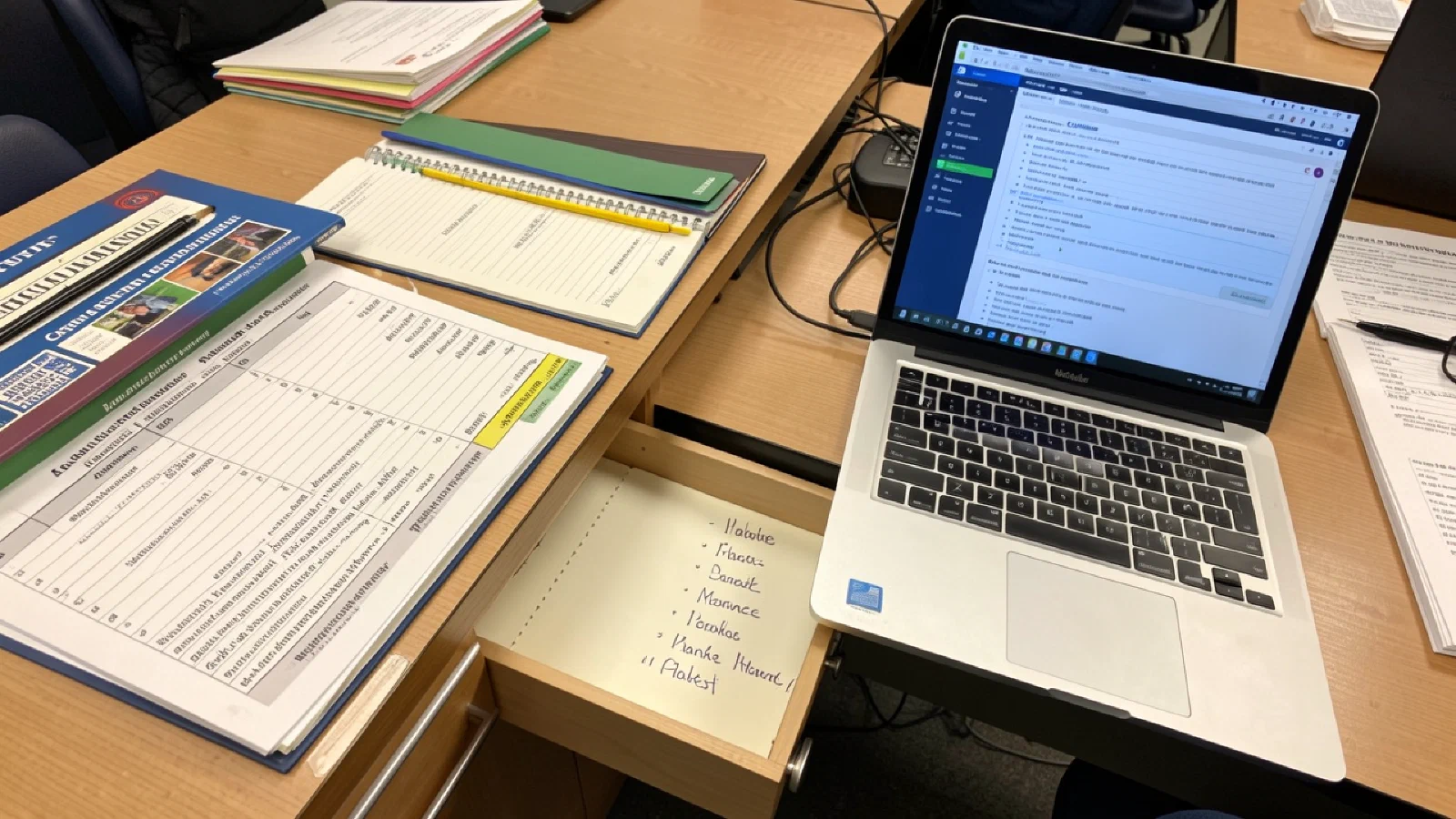
The second list is in a notebook she keeps in her desk drawer, and it contains eleven names. These are the students she thinks about at night. Not the ones in crisis, though some are. The ones who are asking questions the spreadsheet cannot hold. Questions like: what is any of this for? Like: why am I learning things a machine already knows? Like: my mom wants me to be a nurse but the AI does half of what nurses used to do, so what am I actually being asked to become?
Anna does not have clean answers to these questions. She has ten years of preparation that nobody asked her to do, and she has an AI system running on her laptop that she trained herself, slowly, in the evenings, the way a person learns a language by living in it rather than studying it in a classroom.
How She Got Here#
The kitchen table. March 2026. Jack asleep under his dinosaur comforter. The search for “AI for kids” that opened a door she has not closed since.
Anna did not adopt AI the way the school district eventually mandated it, which involved a two-day professional development workshop in 2028 that taught counselors to use a prescribed platform for student scheduling and college matching. She adopted it the way a person with a professional instinct adopts a tool that speaks to that instinct: by using it every day, for real problems, with her own judgment as the filter.
She started with the obvious. Research. When a student came in with a question Anna did not know the answer to, she used to spend twenty minutes after the meeting searching databases and calling colleagues. Now she asks her system, gets a structured answer in ninety seconds, and spends the remaining eighteen minutes thinking about what the answer means for this particular student. The time savings alone would have justified the effort. But the time savings were the least important thing.
What changed Anna was the conversations she started having with the system about her own practice.
She would describe a student’s situation. Not the file, the situation. The family dynamics, the unspoken pressures, the thing the student was not saying in the meeting. She would ask the system to help her see patterns she might be missing. The system could not feel what Anna felt sitting across from a seventeen-year-old who was performing confidence while falling apart inside. But it could cross-reference what Anna described with research on adolescent development, family systems theory, the sociology of aspiration, and the specific labor market data for the career the student was being pushed toward. It could surface a question Anna had not thought to ask.
She was not outsourcing her judgment. She was exercising it against a more informed surface.
Over the next several years, Anna built a methodology she has never presented at a conference or written up for a journal, but which is more rigorous than most of what she reads in the professional literature. It has four components, and she uses the technical language for them because imprecise language produces imprecise thinking, something she tells her students roughly once a week.
The first is psychosocial profiling. Not the reductive kind that fits a student into a category. The clinical kind that maps the full ecology of a student’s life: family dynamics, economic pressures, cultural expectations, peer environment, unspoken losses, developmental history. Anna has always done this intuitively. What her AI system gives her is the ability to cross-reference her intuitions against the research literature in real time. She reads a student. Then she asks the system what the developmental psychology says about a student in this configuration. The confirmation or disconfirmation sharpens what she does next.
The second is cognitive load analysis. Anna started reading the cognitive load research in 2029, when she noticed that her students’ relationship to learning was changing in ways the faculty could feel but not name. The students were not struggling with access to information. They were drowning in it. The procedural layer of education, memorization, retrieval, execution - was being handled by AI, which should have freed cognitive capacity for higher-order thinking. In some students it did. In others, the freed capacity went nowhere. It dissipated. The students had more bandwidth and nothing to route it toward, because nobody had told them that the freed bandwidth was the point.
Cognitive load theory gave Anna the vocabulary: when you remove extraneous load, the intrinsic load of the material does not automatically receive the surplus. Someone has to redirect the student’s attention from the procedural surface to the structural depth. That redirection is what teaching is now. It is also what counseling is now, because a student who chooses a career path based on procedural skill, the kind AI already handles, is investing in the wrong layer.
The third is affinity matching. This is the one that gets Anna in trouble with parents. Traditional college counseling matches students to institutions: GPA to admission range, test score to selectivity tier, intended major to program ranking. Anna still does this because the institution requires it. But what she actually does, the work in the notebook, is match students to orientations. Not what do you want to study, but how do you naturally think? What kind of problems keep you awake? Where does your attention go when nobody is directing it? When you argue with a friend, do you argue about the facts or about the framework the facts sit in?
A student whose attention naturally goes to structural patterns across domains has a different orientation than a student whose attention goes to the details within a single domain. Both orientations are valuable. They lead to different kinds of work, different kinds of graduate programs, different kinds of lives. The college matching spreadsheet cannot see this distinction. Anna can, because she has been sitting across from seventeen-year-olds for twenty-five years and she knows what it looks like when a student’s orientation and their stated plan are pointing in different directions.
The fourth is epistemic learning. Anna learned this phrase three years ago and it reorganized everything she had been doing. Epistemic learning is not learning facts or procedures. It is learning how knowledge itself works. How to evaluate a framework rather than operate within it. How to assess what counts as evidence and for whom. How to recognize when a system of knowledge is failing not at the level of individual findings but at the level of its foundational assumptions. It includes abstraction, reasoning under uncertainty, and retroduction, which is reasoning backward from observed effects to the best explanation. But it is larger than any of these. It is the capacity to think about thinking, to know about knowing, to stand outside a framework and see its shape.
This is what Anna believes every student needs and almost none of them are being taught. Not because the schools are failing. Because the schools are optimizing for a world that has already changed underneath them, and the optimization is so smooth that the mismatch is invisible from inside.
By 2034, Anna was using AI the way a radiologist uses imaging: not as a replacement for clinical knowledge but as an extension of perceptual range. She could see further into each student’s situation, hold more context, track more variables. The students sitting across from her experienced this as Anna being extraordinarily well-prepared, which she was, but the preparation had a silent partner.
Her colleagues noticed. Some asked her what she was doing. Most did not. The professional development workshops continued to teach the prescribed platform, which handled scheduling and college matching and generated reports that administrators liked. Anna used the prescribed platform for what it was good at, which was administration. She used her own system for what mattered, which was understanding students.
The 10:00 Appointment#
Tuesday morning. Caleb Torres sits in the chair across from Anna’s desk. He is seventeen, a junior, third in his class, varsity cross-country, National Honor Society. His file is excellent. His mother, who is not present but whose influence fills the room like a scent, wants him to study pre-med.
“So,” Anna says. “Tell me what you’re thinking.”
“I want to go pre-med. Probably University of Washington. My mom went there.”
Anna has heard this sentence, with variations in the school name and the parent, roughly four hundred times. She has learned to listen not to what it says but to how it sounds. Caleb delivers it the way a student delivers a rehearsed answer: smoothly, without pause, with the faint flatness of someone repeating something they have been told rather than something they have discovered.
“What draws you to medicine?”
“I want to help people.” The second rehearsed answer. Anna waits. Caleb fills the silence. “And the pay is good. And it’s stable.”
“What kind of helping?”
Caleb looks at her. Most counselors would have nodded at “I want to help people” and moved to discussing prerequisites. Anna does not nod at rehearsed answers. She asks the next question, which is the question the rehearsal was designed to prevent.
“I don’t know. Like, diagnosing things? Figuring out what’s wrong?”
“What do you know about what diagnostic medicine looks like now?”
Caleb knows what his mother has told him, which is what diagnostic medicine looked like when his mother was in school. Anna knows what it looks like now, because she asked her system to build her a briefing on the current state of AI in clinical diagnosis six months ago, and she has updated it twice since.
“The imaging is mostly automated,” Anna says. She says this gently. She is not trying to discourage him. She is trying to redirect the conversation from the rehearsed path to the real one. “Radiology, pathology, dermatology screening. The diagnostic pattern recognition that used to take a decade of training, AI does most of it now. The doctors who are thriving are the ones doing something AI can’t do.”
“Like what?”
“Like sitting with a patient whose scan came back ambiguous and helping them understand what the uncertainty means. Like integrating a diagnosis with everything else they know about the patient’s life. Like making judgment calls when the data points in two directions. The thinking part. Not the pattern-matching part.”
Caleb is quiet. He is recalibrating. Anna can see it happen the way she has seen it happen hundreds of times: the moment when the scripted future meets a piece of information the script did not account for.
“So what should I study?”
This is the question Anna has spent ten years preparing to answer differently than any counselor she knows.
The Different Answer#
“I’m going to say something that might sound strange,” Anna says. “Don’t worry about the major yet. Worry about how you think.”
She is doing affinity matching. She has been doing it since Caleb sat down, reading his orientation the way Dale reads a field: not from data points but from accumulated attention. The rehearsed answers told her something. The pause before “figuring out what’s wrong” told her more. Caleb’s orientation is toward diagnosis in the real sense: looking at a complex situation and identifying what is actually happening beneath the surface. This is not the same as pattern matching from a textbook. It is closer to retroduction, reasoning backward from what you observe to the best explanation for it.
“You said you like figuring out what’s wrong. That’s a specific kind of thinking. It’s called retroductive reasoning. You look at symptoms, which are effects, and you reason backward to the cause. Not by matching a pattern you memorized, because AI does that faster than any human. By holding the ambiguity when the patterns don’t fit and asking what must be true about the system that produced what you’re seeing.”
Caleb is listening differently now. The rehearsed posture has loosened.
“That kind of thinking is trainable, but most programs don’t train it directly. They teach you content and hope the thinking develops on its own. Some students it does. Some it doesn’t. What matters is whether you go somewhere that teaches you epistemic learning, how knowledge itself works. How to evaluate a framework, not just operate inside one. How to recognize when the standard model is failing and why.”
“That sounds like philosophy.”
“Philosophy is one way. Anthropology is another. Mathematics, the pure kind, is another. Medicine builds it too, if the program is rigorous and the clinical training starts early enough. What matters less than the department name is whether the program forces you to think about your own thinking. Whether it puts you in situations where the answer isn’t in the textbook and you have to reason your way to it.”
She pauses. She can see him processing. The cognitive load is high right now. She is introducing concepts he has no scaffolding for, and she needs to give him a concrete image before she loses him.
“Think about it this way. Your mom went to medical school and learned to do things. Diagnose, treat, prescribe, follow protocols. Machines do most of that now. What a machine cannot do is sit across from a patient whose scan came back ambiguous and whose mother just died and whose insurance is running out, and make a judgment about what to do next that integrates the medical uncertainty with the human situation. That judgment requires retroduction, reasoning under uncertainty, and the kind of abstract pattern recognition that sees structural similarity across completely different domains. That’s what I mean by epistemic learning. Learning how to know, not just what to know.”
Caleb stares at her.
“What’s retroduction, exactly? Like, if I had to explain it to my mom?”
Anna smiles. She has been waiting for a student to ask this in a way that signals genuine curiosity rather than confusion.
“It’s reasoning backward from an effect to the best explanation. Deduction goes from rules to conclusions. Induction goes from cases to generalizations. Retroduction asks: given what I see, what must be true about the world that produced it? It’s the reasoning a doctor uses when the symptoms don’t fit any textbook pattern. A machine can match patterns. Retroduction is what you use when the patterns are insufficient.”
The Parent Call#
Caleb’s mother calls at 3:15. Anna expected this. She would have called too.
“Mrs. Corbin, I’m confused about the advice you gave Caleb today. He came home saying you told him not to study medicine.”
“I didn’t tell him not to study medicine. I told him to think about why he wants to study medicine, and to make sure the reason matches what medicine actually is now rather than what it was twenty years ago.”
“Medicine is medicine.”
“It’s changed more in the last ten years than in the previous fifty. The diagnostic work, the pattern recognition, the procedural knowledge, a lot of that is automated now. What’s left is judgment, communication, the ability to make decisions under uncertainty. If Caleb wants to do that work, he’ll be a wonderful doctor. But he needs to be prepared for that work, not for the work that existed when you and I were in school.”
Silence on the line. Anna waits. She is good at waiting. Twenty-five years of sitting across from people who are processing information that contradicts their expectations has made waiting one of her primary professional skills.
“What did you tell him to study?”
“I told him to focus on how he thinks, not just what he studies. Epistemic learning. The ability to evaluate how knowledge works, not just accumulate it. He can build that in a lot of programs, including pre-med, if the program is rigorous about clinical reasoning.”
“He said something about retroduction.”
“Retroduction. It’s reasoning backward from what you observe to the best explanation for it. It’s what a good doctor does when the test results don’t match the symptoms. It’s what a good counselor does when a student’s behavior doesn’t match their file. It’s the kind of thinking that machines can’t do, because machines work from existing patterns and retroduction is what you use when the existing patterns aren’t enough.”
Another silence. Longer this time.
“Nobody told me any of this.”
“Nobody told most of us. That’s the problem.”
The Notebook#
After the call, Anna opens her desk drawer and looks at her notebook. Eleven names. She adds a twelfth: Caleb Torres. Not because he is in crisis. Because he is at a threshold, and the people around him, his mother, his teachers, the institutional machinery of college admissions, are all preparing him for a world that no longer exists in the form they imagine.
Anna picks up her laptop and opens a conversation with her system. She has been building something over the past six months: a document she thinks of as “the real college guide.” Not the one the school district publishes, which lists acceptance rates and median starting salaries and application deadlines. The one that describes what the world actually needs from the people entering it. The capacities. The orientations. The kinds of thinking that will matter when the procedural knowledge has been absorbed and what remains is the human judgment that cannot be automated.
She has not shown this document to anyone. Not because she is secretive. Because she is not yet sure how to introduce it into an institution that still measures success by college acceptance rates and starting salaries. She knows the document is right. She also knows that being right is not sufficient. The document needs a way into the conversation, and the conversation is still organized around the spreadsheet, the file, the rehearsed path.
Her system helps her think about this too. She asked it last week: how do you introduce a framework shift into an institution that is not ready for it? The system’s answer was thorough, drawing on organizational change research, institutional theory, the history of educational reform. The answer was also, Anna noticed, somewhat optimistic. The system does not understand institutional inertia the way someone who has sat in faculty meetings for twenty-five years understands it. It sees the logic of the change and underestimates the weight of what resists it.
This is the pattern Anna has learned to recognize: her system is brilliant at structure and weak at friction. It can map the argument perfectly and miss the human thickness that the argument has to pass through. She supplies the thickness. It supplies the map. Between them, they are more capable than either alone.
She recognizes this sentence. Dale said something similar about the soil and the sensors. The system could not have found it without him. He could not have acted on it at the precision the system allows.
The difference is that Dale said it with reluctance. Anna says it with the calm of someone who made her peace with this partnership years ago, at a kitchen table, while her children slept.
4:30#
The building empties. Anna stays. She always stays late on Tuesdays, not because the work requires it but because the quiet after the building empties is when she does her real thinking.
She opens her notebook and reviews the twelve names. For each one, she has been building what she calls an affinity profile: not what the student knows or what the student’s parents want, but where the student’s cognitive orientation naturally points. How they reason when nobody is grading them. What kind of problems attract their attention without external reward. Whether their instinct under ambiguity is to narrow toward certainty or to hold the uncertainty open and explore it. Whether they argue about facts or about frameworks.
Her system helps her build these profiles. She describes the student across multiple sessions, layering observations the way a clinician layers intake data. The system cross-references her observations with the developmental and cognitive research, flags patterns Anna might not have seen, surfaces questions she might ask in the next meeting. It also runs cognitive load analysis on the student’s academic trajectory: where the student is spending cognitive bandwidth on procedural tasks AI should be handling, where the freed capacity is going, and where it is dissipating because nobody redirected it.
She does not type any of this into the school’s official system. The official system tracks grades, test scores, disciplinary incidents, college applications. It does not have a field for “this student’s retroductive reasoning is exceptional but undeveloped because no one has ever asked her to use it.” It does not have a field for “this student shows strong epistemic orientation, the ability to step outside a framework and evaluate its assumptions, but has never been in a class that rewarded this and has therefore learned to suppress it.” It does not have a field for “this student’s mother wants him to be a doctor but his actual affinity is toward the kind of abstract structural reasoning that would make him a better systems theorist or, yes, a certain kind of doctor, if anyone showed him the path.”
The official system measures what the institution values. Anna measures what the student needs. The gap between these two measurements is the space in which her actual work occurs.
Jack texts her at 4:45. Hank left his cleats at school again. Dad says he’s not driving back for them.
Anna texts back: Tell Hank his cleats are his responsibility.
She looks at the text and thinks about what she just did. A small act of retroduction. She did not respond to the surface request, which was about cleats. She responded to the underlying structure: Hank is twelve and still expecting other people to manage his logistics, and the correct intervention is not to solve the logistics problem but to let the natural consequence teach the lesson. She made this judgment instantly, without deliberation, because she has twenty-five years of experience with adolescent development and twelve years of experience with Hank specifically.
No AI system could have made that judgment for her. Not because the reasoning is complex. Because the reasoning requires knowing Hank.
This is what she is trying to teach her students. Not facts. Not procedures. The ability to read a situation, see the structure beneath the surface, and respond to the structure rather than the surface. The ability to know what questions to ask when the obvious question is not the right one. The ability to reason backward from what you observe to what must be true, and to act on that reasoning even when it contradicts the script.
I wonder whether Anna’s twelve names will become fifty, or a hundred, or whether the institution will absorb her framework the way institutions absorb the people who see too far ahead: by praising the insight and declining to act on it.
She closes the notebook. She shuts the laptop. She drives home through Helena, past the schools and the strip malls and the neighborhoods where her students live, past the edge of town where the land opens up toward the Elkhorns and Dale is in the barn doing his evening check.
The sun is low. The mountains are still holding snow at the peaks. Somewhere in a shed behind the machine shop, eight solar panels are powering down for the night, and the servers they feed are running on stored charge, processing whatever Jack asked them before dinner.
Anna pulls into the driveway. The house is lit. Through the kitchen window she can see Hank at the table, probably doing homework, probably barefoot because his cleats are at school. Dale’s truck is back from the fields. The dog is on the porch.
She sits in the car for a moment before going in. This is her version of Dale’s morning inventory: the pause between the professional self and the domestic self, the brief space in which neither role has claimed her and she is just a woman in a car, thinking about twelve students and their affinity profiles, about epistemic learning and who teaches it and who doesn’t, about the distance between what she knows and what the institution she works in is ready to hear.
Then she goes inside. Hank needs dinner. Jack is in the shed. Dale is cleaning something in the barn. The ordinary Tuesday continues, carrying its freight of small decisions and unfinished arguments, the way every day does in a family where the future arrived at different speeds for each person and nobody has quite agreed yet on what it means.
How this essay connects to others across The Approximate Mind.