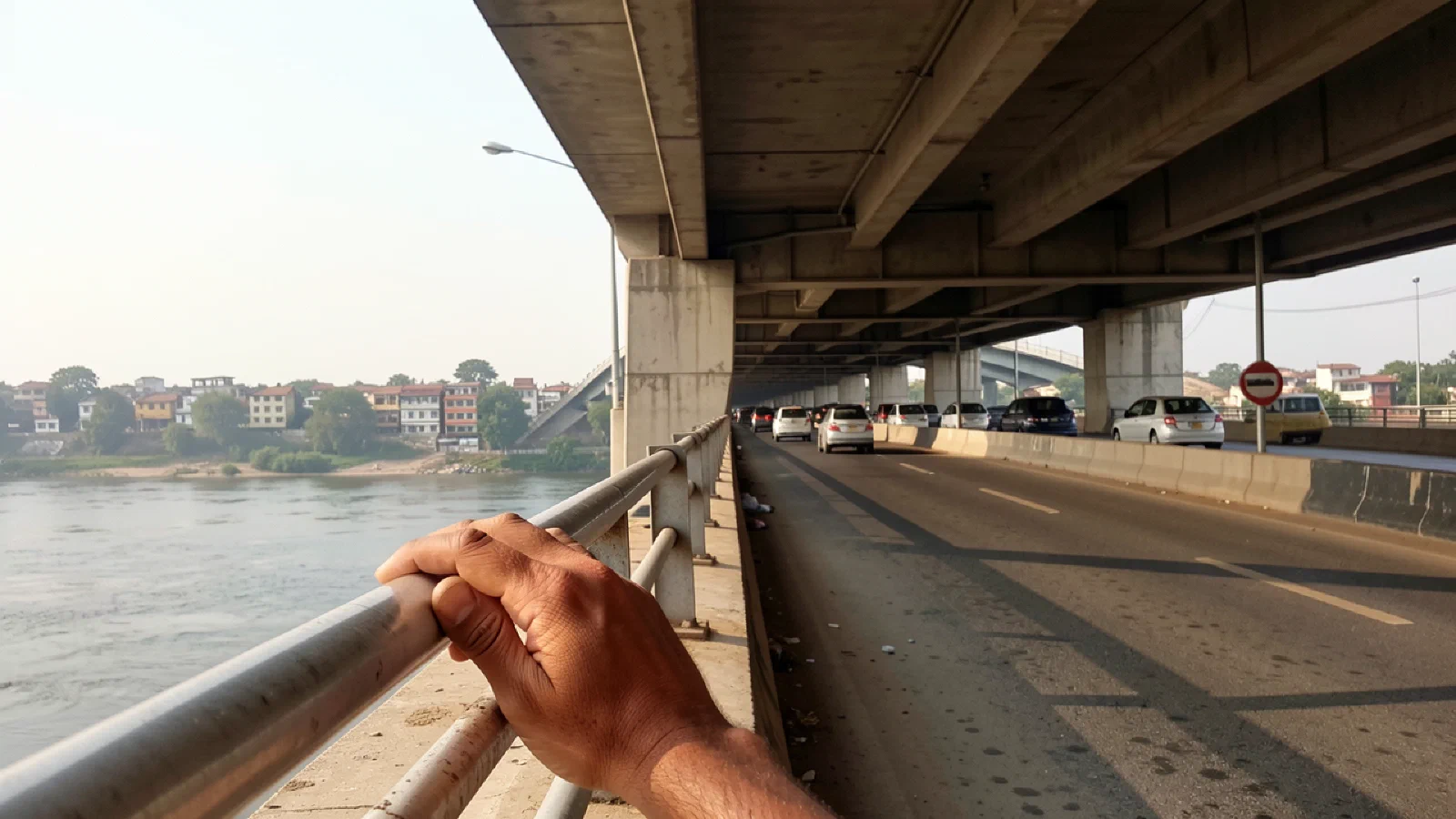
The Bridges
A retired civil engineer in Pune walks past structures he built and discovers that the knowledge he carries has no container until a room full of strangers gives it one.
Vikram Deshpande’s hands have a callus on the left palm, between the thumb and the forefinger, from holding a surveyor’s rod. He has not held a surveyor’s rod in thirty years. GPS replaced the rod, then total stations replaced GPS for precision work, then LiDAR replaced the total stations. Each replacement was correct. Each one was better at the task. The callus remains. The body keeps what the profession discards.
He is seventy-one. He retired from the Maharashtra Public Works Department four years ago after a career that spanned forty-three years, three state governments, and more bridges than he can count, though if pressed he will say the number is either fifty-one or fifty-three, depending on whether you count the two that were redesigned after initial construction and whether redesign constitutes a separate bridge or the same bridge in a different argument with the ground.
He lives in a flat in Kothrud with his wife, Meera, who retired from teaching chemistry at Fergusson College two years before he did. Their son, Arun, is a software architect in Bangalore. Their daughter, Priya, is a structural engineer in Mumbai, which Vikram considers a form of inheritance he did not plan and is quietly proud of, though he has told Priya that structural engineering in Mumbai is a different profession from structural engineering in rural Maharashtra and she should not assume his experience transfers. It transfers. He knows this. He wants her to discover it rather than receive it.
The Walk#
His morning walk takes twenty minutes from the flat to the community technology center on Paud Road. The walk passes three of his bridges.
The first is a pedestrian crossing over a nullah near the Kothrud bus stand. It is small. Vikram designed it in 1997 as part of a municipal infrastructure package that included drainage improvements and road widening. Nobody remembers the bridge was part of a package. Nobody remembers the bridge was designed at all. It is simply there, like a curb, like a wall. People cross it without looking down. This is the highest compliment a bridge can receive.
The second is a road bridge on the Chandani Chowk connector, wider, heavier, carrying a traffic load that exceeds what Vikram’s original calculations anticipated because the neighborhood grew faster than anyone projected and the traffic models from 2004 were, in Vikram’s professional opinion, optimistic to the point of fiction. The bridge handles the load because Vikram’s safety factors were conservative. He was trained by a generation of engineers who did not trust their own models and built margins into everything, not because they lacked confidence but because they understood that a model is a simplification and simplifications fail at the edges and the edges are where people die.
The third is not visible from the road. It is a culvert bridge on a service road behind the industrial area, carrying water and occasional vehicle traffic over a seasonal stream. Vikram thinks about this bridge more than the other two, because it was the first project where he overruled a computer model.
The model said the span could be shorter. The model was correct, given the data the model had. The data the model had did not include the behavior of the black cotton soil on the eastern abutment during the monsoon of 1987, when the ground swelled in a pattern that Vikram’s senior engineer, a man named Joshi who had worked in that district for twenty-five years, recognized as precursor to lateral displacement. Joshi had seen this soil move. He had felt it move, his boots in the mud, the specific softness that preceded the shift. The model had the soil classification. Joshi had the soil.
Vikram lengthened the span. The model was overruled by a man standing in mud. The bridge has not moved in thirty-seven years.
He passes it every morning. He does not stop. He does not need to inspect it. He knows it is there the way he knows his own pulse: by not having to check.
The Center#
The community technology center on Paud Road is a room on the second floor of a building that also houses a printing shop and an accountant’s office. It was funded by an educational trust and is run by a woman named Kavita Joshi, no relation to the engineer, who is thirty-four and has the specific energy of a person who believes that technology should be walked toward, not pushed from behind.
Kavita started the center as a computer literacy program for retirees. It evolved. The retirees learned email and WhatsApp in the first month and did not need further instruction. What they needed, Kavita discovered, was a reason to keep coming. She found the reason by accident when she set up a session pairing retired professionals with younger engineers and an AI that held the shape of the conversation.
She called it the Exchange Room. The name is wrong, Vikram thinks. An exchange implies that both sides give and receive in comparable measure. What happens in the room is more like excavation. The younger engineers come with questions they formulated in simulation. The retired professionals answer with knowledge they accumulated in mud. The AI sits between them, holding the structure of the conversation, translating the decades-old experience into terms the simulation-trained generation can enter.
Vikram found the Exchange Room four months ago, when Meera read about it in the neighborhood WhatsApp group and told him he should go. He went to make Meera happy. He went back because something happened in the room that had not happened since he retired.
Someone asked him a question he had to think about.
The Session#
Today’s session has six people. Three retired professionals: Vikram, a former water systems engineer named Anand, and a woman named Sunita who spent thirty years in geotechnical consulting. Three younger engineers: two from a construction technology startup and a twenty-two-year-old named Pooja who works for an infrastructure design firm and has never touched laterite.
The AI opens with a prompt Kavita has refined over months: “What is something you know from experience that you have never been asked to document?”
Vikram starts talking.
He describes the bridge outside Solapur.
It was 2009. A state highway crossing over a tributary of the Bhima River. Standard design, standard materials, standard everything. The computer model produced a clean result. The contractor began foundation work. Vikram visited the site on a Tuesday, which was his habit, visiting sites on days the contractor did not expect him, because unexpected visits reveal what expected visits conceal.
The eastern pier excavation showed something the model did not predict. The soil at the base of the excavation had a texture Vikram recognized from Joshi’s description of the black cotton soil in the 1987 monsoon. Not the classification. The texture. The way it held the shovel. The way water sat on the surface rather than absorbing. The way it looked, in the early afternoon light, like something that was waiting to move.
Vikram stopped the excavation. The contractor objected. The model was clean. The soil classification was within parameters. Vikram could not explain what he saw in terms the contractor could process, because what he saw was not data. It was pattern, accumulated across decades, transmitted from Joshi’s boots to Vikram’s eyes through a chain of experience that had no documentation because you do not document the thing you prevented. You document the thing that failed.
He redesigned the foundation. Deeper piers, wider footings, a bearing stratum below the problematic layer. The bridge was built. The bridge stands.
Nothing happened. That is the point. Nothing happened because Vikram saw something the model did not see and acted on what he saw. The absence of disaster is the evidence, and the evidence is invisible, because evidence of prevention is the absence of the thing prevented.
He talks for forty minutes. He did not plan to talk for forty minutes. The room held him. The AI asked follow-up questions that were not the questions a person would ask, they were more precise, more structured, but they opened passages in his memory that had been closed since retirement because no one had knocked on them.
Pooja, the twenty-two-year-old who has never touched laterite, asks a question.
“How did you know the difference between soil that would hold and soil that would move? If the classification was the same?”
Vikram pauses. He has never been asked this question, because the people who worked with him already knew the answer and the people who did not work with him never knew to ask.
“Joshi showed me,” he says. “He put my hand in the soil. He said, feel that. I felt it. He said, that is the feel before it moves. I did not understand. Three months later, it moved. After that, I understood.”
“Can that be taught?”
“It was taught. Joshi taught me. I am teaching you now. The question is whether the room holds what I am saying long enough for you to use it before you need it.”
The AI records. It structures. It holds the shape of what Vikram described in a form that can be revisited, cross-referenced, connected to other sessions where other engineers described other moments of knowledge that existed in the body before it existed in the document. The AI cannot feel the soil. It can hold the description of what the soil felt like, and it can present that description to a twenty-two-year-old who will stand on a site someday and remember that someone told her about a texture, and she might, if the room held well enough, recognize it.
The Walk Home#
Vikram walks home in the late afternoon. The light is different going west, the sun in his face, the shadows behind him. He passes the three bridges in reverse order. The culvert. The road bridge. The pedestrian crossing.
He sees them differently after the session. Not as achievements. He stopped seeing them as achievements years ago. He sees them as conversations he had with the ground, frozen in concrete. The ground proposed conditions. He responded with design. The ground accepted or resisted. He adjusted. Each bridge is the residue of a negotiation between what the engineer wanted and what the earth would bear.
The ground remembers. Vikram wonders whether anyone else will.
Not the data. The data is in files, in servers, in systems that will outlast him without effort. The soil classifications, the load calculations, the design parameters: these are documented. What is not documented is the feel of the soil before it moves. What is not documented is Joshi putting a young engineer’s hand in the mud and saying, remember this.
The Exchange Room is trying to hold what Joshi held. The AI is trying to be the room’s memory, the way Vikram was Joshi’s. The chain is imperfect. Each link loses something. The hand in the mud becomes the description of the hand in the mud becomes the recording of the description of the hand in the mud. At each remove, the knowledge thins.
But Pooja asked the question. She asked the right question. She asked it not because the AI prompted her but because something in Vikram’s description of the Solapur bridge opened a passage in her thinking that her simulation training had not opened. She does not yet know what the texture feels like. She knows that the texture exists. That is the first step. Joshi would recognize it.
Vikram reaches the flat. Meera has made tea. He sits at the kitchen table with the cup in his hands, the hands with the callus from a rod he has not held in thirty years, and he thinks about the bridge outside Solapur that stands because nothing happened, and nothing happened because a man named Joshi stood in mud in 1987 and remembered, and told a younger man to remember, and the younger man remembered, and is now telling a room full of strangers in a building on Paud Road, and the room is holding what it can.
How this essay connects to others across The Approximate Mind.