The Aging Doctor
A rural physician in Appalachian Kentucky uses a stethoscope he should have replaced ten years ago, for reasons the diagnostic system cannot process.
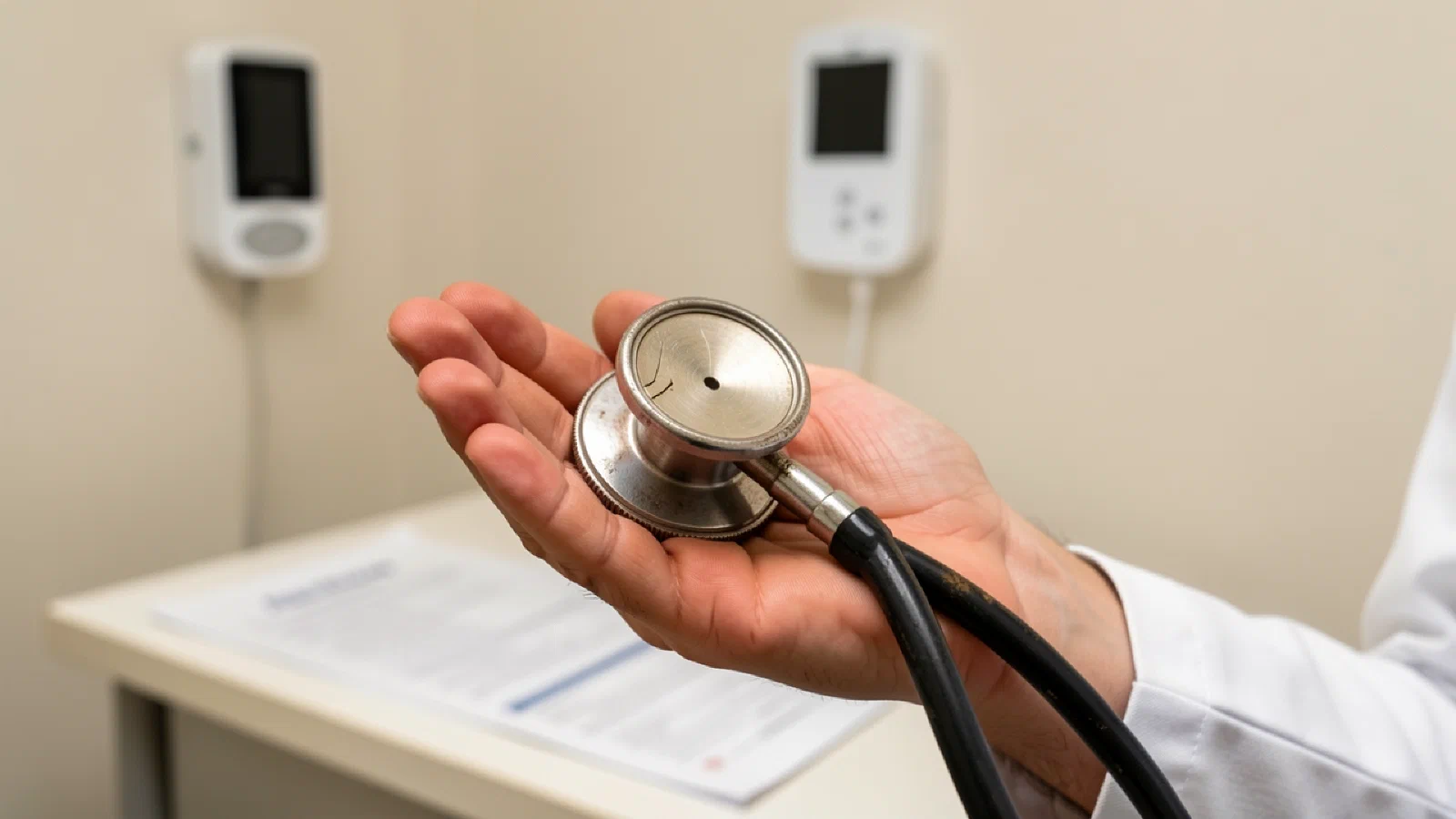
The stethoscope is a Littmann Classic III. Paul Hensley bought it in 1999, the year he moved to Harlan County, Kentucky, to practice medicine in a town that had been losing doctors for two decades and would continue losing them after he arrived. The stethoscope was not top of the line when he bought it. It is not close to top of the line now. The tubing has stiffened with age. The diaphragm has a hairline scratch that does not affect function but would make a resident flinch. The earpieces are original.
Paul has been offered better stethoscopes. The clinic’s supply budget could accommodate a replacement. The AI diagnostic system, which arrived three years ago and is, by every measurable metric, better than Paul at auscultation, does not use a stethoscope at all. It uses a digital sensor array that captures heart sounds, lung sounds, and bowel sounds with a fidelity Paul’s Littmann cannot approach, processes them against a database of 1.2 million recorded examinations, and produces a differential diagnosis before Paul has finished warming the diaphragm in his palm.
He warms it in his palm. Every time. The metal collects the cold of the hallway between exam rooms, and Paul cups the diaphragm in his left hand for the four steps between the door and the patient, so that when it touches skin, what the patient feels is not metal but warmth. A hand was here before the instrument. Someone held this before it touched you.
The AI sensor does not need warming. It is room temperature by design. This is better engineering. Paul knows this. He uses the sensor for the data. He uses the Littmann for the patient.
6:30 AM#
Coffee on the porch. The fog in the hollow is doing what it does in early morning in the Appalachian valleys: filling the low places between ridges like water in a bowl, so that the ridgeline is visible and sharp against the sky and everything below it is erased. Paul has watched this fog for thirty-four years. It arrives the same way and lifts the same way and he has never tired of it, the way you do not tire of something that is not performing for you but simply occurring.
The porch is attached to the house he bought in 1999 for $62,000, the same year he bought the stethoscope. The house needed work then. It needs work now. There is a rhythm to its disrepair that Paul finds honest: the things that break are the things that bear weight, and the weight they bear is time, and time breaks everything, and you fix what you can and live with the rest.
His wife, Carol, is inside. She teaches fourth grade at the elementary school in town. She has taught fourth grade for twenty-eight years. When people ask how they ended up in Harlan County, Carol says, “We came for two years.” Paul says nothing, because thirty-four years of staying in a place you came to for two is not something he knows how to explain in a sentence, and he has stopped trying.
Twelve patients today. A light day. Paul knows what a light day means. It does not mean the town needs less medicine. It means fewer people are coming. The ones who stopped coming are using the telehealth platform the regional health system installed last year, or they are driving to the urgent care in Middlesboro, or they are not seeing a doctor at all. The ones who still come to Paul’s clinic come because Paul is there, and the specific thing they are coming for is not the medicine. Or not only the medicine.
The Twelve#
He categorizes them in his head, the way he has categorized every patient day for thirty-four years, not by diagnosis but by what they actually need.
Three are actually ill. A woman with uncontrolled diabetes whose A1C is climbing despite two medication adjustments. A man with a cough that has lasted six weeks and has the character Paul recognizes, not from the sound specifically but from the way the man holds his chest when he coughs, the protective curl that means this hurts and I am afraid of why. A teenager with mono, uncomplicated, except that the teenager’s mother is more frightened than the diagnosis warrants, which means the fear is about something other than mono.
Five are lonely. Paul does not write this in the chart. The chart has fields for chief complaint, history of present illness, review of systems, assessment, plan. There is no field for “this person is here because they need to sit in a room with someone who knows their name and will ask them how they are doing and mean it.” But five of his twelve patients today are here for that. Their complaints are real. The blood pressure check is real. The medication refill is real. The reason they drove to the clinic instead of using the app that could handle the refill and the blood pressure remotely is that the app does not have a hallway and a door and a person on the other side of it who remembers their husband’s name.
Two are managing chronic conditions the AI monitors better than Paul does. The system tracks their numbers continuously. It adjusts dosage recommendations based on real-time data. It flags trends Paul would not see until the next quarterly visit. These two patients come to the clinic because the system recommends quarterly visits, and because they are in their seventies, and because they have been coming to this clinic since before the system existed, and because changing a habit at seventy-three requires a reason stronger than efficiency.
One is dying and knows it. Earl Sloane, seventy-nine, metastatic lung cancer, diagnosed eight months ago, prognosis understood, treatment declined. Earl comes to the clinic once a month to sit in Paul’s office and talk. Not about the cancer. About his garden, his dog, the truck he is rebuilding that he knows he will not finish. Paul listens. The system has no protocol for this. The visit generates a billing code for a routine follow-up. The follow-up follows nothing. It accompanies.
One is dying and does not know it. Paul will not name this patient, not even in his own head, because the conversation he will have today is the conversation he has had a hundred times and has never learned to have without cost. He will sit across from a person who came in for something ordinary and leave the room knowing something they do not yet know about themselves. The knowledge will live in Paul for the hours or days between now and the test results, and he will carry it the way he carries the stethoscope, against his body, warmed by proximity, waiting.
The twelfth is a child with an ear infection. Paul’s hands know the otoscope the way they know the stethoscope: by feel, by angle, by the specific pressure that lets you see the tympanic membrane without making a three-year-old cry. The AI could diagnose the ear infection from an image. Paul’s hand, guiding the scope into a small ear while the child sits on his mother’s lap, produces the diagnosis and the calm at once. The child does not cry. The mother relaxes. The exam took forty-five seconds. Paul has performed this exam perhaps four thousand times. His hands remember each one the way a river remembers each stone: not individually, but in the shape they have collectively produced.
The Hallway#
Between patients, Paul stands in the hallway. The hallway is twelve feet long, with exam rooms on either side and the supply closet at the end. It is not a designed space for reflection. It is a space between spaces. Paul occupies it for thirty to ninety seconds between each patient, and in that interval he does something the schedule does not account for and the billing system cannot capture.
He transitions.
The transition is not administrative. It is not reviewing the next chart, though he does that too. It is the shift from one person’s life to another’s, from Earl Sloane’s garden to Helen Combs’s chest pain, from the three-year-old’s ear to the conversation he does not want to have. Each patient requires Paul to be fully in their room, and being fully in one room requires fully leaving the last one, and the hallway is where the leaving happens.
He thinks about what happens to this town when he stops. Not retires. Stops. The distinction matters because retirement implies a successor. Paul does not have a successor. He has tried to recruit one for twelve years. Young physicians do not come to Harlan County. The reasons are structural and documented and the subject of health policy papers Paul has stopped reading because the papers describe a problem he lives inside and the descriptions do not help.
The town will get a telehealth kiosk. The kiosk will be excellent. It will connect patients to physicians in Lexington or Louisville or wherever the staffing algorithm places them. The physicians will be competent. The diagnostic system will be better than Paul’s Littmann by every measurable standard. The kiosk will be open longer hours. It will not cancel appointments because the doctor has the flu.
Helen Combs will not use it.
Helen is sixty-eight. Paul delivered her second child. He sat with her husband during the chemo. He was in the room when the husband died. He has watched Helen since then with the attention of someone who knows what a person looks like before and after the thing that breaks them. Helen’s chart says hypertension, well controlled. Helen’s face, when Paul sees her in the examination room, says something the chart does not have a field for.
The kiosk will have Helen’s chart. It will not have Helen.
5:15 PM#
The last patient is gone. The clinic is quiet. Paul sits at his desk, which is a desk from the 1990s that the clinic has never replaced because replacing it would require someone to notice it needs replacing and the someone who would notice is Paul and Paul does not notice because the desk works.
He writes his notes. The AI system drafts them now, pulling from the visit transcript and the sensor data and the diagnostic outputs. Paul reviews them. He reads each note. He corrects small things. He adds what the system cannot add, which is context. “Patient reports feeling fine. Affect suggests otherwise. Will follow up.”
The system does not have a field for “affect suggests otherwise.” Paul has been writing this phrase or its equivalent in charts for thirty-four years. It means: I saw something the data did not see. I cannot prove it. I am noting it because noting it is what a physician does when the clinical picture and the human picture diverge.
He locks the clinic. He drives home. The fog has lifted. The hollows are visible now, the houses scattered along the creek bottoms, the roads winding between ridges. He passes the church, the post office, the gas station that is now a Dollar General, the school where Carol is still grading papers because fourth grade does not end when the bell rings.
He parks. He walks to the porch. The coffee mug from this morning is where he left it, on the railing, beside the chair. He sits. The ridgeline is sharp against the evening sky. Tomorrow is Wednesday, which means Helen Combs.
He already knows what she will say. He already knows what she won’t.
How this essay connects to others across The Approximate Mind.