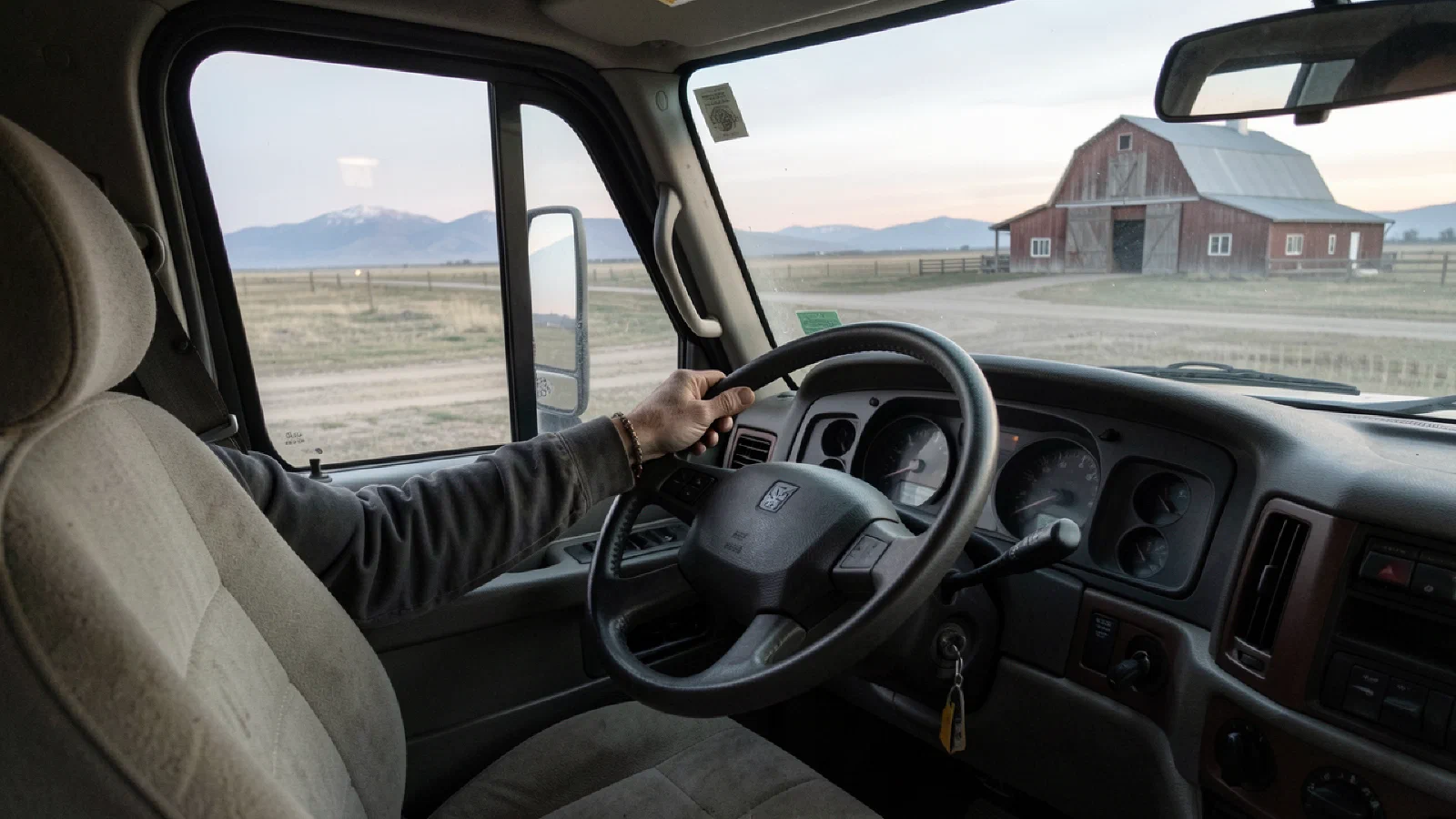
The Ache
A farmer in Helena, Montana discovers that the technology he never asked for has been waiting for his body to make the argument his mind would not.
Dale Corbin has a morning inventory and it is not about the cattle.
Left knee: stiff, three on a scale he does not articulate to anyone. Right shoulder: the one that caught the gate in 2029, tight until about ten o’clock, then functional. Lower back: depending on the day, somewhere between background hum and the thing that makes him grip the edge of the truck bed and stand still for fifteen seconds before moving again. Hands: the right one closes all the way now only after he works it open and shut a few times against the steering wheel.
He is fifty-six. His father farmed until seventy-one and then died four months after stopping, which Dale does not think about directly but which occupies a room in his mind that he walks past several times a day.
The inventory happens between the house and the barn, a walk of maybe a hundred yards that used to take him forty-five seconds and now takes a minute and a half. Not because the distance changed. Because the first thirty steps of the day are a negotiation between his intentions and his cartilage.
Nobody watches this. Anna is in the kitchen. Jack, who is fifteen now and taller than his mother, is still asleep. Hank, who is twelve and has never in his life put a sock in the dog’s water bowl despite family legend insisting otherwise, is also asleep. The morning inventory is private. Dale has performed it roughly two thousand times without naming it, and he does not plan to start.
He passes the lean-to behind the machine shed on the way to the barn. Eight solar panels on a tilted frame that Jack built last summer with lumber from the old calving shelter and brackets he ordered online. The panels power a ventilated cabinet inside the shed that holds three refurbished servers Jack bought at a state surplus auction in Great Falls for two hundred dollars. The servers run his model swarm, which is what Jack calls it: a cluster of open-source models that he routes tasks through depending on what he needs. One for code. One for research. One smaller one that runs all the time, handling whatever Jack throws at it throughout the day.
The electricity was the problem Jack solved first, because running compute in rural Montana means paying NorthWestern Energy rates that will eat a fifteen-year-old’s savings in a month. The solar array produces about twice what the servers draw on a clear day, and Montana has a lot of clear days. Jack sells the surplus back to the grid for a credit that covers the cloudy stretches. Dale does not understand the model swarm. He understands the economics, which are sound, and the carpentry, which is adequate.
The kid who asked for an ollama at five built his own.
The Neighbor’s Field#
Craig Petersen’s east parcel is visible from Dale’s barn. Has been for thirty years. They share a fence line and an understanding about water rights that has never been written down because that is how things work between neighbors who have known each other since both their fathers were farming.
Craig’s field looks different this year.
Not the crop. The crop is winter wheat, same as Dale’s, same variety, planted within a week of each other. What looks different is the absence. Craig is not on his tractor. Craig’s tractor, in fact, is operating without Craig. It has been operating without Craig since March, guided by a system that Craig’s son Tyler installed over the winter.
Tyler Petersen, who at fifteen loaded an open-source language model on the family computer and inadvertently set a five-year-old on a quest for a llama, is now twenty-five and works for a precision agriculture company out of Bozeman. He came home for Christmas, looked at his father’s operation, and told him he was farming like it was 2015. Craig, who listens to Tyler the way all fathers listen to sons who have left and come back with expertise, agreed to a pilot season.
The pilot season involves: an autonomous GPS-guided tractor that follows pre-programmed field paths, a fleet of three drones that survey crop health twice weekly using multispectral imaging, soil moisture sensors on a grid across both parcels, and a software platform that integrates all of it into recommendations Craig receives on his phone.
Craig showed Dale the phone app in February, standing in Dale’s kitchen, scrolling through color-coded maps of his own fields. Green for healthy. Yellow for stress. Red for intervention needed. The maps were detailed down to ten-meter resolution. Craig could see which corner of which field needed nitrogen and which was overwatered and which had an emerging pest pressure that was not yet visible to the eye.
“Tyler says I should have been doing this five years ago,” Craig said.
Dale looked at the maps. They were beautiful, in the way that any precise representation of land is beautiful to a person who has spent his life on it. He could see Craig’s west drainage problem, the one they’d talked about for years, rendered in a blue gradient that proved what both of them already knew from walking it in spring.
“What do you do all day?” Dale asked.
Craig laughed. “That’s the thing. I don’t know yet.”
What Dale Knows#
Dale knows his land the way a person knows a face they have looked at for thirty years.
He knows that the east section drains faster than the west, not from a sensor map but from the way his boots behave in April. He knows the wind patterns through the draw between the two ridges because he has felt them shift against his neck in every season for three decades. He knows where the elk cross because the fence is bent in the same place every fall, and he knows they cross there because the creek narrows and the bank is low, which he knows because he walked it once in 1998 looking for a lost calf and has remembered the topography ever since.
He knows Betsy’s granddaughter, another Hereford, by the way she holds her head when she is about to refuse to move. He knows which gate latch sticks in cold weather and which post is going to need replacing next year and which section of the barn roof leaks when the wind comes from the northwest, which it does about eleven times a winter.
This knowledge lives in his body. It is not stored in a way that could be uploaded or transferred or mapped. It accumulated through presence, through years of being on the ground in all weather, through the slow education of attention that happens when a person does the same work in the same place long enough for the place to become legible in ways that have no vocabulary.
Craig’s drone sees more than Dale’s eyes. The multispectral imaging detects chlorophyll variations invisible to human vision. The soil sensors measure moisture at depths Dale’s boots cannot reach. The satellite overlay tracks weather patterns with a precision his neck cannot match.
The drone does not know what any of it means. The drone does not know that the stressed patch in the northeast corner is stressed because the previous owner, before Dale’s father bought the parcel in 1974, ran a feed lot there and the soil chemistry has never fully recovered. The drone flags the stress. Dale knows the story.
But the story does not increase yield. The nitrogen recommendation does.
The Morning the Case IH Didn’t Start#
A Thursday in April. Dale turns the key on the tractor he has driven for seven years, the one he bought used from a dealer in Great Falls with 4,200 hours on it, the one whose transmission he rebuilt himself in the winter of 2031 with Jack handing him wrenches in the barn.
Nothing.
He tries again. The starter engages, turns over, catches briefly, dies. He sits in the cab and listens to the silence that follows a failed ignition, a silence that is different from ordinary silence because it contains the specific weight of a plan that has just become a problem.
He gets out of the cab. The getting out is the part that has changed. There was a time when he swung down from the step without thinking. Now there is a sequence: right hand on the grab bar, left foot to the step, a pause that is not quite a rest, then the drop to the ground that sends a message from his knees to his lower back to the base of his skull.
He opens the engine compartment. He looks at what he already suspects. The fuel system, probably the injection pump, possibly electrical. Either way, not a fifteen-minute fix. Not a one-day fix, if parts are involved. And the west section needs to be worked this week because the window between frost and planting is narrow and getting narrower.
He calls Craig.
“Can I borrow your rig for a couple days?”
Craig pauses. “The autonomous one?”
“Whatever’s available.”
“I mean, it’s available. Tyler set it up for my fields, but someone would need to reprogram it for yours.”
Dale stands in his barn, phone against his ear, looking at the dead Case IH that has been the center of his working life for seven years. Through the barn door he can see Craig’s field, where a tractor is running perfect lines without a human being anywhere near it.
“I’ll figure it out,” Dale says, meaning he will ask Jack.
The Translation#
Jack is in the shed behind the machine shop when Dale finds him. The shed door is open because the servers generate heat even with the ventilation fan running. Jack is sitting on a milk crate with his laptop balanced on a plywood shelf he mounted to the wall studs, and two of his models are working on something Dale cannot see and does not ask about.
“Case is dead,” Dale says. “Craig’s lending us the autonomous rig. Can you set it up for our fields?”
Jack does not look surprised. He has been watching his father’s tractor age the way a mechanic watches a timing belt stretch: with the calm certainty that the failure is coming and the only question is when.
“Yeah. Give me a couple hours.”
What happens in those couple hours is something Dale observes from the periphery with the partial comprehension of a man watching his son operate in a language he never learned. Jack pulls the parcel boundaries from the county GIS database. He downloads the NRCS soil survey, which contains a federal classification of every acre Dale has farmed for thirty years, data Dale did not know was public.
“You already have our soil data?” Dale asks from the barn doorway.
“Everyone does, Dad. Federal survey. Has been for decades.”
Dale has known his soil for thirty years through a method that involved putting his hand in it and rubbing it between his fingers. He did not know that this knowledge existed in a federal database accessible to anyone with a browser.
Jack routes the field mapping problem through two of his models, one handling the GPS coordinate conversion and one generating the implement specifications from Craig’s tractor manual, which Jack photographs and feeds in. He cross-references Tyler Petersen’s configuration notes, which Tyler shared on a precision ag forum Jack has been reading since he was thirteen. By noon, Jack has a complete field program on a USB drive.
“What do I do when the tractor shows up?” Dale asks.
“Nothing. It runs the program. I’ll monitor it from the shed.”
“So my fifteen-year-old is going to farm my field.”
“I’m not farming it. I’m driving the tractor. You’re still farming it.”
Jack says this with the patient certainty of a teenager who understands a distinction his father has not yet made. The distinction between operating equipment and understanding land. Jack can run the tractor. Jack cannot read the field. He does not know about the old feed lot or the wind through the draw or the elk crossing. He does not know that the west section holds moisture two days longer than the east after rain, which changes when you can work it, which changes what you plant, which changes everything downstream.
But Jack knows who does know these things. He also knows his father’s knees.
“Your back’s been bad since February,” Jack says.
“My back is fine.”
“You stood in the barn for a full minute this morning before you could walk to the house.”
Dale looks at his son. The boy has his mother’s observational precision and his father’s stubbornness, a combination that Dale recognizes as his own undoing.
“Two days,” Dale says. “Until the Case is fixed.”
The Two Days#
The autonomous tractor arrives on a flatbed at two in the afternoon. It is newer than Dale’s, cleaner, and utterly silent when it is not running. Jack has it programmed and calibrated by three-fifteen, working from his shed with a seriousness that Dale recognizes as vocational even if the vocation has no name yet. By three-thirty, it is working the west section in lines so straight they look ruled.
Dale watches from the fence.
He has watched tractors work fields since he was younger than Hank. His father’s tractor, then his own, always with a figure visible in the cab, a silhouette that meant someone was present on the land, doing the work, taking the weather and the dust and the hours. The cab of this tractor is empty. The machine moves with a precision that Dale’s body could never have produced, tracking to within two centimeters of the previous pass, adjusting speed for soil resistance, logging data that Dale does not know how to read and is not sure he wants to.
He watches for twenty minutes. Then he walks the section on foot, something he has not done during field work in years because he was always on the tractor. The walking is slow. His knees protest the uneven ground. But he is on his land, and the land is the thing he knows, and the machine working it is just a machine, no different in kind from any other machine he has used, only different in the specific detail that it does not need him.
The first evening, Anna asks how it went.
“Fine,” Dale says.
“Just fine?”
“It works. The lines are good. Jack checks it from the shed.”
“Do you like it?”
Dale considers this question longer than he expected to. Like is not the right word. The machine does not ask to be liked. It asks nothing. It simply does the work, precisely and tirelessly, in a way that Dale’s body can no longer do precisely and has never done tirelessly.
“It doesn’t need me to like it,” he says.
Anna watches him. She is a school counselor. She has spent twenty-five years listening to what people say alongside what they mean. Her husband just told her something important, and she has the professional grace not to name it out loud.
What the Body Concedes#
The Case IH takes nine days to fix. A fuel injection pump, sourced from a dealer in Billings, backordered for a week. During those nine days, the autonomous tractor works Dale’s fields with a consistency that makes the comparison unflattering.
Dale still walks the land every morning. He checks the work the way he has always checked the work: by looking, by touching, by standing in the field and reading what the ground and the crop and the sky are telling him. He finds nothing wrong. The machine’s work is, by every measure he has access to, correct.
On the sixth day, he drives out to the northeast corner, the old feed lot section. The autonomous tractor treated it identically to the surrounding field. Jack’s program does not know about the feed lot. The NRCS survey classifies it as the same soil series as everything around it.
Dale gets out of the truck. His knees perform their morning protest, which by afternoon has dulled to a background awareness. He kneels, which costs him, and puts his hand in the soil. It is different here. A little heavier. A little more compacted at depth. The chemistry of fifty-year-old cattle waste, invisible to the eye, detectable to the hand.
He finds Jack in the shed.
“That northeast corner. Your program treating it the same as the rest?”
Jack checks. “Yeah. The soil map shows it as the same series. Judith clay loam throughout.”
“It’s not the same. There was a feed lot there before Grandpa bought the place. Soil’s different. Needs different inputs.”
Jack looks at his father. He has grown up on this land without knowing this particular thing about it, which is a small reminder that thirty years of presence produces knowledge that cannot be inherited by proximity alone.
“I can create a management zone for it,” Jack says. “Custom prescription. But I’d need soil samples to calibrate.”
“I can tell you what it needs.”
“I believe you. But the system needs numbers.”
Dale stands in his son’s shed, surrounded by humming servers powered by sunlight, looking at a screen displaying his own land in colors that represent data he carries in his hands, and translates his knowledge into language the software can use. The phosphorus is high. The organic matter is above the surrounding average. The compaction at twelve inches is real. He does not have numbers. He has hands.
“I’ll pull samples,” he says. “Send them to the lab.”
“That works. Once I have the data, I can zone it in about ten minutes.”
Ten minutes. The knowledge took thirty years to accumulate and ten minutes to integrate. The integration required Dale to convert what he knew into what the system could know, which meant losing everything about the knowledge that was not a number. The history, the context, the feel. What remained was correct. It was also thin.
The system could not have found this without Dale. Dale alone could not have acted on it at the precision the system allows. Together, they are more capable than either one alone. This is supposed to be the optimistic story. Dale is not sure why it does not feel optimistic.
Evening#
The Case IH is back by the following Thursday. Dale drives it out to the east section, the one he always starts with, the one closest to the barn. The engine runs. The transmission holds. The cab smells like diesel and dust and the specific metal scent of a machine that has been his for seven years.
He runs three passes. The lines are not as straight as the autonomous tractor’s. The speed is not as consistent. The fuel consumption is higher because his throttle management is intuitive rather than algorithmic, which means it is adaptive and also wasteful.
His shoulder aches by the fourth pass. His back tightens. His hands, gripping the wheel at ten and two, work the stiffness out against the vibration of the engine, which is a method he has used for years without calling it therapy.
He can feel the field through the machine. The slight pull when the soil density changes. The way the tractor labors in the low section where moisture collects. The vibration pattern that tells him the discs are hitting a rock that is too deep to see. This is information. It is not data. No sensor replicates it because no sensor is sitting in this seat, absorbing thirty years of the same vibrations through the same skeleton.
I wonder how long the body holds. Whether Dale has two years of this or ten, whether the morning inventory will eventually produce a number that makes the negotiation impossible. Whether the ache that is manageable today will be the argument that finally wins, not because the technology is better but because the body is finished.
Jack finds him in the barn after dinner, cleaning the discs. Jack does not say anything about the autonomous tractor. He does not mention Tyler or the software or the perfectly straight lines. He picks up a wrench and starts on the other side.
They work in silence for a while. The barn smells like grease and hay. One of the cats, a gray tabby who has been hunting mice in this barn longer than Hank has been alive, sits on a hay bale and watches them with the calm indifference of a creature that has never once considered whether its work could be automated.
Dale’s hands move over the equipment with the fluency of repetition. The wrench fits. The bolt turns. The body, for now, holds.
How this essay connects to others across The Approximate Mind.