Two People, One Capability
The same tool, handed to two brothers, becomes two different things
TAM-CMN.01 · The Common Mind · The Approximate Mind
Arjun checks the weather the way his father taught him, by standing in the field before dawn and reading the sky, and then he checks it again on his phone, because the phone is what the buyer will cite when he argues about the price. The two readings rarely agree. Arjun trusts the first one. He farms four acres of cotton and rice in Warangal district, Telangana, the land his father worked and his father’s father before that, and he has learned over twenty years which corner drains badly after a hard rain and which buyer at the market will wait until his position is weak before naming a number.
His brother Ravi left for Hyderabad at nineteen. He is in middle management now, in a company that makes enterprise software, in an office tower in the technology corridor east of the city. He checks the weather on his phone and believes it, because nothing in his day depends on the difference between what the app says and what the soil says.
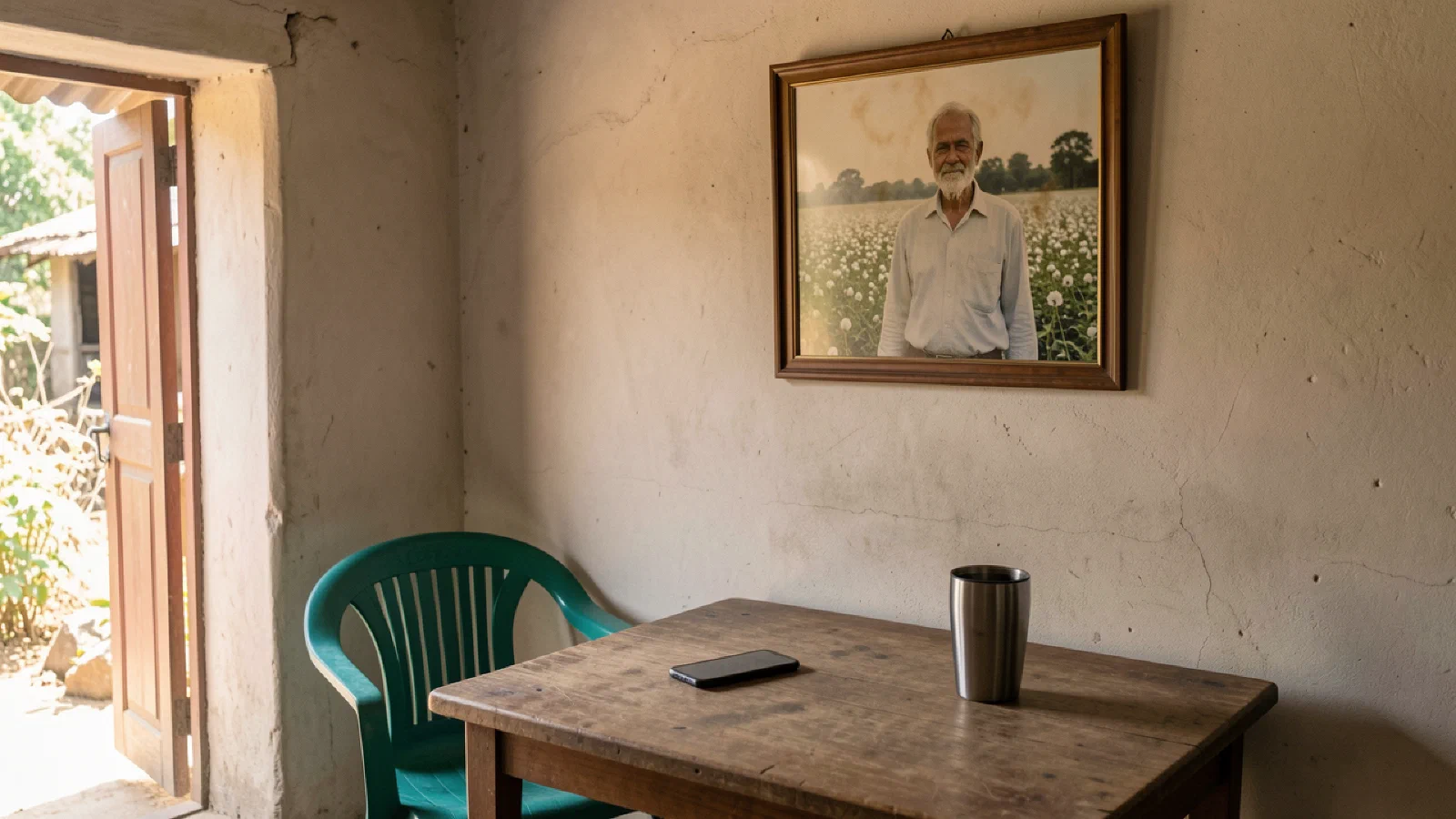
They are six years apart and have not shared a daily life in over two decades. Above Arjun’s kitchen table hangs a photograph of their father standing in the cotton field in the week of a good harvest, eyes half-closed against the sun. Ravi has the same photograph on his phone. He has never printed it.
Hand both of them the same AI, and you can watch it become two different things.
For Ravi, it folds into a life already saturated with tools. He uses it to summarize vendor contracts, to draft the emails he doesn’t want to write, to think through a budget problem at eleven at night when the apartment is finally quiet. It answers him in fluent English, which he works in all day. It understands the shape of his problems because his problems are the kind the system was trained on: documents, schedules, the grammar of corporate work. He does not think of it as remarkable. It is simply there, the way electricity is there, and like electricity he notices it mainly when it fails.
The same tool reaches Arjun differently, which is to say it mostly does not reach him at all.
It answers in English, which he reads haltingly and does not think in. He thinks in Telugu, and the Telugu it produces is the Telugu of someone who learned the language from a textbook, technically correct and subtly wrong, the words a city official would use rather than the words a farmer would. It knows agriculture the way a university knows agriculture, in general principles that may not survive contact with cotton in Warangal in a year the monsoon comes late. It assumes a connection his village has only sometimes. Ask it what his crop will fetch this week and it offers a national average that has nothing to do with the buyer who will actually stand in front of him.
What Arjun needs is not information in the abstract. He is not an uninformed man. He knows his soil and his rates and the borewell politics that decide whether he has water. His constraint has never been knowing. It has been leverage: the buyer who sets the price, the loan against next season’s crop, the rain that comes when it comes. The thing that would change his life is a tool that understood the transaction from his side of it, in his language, on the signal he actually has.
If the tool does that, it is worth a great deal to him. If it does not, it is worth nothing. Not a little. Nothing.
That word is exact, and it is the reason the two brothers belong side by side. Ravi can use a tool that is merely good. A tool that is eighty percent of what he needs is still useful to him; he supplies the rest himself, in English, on a fast connection, inside a life built to absorb imperfect tools. Arjun cannot. A tool that is eighty percent of what he needs, where the missing twenty percent is the language he thinks in and the crop he grows and the network he can reach, is not eighty percent useful to him. It is a brick. The thresholds are different because the lives are different, and below his threshold the value does not shrink. It vanishes.
Value is not one thing measured in different amounts. For the person the tool was built for, it is a gradient. For the person it was not, it is a cliff.
The cliff is not an accident, and it is not anyone’s cruelty. It is what happens when capability is built by people who have to justify the cost. A company that builds an AI system answers to whoever pays for it, and it gets good at serving those people because serving them is what keeps it alive. Ravi is close enough to that center to be served well. He is urban, employed in a sector the builders understand, working in a language they trained on, generating the kind of value that makes a subscription or an advertisement pay. Arjun is not close to that center. He speaks a regional language, lives where the network is thin, and represents, in the only terms the builders are accountable to, almost no return at all. He is not a market the system failed to capture. He is outside the market the way the unprofitable have always been outside it.
This is the asymmetry the rest of the series has to reckon with. Most of the world’s people are closer to Arjun than to Ravi: speakers of languages the frontier serves badly, residents of places the signal reaches poorly, workers in trades that generate dense local knowledge and little measurable return. A tool built for the center reaches them as an afterthought, in a language that is technically theirs and practically foreign, and for them the afterthought is the cliff.
Arjun and Ravi talk on the phone every week or two, when the signal cooperates. Ravi sends money home when he can. Arjun sends vegetables when there is a surplus and someone making the trip. Neither of them would call this an economy, but it is one, with an urban end and a rural end and value moving in both directions across the gap between them. They do not say out loud that each wonders about the road the other took. They both know it anyway.
The photograph above the kitchen table has hung in the same place for eleven years. Their father never held a smartphone and would not, Arjun suspects, have wanted one. The question the photograph leaves is not what the old man would have chosen. It is whether anything being built today can find its way to a man standing in his field before dawn, reading a sky the app gets wrong, in the language he has thought in his whole life, for the problem that is actually in front of him.
I keep wondering whether the people who decide what gets built have ever had to explain a loan term to someone who didn’t get to choose the terms.
How this essay connects to others across The Approximate Mind.