The Urban Verdict
In the city where private capability arrives aggressively and often free, the floor's value is real, less visible, and harder to argue for.
TAM-CMN.15 · The Common Mind · The Approximate Mind
Ravi is still in HITEC City. He has not thought about the floor since the last time he thought about public water, which is to say never. His AI tools work. They summarize contracts, draft emails, catch errors in spreadsheets, and do it in English, which is the language his work runs on. They are free or nearly free, subsidized by companies that want his attention or his data or both, and the subsidies show no sign of ending. If someone told him that a public AI floor had been built for India, he would nod politely and continue using the tools he already has, because the tools he already has are good, and the floor, whatever it is, would have to be better to earn his attention.
The honest reckoning is that for a person like Ravi, the floor is not better. Not in the way he would notice. Not in the way that changes his Tuesday.
The private systems that serve him were built for someone like him. He sits near the center of the average they were optimized for: urban, English-fluent, employed in a sector the builders understand, generating the kind of interactions that improve the model. The gradient Two People, One Capability described, where value diminishes smoothly as you move from the center, barely touches him. He is close enough to the center that the distance is imperceptible. The tools work for him the way the bottle of water works for the executive: he chose them because he prefers them, and the preference is informed and rational, and nothing about the floor changes the preference.
So what does the floor give Ravi that the private systems do not.
Three things, none of which he will feel on any given day, all of which he might feel over a decade.
The first is sovereignty over his own data and the intelligence it produces. The private system he uses extracts patterns from his work and aggregates them into a model he does not own, governed by a company whose incentives are not aligned with his. The floor, if it runs on locally owned infrastructure, keeps those patterns inside the country. Ravi does not experience data sovereignty as a daily benefit. He experiences it, if at all, as an absence: the absence of the moment when the private system changes its terms, or its pricing, or its availability, in a direction he did not choose and cannot reverse. The absence may never arrive. If it does, the floor is the thing that was there when the bottle was not.
The second is surplus retention. The value Ravi generates through his interactions with the private system compounds at the center, in Virginia or wherever the model lives. The same interactions with a locally owned system would compound locally, enriching the domestic AI ecosystem rather than the foreign one. Ravi does not see this surplus. It is invisible in his individual transactions, the way the outflow of capital from a developing economy is invisible to the individual who sends a wire transfer. The aggregation is what matters, and the aggregation is something a country feels, not a person.
The third is epistemic accountability. The private system that serves Ravi is not required to tell him what it does not know. It is not required to declare its confidence, flag its limits, or admit when its output is based on thin evidence. The epistemic layer the floor carries would require these things, and Ravi, who is sophisticated enough to evaluate the quality of what he is told, would benefit from knowing when the system is guessing rather than knowing. He would benefit, that is, if he noticed, and the honest answer is that most of the time he would not, because most of the time the system is right enough for his purposes, and the difference between right and right-with-declared-confidence is a difference he is not looking for.
The floor’s value to the urban professional is real, deferred, and invisible. The private system’s value is real, immediate, and felt. In the contest between the two, the private system wins every Tuesday.
The series could stop here and claim the urban case is lost. It would be partially right. For the person the private market was built to serve, the floor’s daily value is marginal, and the floor’s structural value, sovereignty, surplus, accountability, operates at a level of abstraction that does not compete with the concrete experience of a tool that works.
But the city is not only Ravi.
The city is also the auto-rickshaw driver who speaks Hindi and some English and neither well enough for the system to serve him in the confident, fluent way it serves Ravi. It is the domestic worker who does not use AI at all because the tools available assume a literacy and a context she does not have. It is the street food vendor whose business runs on patterns the system has never been trained on, and the elderly parent navigating a government portal designed for someone younger and more digitally fluent. The city contains its own periphery, and the periphery is large, and for the people in it the floor is not a marginal improvement over something they already have. It is the difference between something and nothing, the same cliff Two People, One Capability described, located inside the same postal code as the person for whom the private system works perfectly.
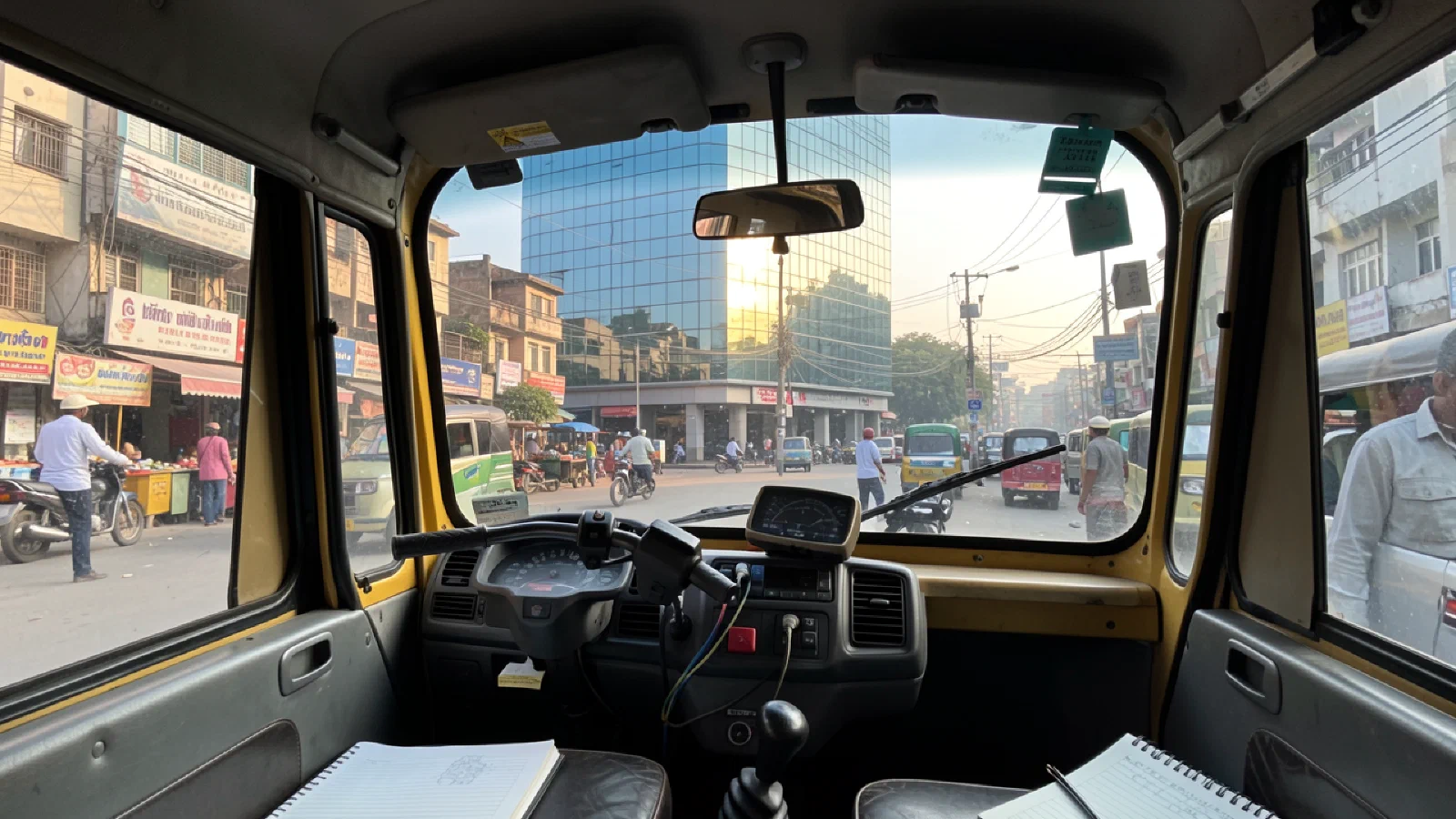
The auto-rickshaw driver, specifically. His name is Mohan, and he has been driving in Hyderabad for fourteen years. He owns his vehicle and manages his own finances, which means he does his own accounting, such as it is, in a notebook he keeps under the seat. He knows his routes the way Arjun knows his fields: by feel, by experience, by the accumulated knowledge of a man who has been doing a thing long enough to know it in his body. The AI tools available to him are the same tools available to Ravi. They are free. They are powerful. They assume he can type a question in English, understand a response in English, and apply the answer to a context the system can reason about. He can do the first haltingly, the second with effort, and the third not at all, because the system does not know what it means to manage a rickshaw’s fuel costs against variable fares against the loan on the vehicle against the bribe the traffic police expect on the third Thursday of the month. The free tool is free and powerful and useless to him in the way a library is useless to someone who cannot read the books it holds.
For Mohan, the floor is not insurance. It is not a structural benefit he might feel over a decade. It is the difference between navigating his finances alone and having something that understands his situation well enough to help, in Hindi, in his terms, for his actual problem. The cliff is right here, in the city, two kilometers from Ravi’s office tower.
The urban verdict, then, splits. For the person the market serves well, the floor is insurance, real but unfelt, valuable in the way a fire extinguisher is valuable to someone whose house has never burned. For the person the market does not serve, the floor is the only thing there, and its absence is the absence of capability the neighbor in the next apartment has and they do not. The series says this without flinching: the urban case for the floor is not as strong as the rural case, measured by the person who benefits most visibly. But the urban case is not about the person who benefits most visibly. It is about the person standing next to him, and the distance between them is not a continent. It is a language, a literacy, a context the system was not built to see.
I wonder whether the strongest case for the floor is not the person it helps most but the person standing next to them who has nothing at all.
Ravi sends money to Arjun every month. He does not think of this as a subsidy. He thinks of it as what brothers do. The floor asks the country to do something similar: build the thing that serves everyone, including the people who do not yet know they need it, and fund it with the collective surplus of a society that includes both the software engineer in HITEC City and the auto-rickshaw driver outside his gate. Ravi will not feel the floor. The driver will. Whether the country builds it depends on whether it values the driver’s need as much as it values Ravi’s satisfaction, and the history of public infrastructure suggests that the answer is always contingent, always political, and never as generous as the speeches claim.
How this essay connects to others across The Approximate Mind.