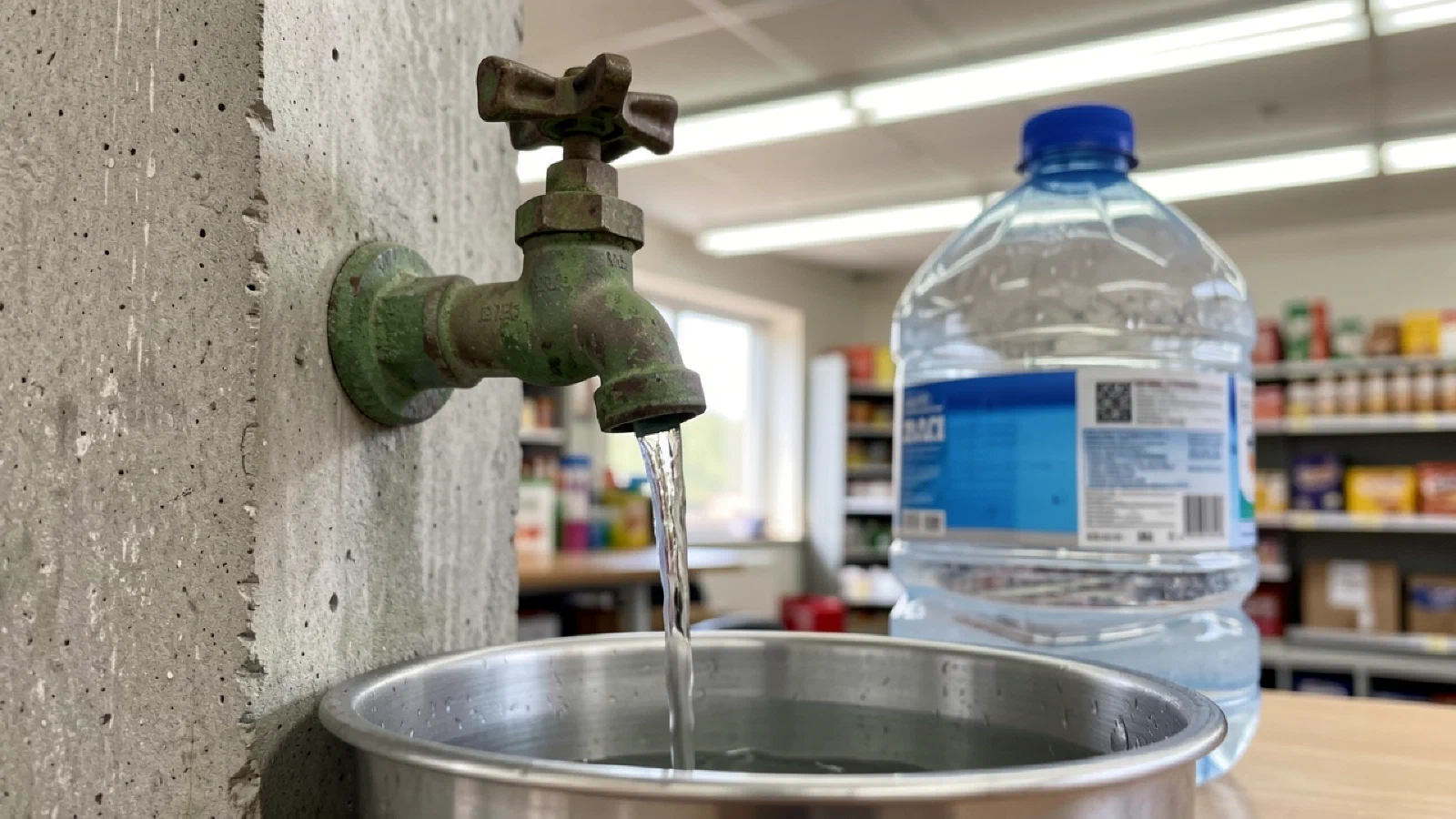
The Tap and the Bottle
Public infrastructure does not compete with the private market. It becomes the ground the market stands on.
TAM-CMN.02 · The Common Mind · The Approximate Mind
There is a bottle of water on the desk of nearly every executive who has ever argued that the government should stay out of a market. The bottle cost more per liter than gasoline. A few feet away, usually, there is a tap that delivers water of comparable safety for a fraction of a cent. The executive drinks from the bottle and sees no contradiction, because there isn’t one. The tap did not put the bottle out of business. The tap made the bottle a choice.
When people hear public AI, they hear a government system competing with private companies, picking winners, crowding out the better product with a worse one funded by taxes. The water on the desk says otherwise.
Municipal water is not in competition with bottled water. It occupies a different layer entirely. It guarantees that no one in the city dies of thirst or cholera because they could not afford to drink, and on top of that guarantee a market in preference flourishes: sparkling, filtered, flavored, imported from a glacier, sold at a markup that would be obscene if the buyer had no alternative. The buyer has an alternative. That is precisely what makes the markup acceptable. The floor is what turns a necessity into a preference, and a preference is something a market can sell honestly.
Take the floor away and the market changes character. Where there is no public water, bottled water is not a preference. It is the only thing standing between a family and a waterborne disease, and its price is no longer a markup on convenience but a tax on survival. The same product, in the absence of a floor, becomes something predatory, not because the seller changed but because the buyer lost the ability to walk away.
A floor does not lower the ceiling. It changes what the ceiling is allowed to charge for.
The public option is not a rival product on the same shelf. It is the shelf.
The clearest proof of this is not water but electricity, in places the market declined to serve. In the United States in the 1930s, private utilities had wired the profitable cities and left the countryside dark, because stringing line to a farm thirty miles from the nearest town could not be justified to a shareholder. The math was correct. The farms were unprofitable, and they stayed unlit for as long as the decision belonged to capital alone.
A farmer’s wife in rural Georgia read to her children by kerosene after dark. She heated water on a wood stove, churned butter by hand, ironed with a flatiron heated on the same stove, and lost hours every day to labor that electricity had already erased from the lives of city women twenty miles away. The utility that served those city women had looked at the cost of reaching her and decided the answer was no. Not forever, perhaps, but for now, and for now had lasted her entire adult life.
What changed her county was the rural electric cooperative: farmers pooling to build and own the lines the market would not build, often with public financing behind them. The cooperatives did not compete with the private utilities. They served the customers the utilities had written off, and in doing so they created an entire population of people who could now buy refrigerators and radios and milking machines. They manufactured a market that private capital then happily sold into. The appliance companies did not complain about the cooperatives. They sent salesmen.
The floor did not shrink the private sector. It enlarged it, by bringing into the economy people who had been outside it.
India built something similar in this century, and built it as digital infrastructure rather than physical. The payment system that lets a vegetable seller in a small town accept money from a phone with no transaction fee was not a private product. It was a public rail, open and free at the base, owned by no company. Private apps were built on top of it, hundreds of them, competing fiercely on design and features and convenience. None of them had to build the rail, because the rail was a commons.
The vegetable seller’s name does not matter here, but her morning does. She arranges brinjal and okra on a cloth by six, and her first customer pays with a phone. The money lands in her account before the customer has walked away. A year earlier that customer would have needed exact change or she would have lost the sale. Five years earlier the nearest bank branch was forty minutes by bus and open at hours that required her to close the stall. The rail did not teach her to run a business. She already knew how to run a business. It removed the wall between her and the financial system, and private companies built the apps she actually touches, each one competing for her attention on top of a foundation none of them had to pay for.
The result was not a government monopoly that crushed private innovation. The result was an explosion of private innovation sitting on a public foundation, reaching hundreds of millions of people the old banking system had never found worth the cost of a branch.
Neither the cooperative nor the payment rail was sold as a revolution. They were built as plumbing, unglamorous and load-bearing, the kind of thing you notice only when it is absent. The power they created was real, but it followed quietly from the utility rather than being announced ahead of it. The farmer with electric light did not experience a transfer of power from the utility to the people. He experienced light. The seller taking a payment on her phone did not experience the disintermediation of the banks. She experienced getting paid.
The systems that endure are the ones that present as utilities, not as statements. A floor announced as a challenge to private power invites a fight it does not need and may not win. A floor built as plumbing gets used, and the using is what makes it permanent.
I wonder whether the reason public infrastructure so often arrives late is that it has to wait for someone willing to build something important without making it sound important.
An AI floor, if it is built, has to be the tap and not a rival bottle. It does not need to be the most capable system in the world, the way municipal water does not need to be the most refreshing water in the world. It needs to be the thing that is simply there, reliable and free at the base, so that no one is left with private AI as their only option the way a family with no public water is left with the bottle as their only option. On top of that floor, let a market in preference flourish: faster systems, specialized systems, premium systems sold to people who can choose them because they have something to choose against.
The farmer’s wife in Georgia did not need the most advanced electrical grid in the world. She needed light, and a motor to run the churn, and the hours those gave back to her. The vegetable seller did not need the most sophisticated financial technology. She needed the wall gone. An AI floor works the same way. A woman asking a question about her child’s fever at two in the morning, in a language the frontier systems handle as an afterthought, does not need the most capable model ever built. She needs a model that understands the question, in her language, right now, and gets the answer right. The premium system that could also answer the question, in better prose, with a broader knowledge base, is the bottle. It is fine. It can exist. It should exist. But the child has a fever now, and the question is whether something answers.
The bottle on the executive’s desk is not the enemy of the tap. It is the proof that the tap is working. When the floor exists, the private market becomes what it is supposed to be, a place to sell people things they want rather than things they cannot survive without. The question is never whether to have the bottle. The bottle takes care of itself. It will be exquisitely designed, relentlessly marketed, and available in thirty flavors by next quarter. No one needs to worry about the bottle. The question is whether anyone will build the tap, and build it quietly enough that it lasts.
How this essay connects to others across The Approximate Mind.