The Maintained Commons
The floor can be built. Whether it will be maintained is the question that has no technical answer.
TAM-CMN.16 · The Common Mind · The Approximate Mind
Arjun is standing in his field before dawn again, reading the sky the way his father taught him, then checking the phone. This morning the phone answers in Telugu, the real Telugu, the Telugu of a person who knows what cotton looks like in a bad year, not the phrasebook Telugu of the frontier’s afterthought. It tells him that the buyer in the nearest mandi is offering a price twelve percent below the regional average, that the monsoon forecast for his district has shifted by a week, that the second application of the pesticide he is considering interacts with the nitrogen treatment he applied last month. The answer came from a model running in the state, trained on data from his district, fine-tuned on the crop cycles and market patterns that shape his year. It ran on hardware his state government owns, maintained by someone like Priya in a room that used to hold something else.
The floor reached him. Not perfectly. Not in every dimension. The model’s confidence in its market price data is flagged as moderate, because the data source updates irregularly and the system knows it. The monsoon forecast carries an explicit uncertainty band that the old weather app did not. The pesticide interaction is marked as based on limited local evidence and the system recommends he confirm with the agricultural extension officer, whose number it provides. The system told him what it knows, told him what it is not sure of, and told him where to go for the part it could not answer. This is what the epistemic layer looks like when it works.
Ravi, in HITEC City, has not noticed the floor. His private tools are the same as they were. If anything, they have improved, because the competitive pressure from the floor’s existence, the fact that a free public alternative now handles basic capability, has pushed the private systems to differentiate on quality and specialization rather than on access. The bottle got better because the tap exists. Ravi is using the bottle and has no reason to switch.
The floor delivered. In the rural case, clearly. In the urban case, to the people the market does not serve, the auto-rickshaw driver, the domestic worker, the elderly parent. To the urban professional, only in the structural dimensions he does not feel. The series said it would hold itself to this test, and the test is passed unevenly, which is the honest result.
Now the three honest reckonings.
Maintenance#
The floor is only as sovereign as the coalition’s weakest budget year. The history of public infrastructure is not a history of permanence. It is a history of things built and then starved: roads that crack, hospitals that lose staff, water systems that run until the pipes corrode and the budget to replace them is allocated somewhere else. The floor will face this. The server room in Bhubaneswar will need new hardware in three years, and the budget line that paid for the first machines was a one-time allocation, and Priya, who has become indispensable, is being recruited by a private company in Bangalore that will pay her three times what the district does.
A floor that is built and then starved teaches the population it serves that public provision is a promise with an expiration date. The clinics that integrated the model into their triage will revert to the chaos that preceded it. The farmer who learned to check the market price before selling will lose the tool and face the buyer alone again. The withdrawal of capability, once established, is not a return to the status quo. It is worse than the status quo, because the adaptation to the tool’s presence has already happened, and the skills that compensated for its absence have atrophied.
Whether the floor survives the budget cycle depends on whether it generates enough visible value to justify its line item against every other claim on public money. This is a political question, not a technical one, and the honest answer is that it is not guaranteed. The floor’s defenders will point to retained surplus, improved health outcomes, agricultural productivity gains. The floor’s opponents will point to the cost and ask whether the private systems, which are free, do not already serve the same people. The answer to that question is the argument this series has made across fifteen essays, and whether the argument is persuasive enough to survive the budget hearing is something the series cannot promise.
Capture#
Open and public does not mean no one is in charge. Someone maintains the models. Someone decides the epistemic standards. Someone approves the domain models that enter the stack and monitors the ones already there. The floor relocates the center from a private corporation to a public institution, and the public institution carries its own risks: bureaucratic capture, political interference, the tendency of any institution to serve its own perpetuation ahead of its stated mission.
The center has not been abolished. It has been moved. The new center is closer to the population it serves, and it is accountable through political mechanisms rather than market mechanisms, and political accountability is imperfect in ways the series does not need to catalog because they are familiar to anyone who has dealt with a government. The floor is better than the alternative not because it eliminates the problem of power but because it places power where it can, in principle, be contested by the people it affects. In principle is doing real work in that sentence, and the series leaves it there rather than pretending it is more than it is.
Residual frontier dependency#
The floor shrinks dependency. It does not eliminate it. The models at the edge are distilled from larger ones. The hardware is manufactured in a concentrated supply chain. The research that produces new architectures still happens at a few centers in a few countries. The floor’s honest claim is that it reduces dependency from total to marginal, that it converts a rent relationship into a possession relationship, that it moves the country from consuming someone else’s intelligence to owning the last mile and the domain layer and the epistemic standard, while acknowledging that the first mile, the frontier training run and the chip fabrication, remains beyond its reach.
This is a large win. It is not independence. The distinction matters, because overselling the floor as full sovereignty invites the disillusionment that follows every overpromise, and the floor needs to survive on what it actually delivers rather than on what its advocates wish it delivered.
The tension, not the resolution#
The technical pieces exist. The architecture described across these essays, small models at the edge, domain models at the regional layer, a composition layer that assembles context dynamically, an epistemic layer that governs what the system may claim, is coherent and buildable with current methods at a cost most mid-income countries can afford. The community ecosystem layer, built on top of the universal floor by the communities it serves, extends the architecture into the identity and self-determination space that the universal floor alone cannot reach. The economic logic, retained surplus funding maintenance, the floor as seed for community-built growth, holds if the political will holds.
Whether the floor is built for the people who need it most, and maintained once built, depends on choices being made now, by ministers and engineers and communities and the people who fund them. The choices are not inevitable. They are not even likely, if the measure of likelihood is the historical frequency with which public infrastructure has been built for the unprofitable rather than the profitable. They are possible. Possibility is a thinner word than most advocates want, and it is the honest one.
I wonder whether the will to maintain a common thing outlasts the moment that made it necessary.
Arjun checks the sky again. The phone in his pocket holds an answer that came from a machine in his state, in his language, about his crop. He does not know how long it will last. He knows it is there this morning, and that this morning’s answer was better than anything he had before, and that the buyer at the mandi will hear a different farmer than the one he was used to, because this farmer knows the price before he walks in.
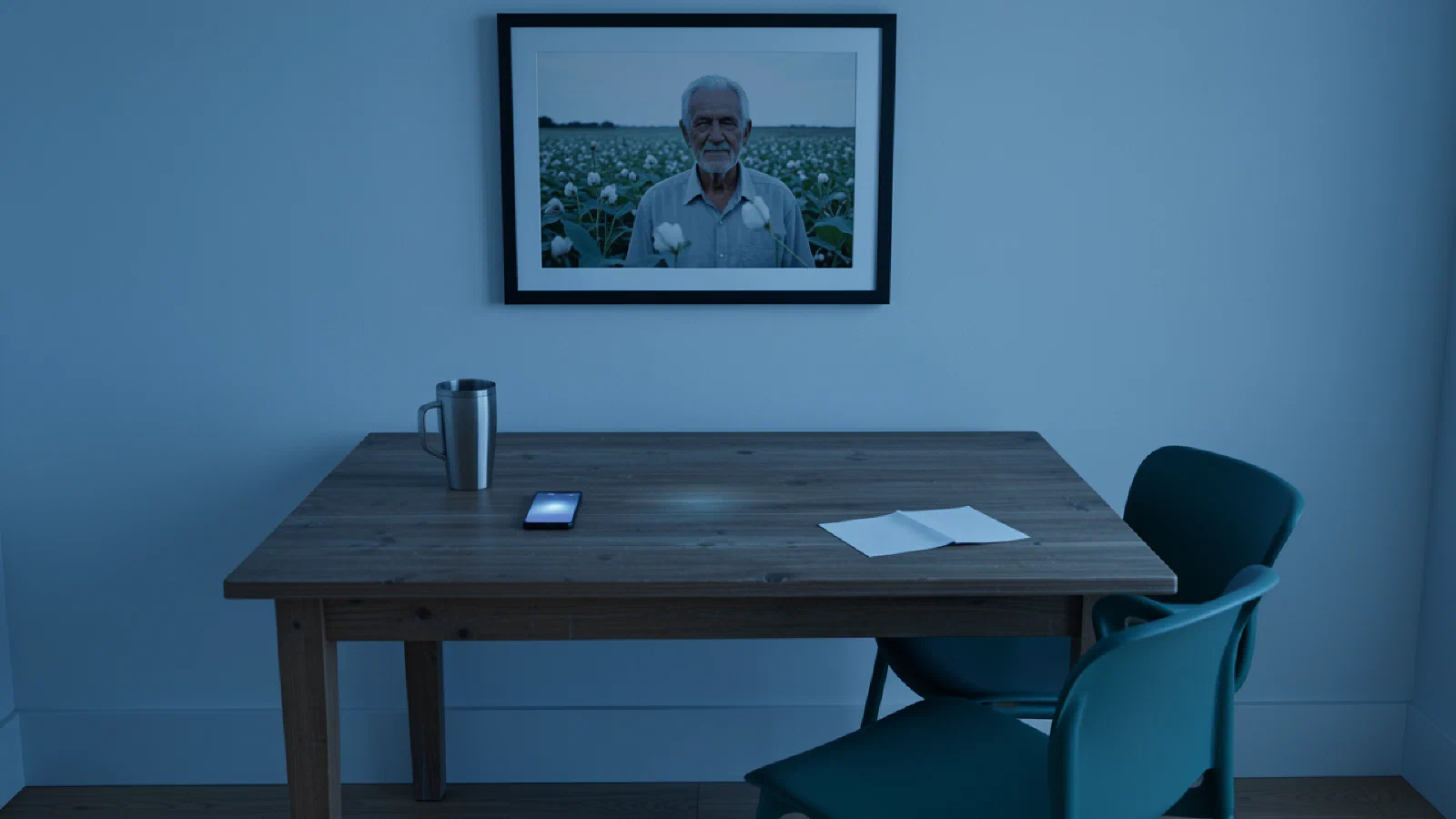
The photograph above the kitchen table has not moved. His father’s eyes are half-closed against the sun, standing in the same field, in the week of a good harvest. The old man never had what Arjun has in his pocket. What Arjun has in his pocket is what people built, and what people built can be maintained or abandoned, and the distance between the two is not a technology. It is a choice.
How this essay connects to others across The Approximate Mind.