The Layered Cognition
Most thinking does not need the largest mind. It needs the nearest one that knows the work.
TAM-CMN.05 · The Common Mind · The Approximate Mind
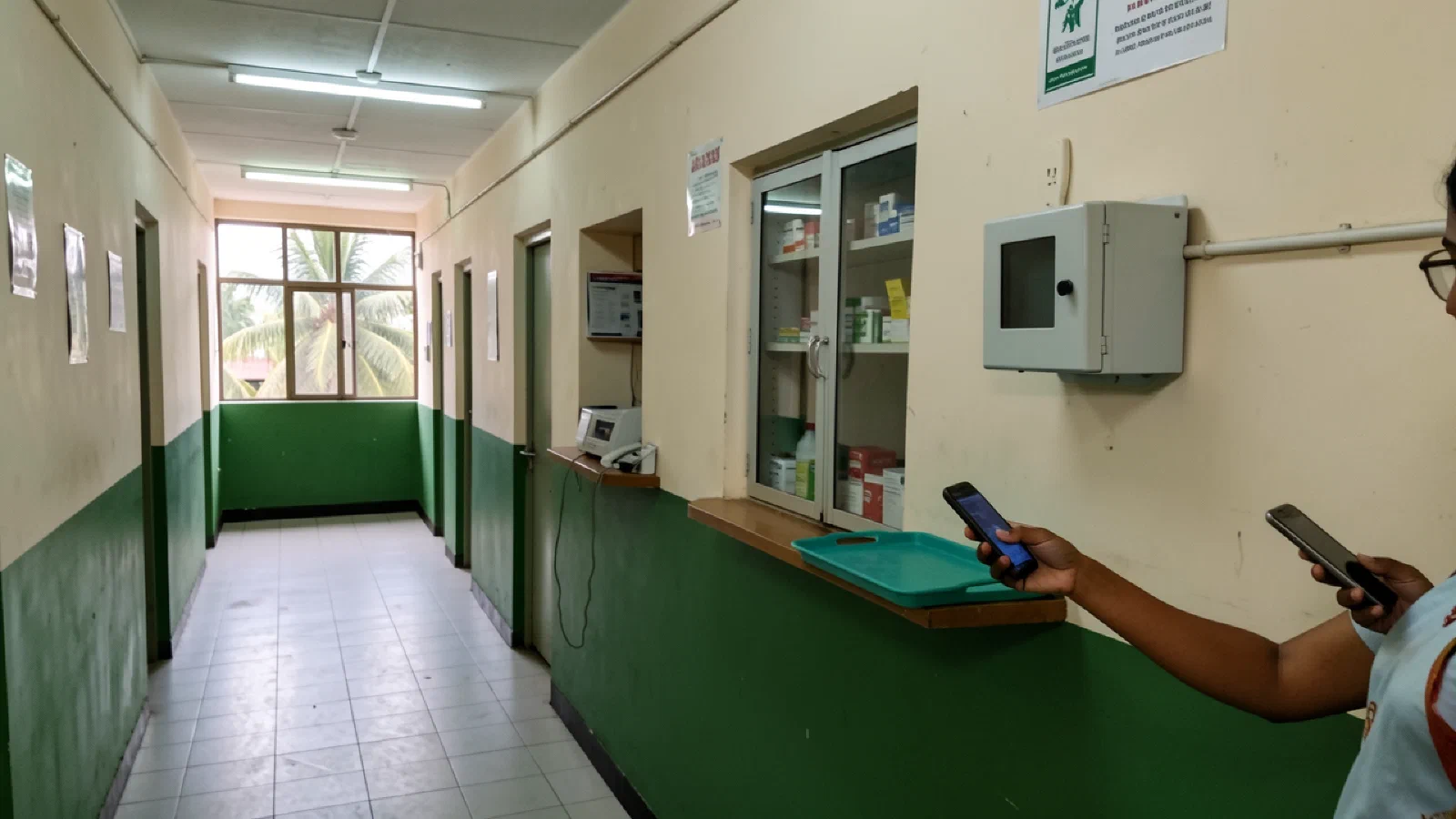
A nurse in a district hospital in Kerala asks a question in Malayalam about a drug interaction, and the answer comes back in two seconds, in Malayalam, from a model running on a server in the same building. The model is small. It would lose badly to a frontier system on a test of general reasoning, on poetry, on the kind of broad question that makes headlines. It has never been asked to do any of that. It knows medications and the way they interact, it knows the language the nurse thinks in, and it runs on hardware the hospital could afford. For the question she actually asked, it is not worse than the frontier. It is better, because it answered, in her language, at the moment she needed it, without sending her words to a data center on another continent.
The reflex in most discussion of AI is to assume that capability means size, that the path to serving everyone runs through making the biggest models bigger and then finding ways to push them out to the edges. This gets the architecture exactly backward, and the backward version is the one that leaves the nurse waiting.
Think about how a person actually uses their own mind. Most of what you do in a day does not call on the full depth of your intelligence. You recognize a face, judge whether the milk has turned, remember the way to a friend’s house, follow a familiar recipe. These run on something fast and local and cheap. Now and then you hit a problem that requires real effort, an unfamiliar tax form, a hard conversation you have to plan, and you slow down and bring more to bear. And rarely, you confront something genuinely beyond your daily range and you go find an expert, a doctor, a lawyer, someone who has the depth you lack for this one thing. You do not consult a neurosurgeon to decide what to cook. The cost would be absurd and the neurosurgeon would not be better at the actual question.
A sane system distributes cognition the same way. Most of the work belongs close to where it happens, handled by something small and specialized and cheap to run. Some of it needs more, a model that knows a whole domain in depth. And a thin slice, the genuinely hard and unusual, needs the frontier. The frontier is the neurosurgeon. It is indispensable for the thing only it can do and ruinous as the default for everything else.
The frontier is a destination you should reach rarely, not the road you travel on.
This is the architecture the floor is built on, and it inverts the usual picture. At the edge sit small models, running on a phone, a local server, a cheap box in a clinic, fast and private and functional without a network connection at all. Above them sit domain models, larger but still far short of the frontier, each one deep in a particular thing: a model that knows agriculture, a model that knows a body of law, a model that knows a language and the world that language carries. These are the layers most of life actually runs on, and they are buildable now, with current methods, at a cost that does not require owning a frontier lab.
What connects the layers is not a menu the user navigates but a kind of triage that happens before the user sees it. The nurse asks her question. The edge model recognizes the question is medical and routes it to the domain layer that holds the pharmacological knowledge, where the answer lives. If her question had been something else entirely, something the domain layer could not handle, it would have climbed further, to a more general model or, at the limit, to the frontier. The point is that the climbing is automatic and rare, the way a hospital triages patients: most are seen by the nearest competent person, a few are referred up, and very few reach the specialist at the top. A hospital that sent every patient to the neurosurgeon would not be a better hospital. It would be an expensive, slow, collapsed one, and the patients who actually needed the neurosurgeon would wait behind everyone else.
The domain layer is where the most striking gap lives, the capability the frontier will never build because the frontier has no reason to. A model deep in Malayalam medicine, or in the agronomy of cotton in a specific climate, or in the legal procedure of a particular state in a particular language, is enormously valuable to the people it serves and worth almost nothing to a company optimizing for the largest paying market. No frontier lab will build the model that knows a minor language’s medical vocabulary, because the return does not justify the training run. But that model is cheap to build if you are not trying to build the frontier, and it is exactly the model the nurse needs. The thing the market will not make is the thing that is most buildable by someone who is not the market.
Think about what a domain model actually carries. The Kerala nurse’s drug-interaction model does not need to know poetry or geopolitics or how to write code. It needs to know that metformin and certain contrast dyes interact dangerously, that the dosing window for a particular antibiotic shortens in renal insufficiency, that the generic available in her district pharmacy is bioequivalent to the brand she learned about in training. This knowledge is finite, testable, and expressible in a model that fits on hardware the hospital already owns. A frontier system knows all of this too, somewhere in its vast interior, but it also knows a billion things the nurse will never ask about, and the cost of carrying all that knowledge is the cost she cannot pay and does not need to.
The same logic holds for the cotton farmer of Two People, One Capability. A domain model for Telangana agriculture does not need to understand financial derivatives or translate Mandarin. It needs to know what cotton fetches this week in Warangal, how a late monsoon changes the calculus on a second planting, what loan terms are standard in the district, and which pesticide is locally available for the pest that arrived last month. Build that model, train it on data the farmers themselves contributed, run it on a server that costs what a village can collectively afford, and the capability gap that the frontier was never going to close is closed not by making the biggest model bigger but by making a small model specific.
This answers an objection that comes up immediately, that decentralizing means handing poorer people weaker AI, a thin local model where the rich get the real thing. The objection assumes there is one scale of better and worse, that the frontier is simply more of what the small model is less of. For most real questions that is false. The nurse’s drug-interaction question does not have a better answer at the frontier. The frontier’s answer would be the same fact, delivered slower, at higher cost, after a round trip across the world, possibly in worse Malayalam. A different decomposition of the problem is not a worse version of the same thing. It is a better fit, and the frontier waits in reserve for the slice of questions that genuinely exceed what the nearer layers can do.
I wonder whether the assumption that bigger is always better in cognition says less about cognition than about who has been doing the assuming.
There is a real dependency hiding under this, and the series will not pretend otherwise. The small model at the edge is often distilled from a larger one, its capability flowing downhill from a frontier it did not build and cannot reproduce. A floor that only ever receives capability from above, and never generates any of its own, is a softer dependence but a dependence still, and whether the flow can ever run the other way is a question What the System May Claim has to face. For now the architectural point stands on its own: the everyday work of intelligence can live close to the people doing it, in their language, on hardware they can reach, answered in the time a real question allows.
The nurse does not know or care how the layers are arranged. She knows the answer came back fast, in the language she dreams in, and that it was right. The architecture is invisible to her, the way the layers of her own mind are invisible to her, and that invisibility is the point.
She will ask eleven more questions before her shift ends. Two are about dosing, one is about a patient’s allergy history, several are administrative, one is about a rash she has not seen before. The rash is the one that climbs. The edge model does not have enough to answer it, and it says so, and the question moves to a dermatological model at the domain layer that identifies the presentation and suggests a referral. The nurse did not choose which layer to ask. She asked, and the system found the layer that could answer. Ten of her eleven questions never left the building. One did, briefly, and came back. None went to the frontier, because none needed to.
A floor that works is one nobody has to think about. She asked, it answered, she went back to the patient. The largest mind in the world was never in the room, and it did not need to be.
How this essay connects to others across The Approximate Mind.