The Floor Under the Average
Even a free private AI is built around the average. Most of the world does not live there.
TAM-CMN.04 · The Common Mind · The Approximate Mind
There is a version of the future where the private companies win the argument by giving the product away. The best systems become free, supported by advertising or by the customers who pay for more, and a child in a village holds in her hand the same model a lawyer in a capital city uses. The case for a public floor seems to evaporate. Why build a tap when the bottle is being handed out at no charge.
This is the strongest objection the floor has to answer, and it deserves a better answer than a guess about whether the free systems will stay free. The honest position does not rest on the subsidies collapsing. They might. But an argument that depends on a forecast is only as good as the forecast, and there is a more durable reason the free private system is not a floor, one that holds even if the price stays at zero forever.
A free private system is built around an average. The floor is the thing that has to hold up the people who do not live near it.
Consider how a system gets good. It improves by training on data, by tuning against feedback, by optimizing for the cases its makers can measure. The cases that are common, well documented, and generated by users who matter to the business become the cases the system handles beautifully. This is not laziness or malice. It is what optimization is. A system pulled toward its center of mass gets very good at the center and progressively worse as you move out from it, and the rate at which it gets worse is steepest exactly where the data is thinnest, which is to say among the people least like the average user.
The average user is not a person. It is a statistical place, assembled from the people the system saw most of: connected, literate in a major language, generating the kind of interactions the makers could collect and learn from. A system optimized toward that place serves the people who live near it well, at any price, including free. It is the people who live far from it who are the question.
Free does not mean built for you. It means the thing built for someone else now costs nothing.
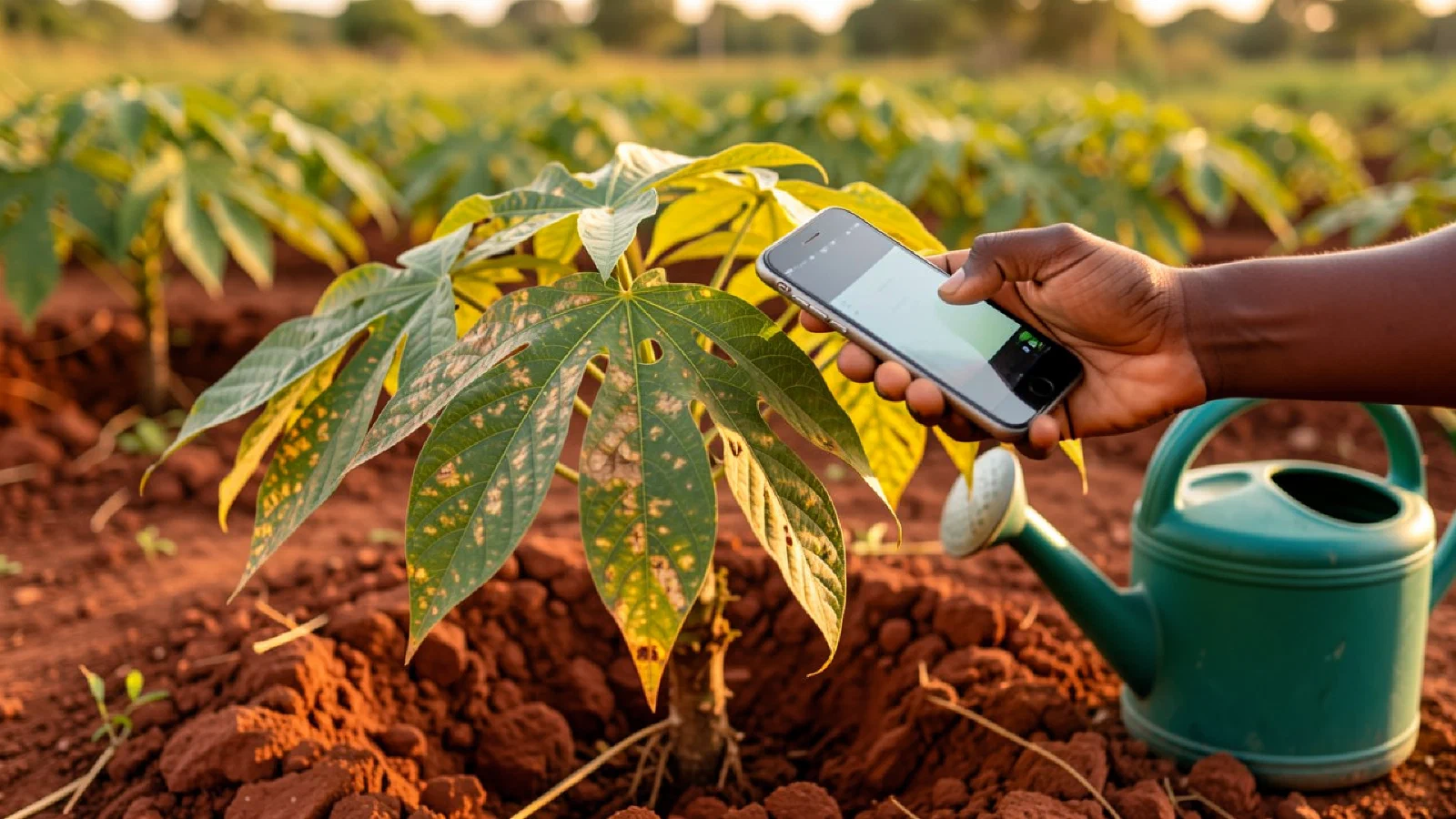
Picture the woman the system was not optimized around. She lives outside Kumasi, in Ghana’s Ashanti region, and she speaks Twi at home and some English for commerce. The free system’s Twi is thin and brittle, fluent in the way a phrasebook is fluent, the words of a textbook rather than the words of the market where she sells yam. Her work is agricultural and local, full of knowledge the system never saw because no one wrote it down in a form a model could ingest. She wants to know whether the blight on her cassava is the kind that spreads or the kind that stays, and the system offers her a paragraph about cassava cultivation in general, sourced from an agricultural extension manual written for a different continent’s climate. Her question arrived over a connection that drops, in a mix of Twi and English the system parsed badly, about a situation with no parallel in the training data. The free system met her with its worst self, the self at the far edge of its competence, and the fact that this worst self costs her nothing does not make it adequate. A bridge that holds the average traveler and gives way under everyone heavier is not free infrastructure. It is a hazard offered at no charge.
She is not the only person at the edge. Consider the retired shopkeeper in Marrakech who speaks Darija, the Moroccan Arabic that is technically Arabic and practically its own language, different enough from Modern Standard Arabic that a model trained on news text and novels understands him the way a Parisian understands a Cajun. He is seventy-one and trying to navigate a government benefits portal that was built for people who learned to use computers before they learned to need them. The free system is available to him. It answers in Modern Standard Arabic, which he reads slowly and trusts less than the dialect he thinks in, and it assumes a familiarity with digital forms that he does not have and should not need. He is urban, connected, and literate. He is also at the edge, because the edge is not only rural. It is everywhere the average does not reach, and it reaches less of the world than the people at the center tend to imagine.
This is the phrase the series keeps returning to, and it is not a slogan. I am not average. No one is. The average is a construction that describes a population and fits no individual in it exactly, and the further a real person sits from that construction, the less the system built around it has to offer them. For the people near the center the gap is small and forgivable. For the people at the edge the gap is the whole experience.
And most of the world lives at the edge. This is the part that resists intuition for anyone whose own life sits near the center. The speakers of major languages are a minority of humanity. The people with reliable high-speed connection are a minority. The people whose work and lives are well represented in the text a model trained on are a small and unrepresentative slice. The average the free system optimizes toward is not the middle of humanity. It is the middle of the population that was profitable and legible enough to learn from, and that population is far smaller and far richer than the species it gets mistaken for.
The mistake is not counting wrong. It is forgetting that legibility and value are not the same thing. The woman outside Kumasi knows things about cassava blight that no dataset contains, because she learned them from her mother and her mother’s mother and they never wrote it down because writing it down was not part of how the knowledge lived. The shopkeeper in Marrakech has sixty years of negotiation instinct in a souk economy that no training run captured, because Darija commerce runs on spoken rhythm and trust and the kind of knowledge that does not survive translation into Standard Arabic, let alone English. Both are knowledgeable people. Neither is legible to a system that learned what it knows from text on the internet, and their illegibility is not their failure. It is the system’s boundary, presented as a universal.
A floor is the thing built for the people the average leaves out. Not a better average, a wider one, which would only move the edge somewhere else. A floor is built on a different principle: that the measure of the system is how it treats the person at the margin, not the person at the center, because the person at the center was always going to be fine. The center takes care of itself. It is profitable. The market finds it. The floor exists for everyone the market’s optimization quietly leaves behind, and it has to be designed around them from the start, because a system designed around the average and then patched outward will always be a center with apologies at its edges.
I wonder whether the people who will tell you the free systems make a floor unnecessary have ever been the far point in someone else’s average.
The woman outside Kumasi with the dropping connection does not need the system to be free. The free system is already available to her, and it already fails her, and its being free is no comfort at all. The shopkeeper in Marrakech does not need a more powerful model. He needs one that speaks to him the way he speaks to himself. What both of them need is a system that was built with them at the center of its concern rather than at the vanishing edge of its competence. That system may also be free. But its freeness is not the point, and it was never the point. The point is who it was built to hold.
The bottle being handed out for nothing is still a bottle of someone else’s water, formulated for someone else’s thirst. For the people it suits, the price of zero is a gift. For the people it does not suit, zero is just the price of being told, one more time, that the thing was not made with them in mind. The gift and the dismissal are the same object. The only difference is where you stand when you receive it.
How this essay connects to others across The Approximate Mind.