The Composed Answer
A decentralized system does not give poorer people a weaker mind. It gives them a different one, assembled from pieces that know them.
TAM-CMN.07 · The Common Mind · The Approximate Mind
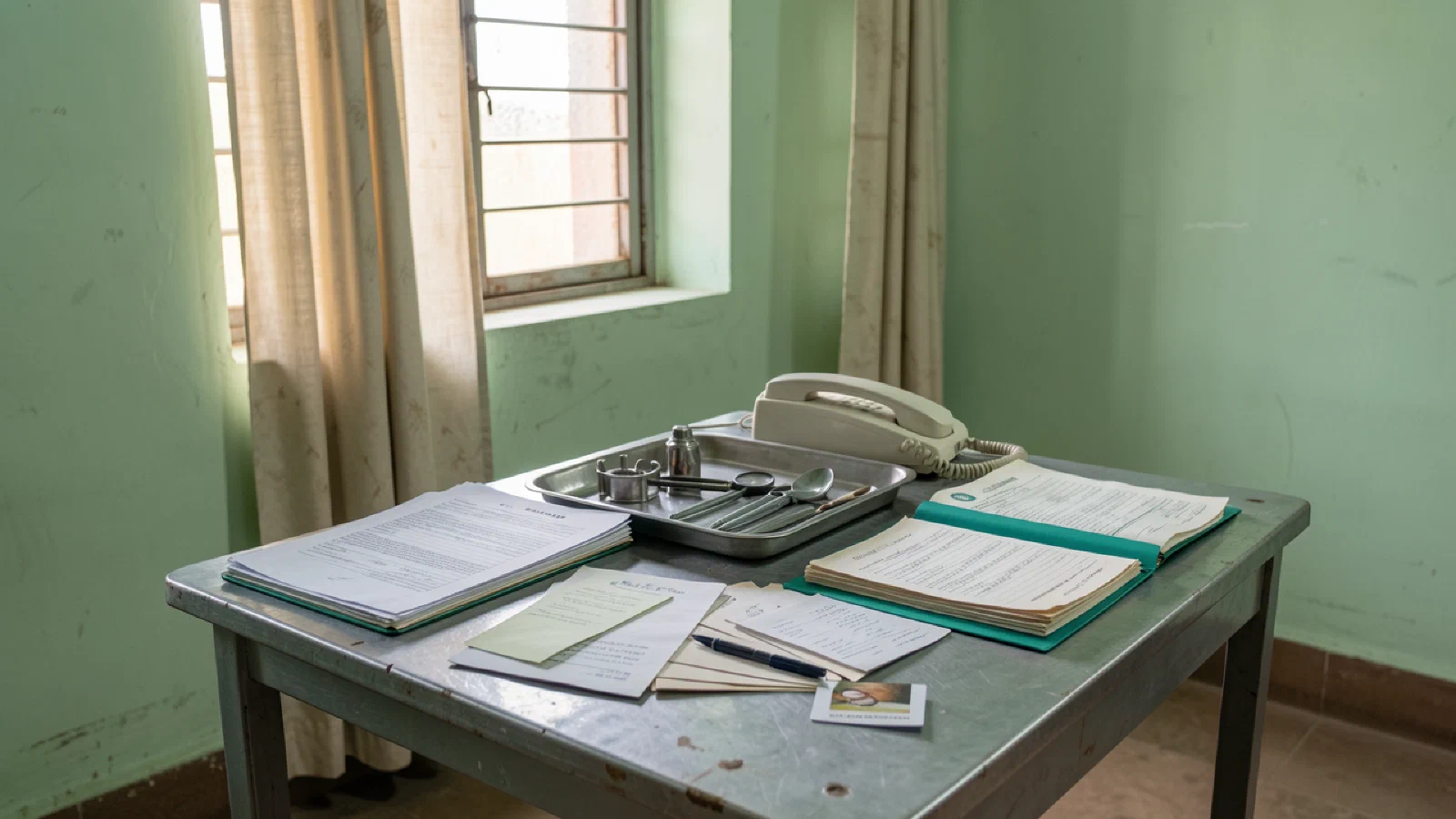
A woman arrives at a regional clinic in Odisha with chest pain, shortness of breath, and a history that is complicated in ways the frontier was not built to see. She is fifty-three, diabetic, on two medications that interact, and she has been treated for tuberculosis twice, the second time incompletely, which left scarring that shows on a chest X-ray and looks, to a system that does not know her history, like something worse. She speaks Odia. Her records are split across two facilities, one of which still uses paper. The question the clinic needs answered is not simple, and the answer, if it is going to be right, has to be composed from pieces that live in different places.
The local model knows the drugs she is on and flags the interaction. It has seen her glucose trajectory and knows it has been worsening. The regional health model knows the TB scarring pattern and can distinguish it from the cardiac finding the X-ray might otherwise suggest. The agricultural season matters too, because she is a farmworker whose symptoms worsen during harvest when the hours are longest and the dust is thickest, and the model that knows the local crop calendar carries that context. Her caste and gender intersect with her access to follow-up care in ways the system needs to account for without reducing her to a demographic label. None of these pieces, taken alone, is the answer. The answer is composed from all of them, assembled in real time, for this person, in this moment.
The frontier could attempt this. It would bring its vast general knowledge to bear on the question, and it would get some of it right. It would not know her medication history, because that lives in a local system it has no access to. It would not know the TB scarring, because it has never seen her prior imaging. It would not know the harvest calendar or the dust or the caste dynamics of follow-up care in rural Odisha, because none of that was in its training data. It would answer with confidence from what it knows, which is a great deal about medicine in general and very little about this woman in particular.
The frontier knows everything about everyone in general. The floor knows what matters about this person in particular.
The composition layer is where this happens, and it is the part of the architecture that has no equivalent in the centralized model. A single large model holds everything it knows inside itself, fused together during training, inseparable afterward. It cannot update one piece without retraining the whole. It cannot add local knowledge without diluting global knowledge, or prioritize a regional context without demoting another. The composition layer works differently. It assembles context dynamically, pulling from the models and data sources that are relevant to the question being asked, at the moment it is being asked, for the person asking it.
The drug-interaction model contributes what it knows. The regional health model contributes the TB history. The temporal model contributes the glucose trajectory. The local context layer contributes the harvest calendar and the dust exposure. The composition layer holds all of these in relation to each other, for this query, and produces an answer that none of the pieces could have produced alone. When the question is resolved, the assembly dissolves. The next question, from a different person with a different history, assembles a different constellation from the same and different pieces.
What makes this more than a technical trick is what it means for the person at the intersection. The woman in the clinic is not one thing. She is not only diabetic, not only a TB survivor, not only a farmworker, not only Odia-speaking, not only lower-caste, not only a woman in rural India whose access to follow-up care is shaped by all of these at once. A system that knows one of these dimensions and not the others will get her partly right, which for a medical question can mean getting her wrong. A system that flattens her into a demographic composite will miss the specific way these dimensions interact in her life, because the interaction is not a sum. It is a shape, particular to her, and the composition layer is the place where that shape can be held.
This is where the intersectional argument enters the architecture, not as a policy aspiration but as an engineering requirement. A monolithic model trained on global data will have learned averages for each dimension separately: what diabetic patients generally need, what TB survivors generally face, what farmworkers are generally exposed to. It will not have learned how these interact for a lower-caste woman in Odisha during harvest season, because that intersection was never a significant enough cluster in its training data to emerge as a pattern. The composition layer does not need the intersection to exist as a pattern in a global dataset. It assembles the intersection in real time from the components that each know their own piece, and the answer it produces is specific to the woman, not to a category she has been assigned to.
This is not weaker than the frontier. It is a different kind of intelligence, one that is relational rather than monolithic, and for the problems the floor exists to solve, the relational kind is often the one that matters. The frontier’s strength is breadth: it knows a vast amount about a vast range of subjects. The floor’s strength is composition: it knows the specific things about a specific person and can bring them together in the moment they are needed. These are different capabilities, and the question of which one serves the woman in the clinic better is not close.
There is a piece of knowledge at the center of this that deserves its own weight, because it is the piece the centralized model can never hold. The nurse at the clinic knows that this patient’s daughter usually brings her but did not today, and that when the daughter is absent the patient minimizes her symptoms. The neighbor who sometimes drives her mentioned last week that she had been coughing at night. The pharmacist at the local medical shop knows she has not refilled one of her prescriptions in six weeks. None of this is in any formal record. All of it matters. It is the kind of knowledge that exists only in relationships, in the small observations that people who see each other regularly accumulate without trying.
A centralized system, however powerful, has no mechanism to hold this. It does not know the nurse, the neighbor, or the pharmacist. It does not have access to the texture of a life observed over years by the people around it. The composition layer can hold it, if the people who carry it choose to contribute it, because the layer is local and the knowledge stays local and the trust that governs whether it is shared at all is local trust, not trust in a distant corporation. This is the relational knowledge this collection calls the blue mug (The Blue Mug), the irreducible (The Irreducible), the thing that cannot be centralized because it exists only in the particular relationship between this person and the people who know her.
I wonder whether the most important knowledge about a person is always the knowledge that lives in the people around them rather than in any system at all.
The clinic in Odisha will not experience any of this as a technical architecture. The nurse will ask a question, the answer will come back, and it will be an answer that accounts for the drugs and the scarring and the glucose and the season and the missed prescription. She will not know that seven models contributed, or that the composition layer assembled them, or that the frontier was never consulted because it did not need to be. She will know that the answer was right, and that it was right in a way that reflected the patient she has been seeing for three years, not a statistical average of all patients everywhere.
The woman will go home with an adjusted prescription and instructions to come back in two weeks, and her daughter, who could not make it today because of the harvest, will call the clinic to ask what the doctor said. The nurse will tell her. The knowledge will move the way it has always moved in a place like this, from person to person, carried in language and trust and the small acts of attention that no model, however large, can replace. The floor’s job is not to replace that movement. It is to make sure the clinical answer underneath it is as good as the relational knowledge around it deserves.
How this essay connects to others across The Approximate Mind.