The Capital View
What the Investment Thesis Knows That We Have Not Said Out Loud
TAM-CV.01 · The Capital View · The Approximate Mind
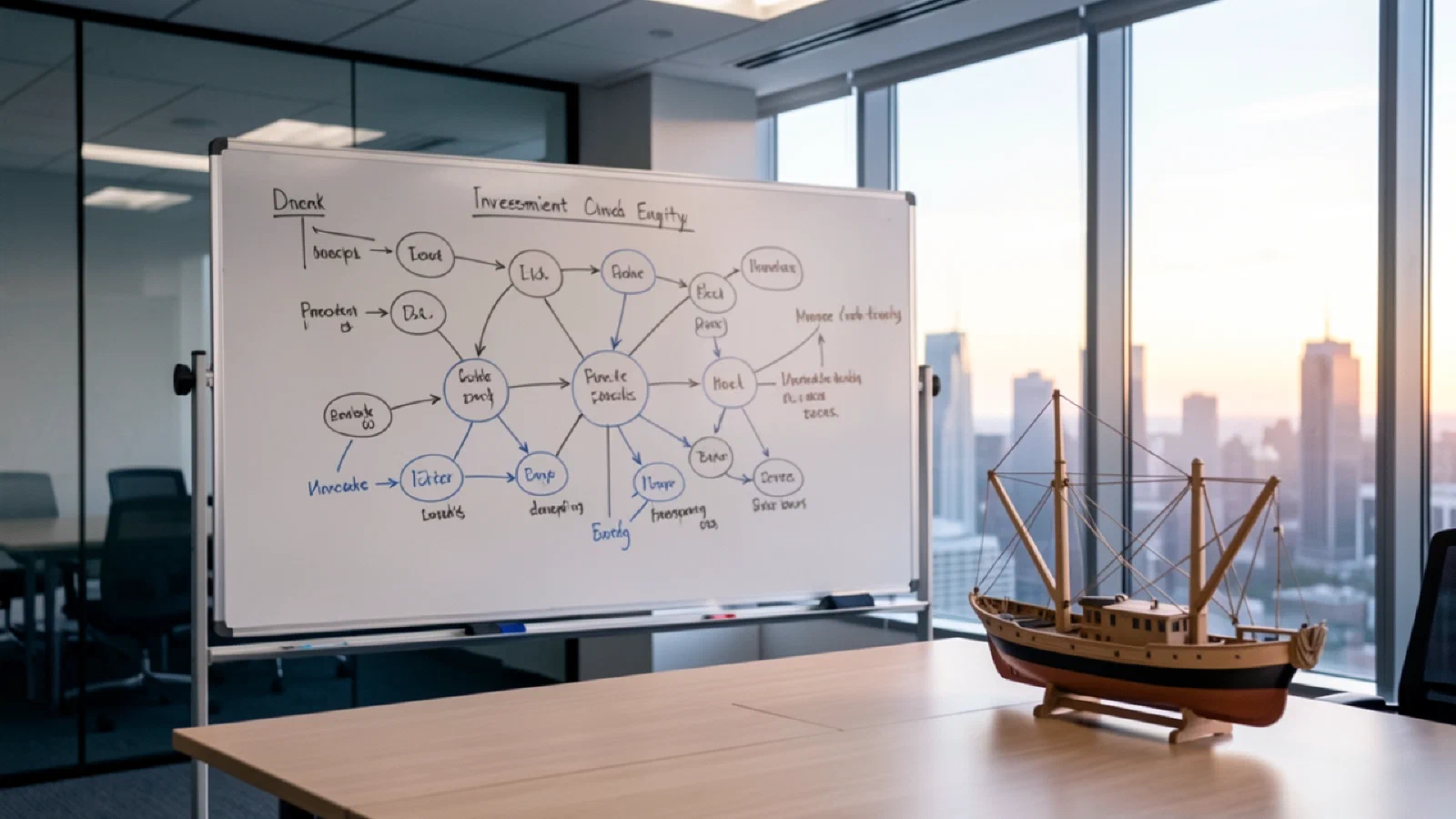
Marcus keeps a small wooden model of a fishing trawler on the corner of his desk. He bought it in Portugal twenty years ago, during his first deal that closed in Europe, and has moved it through four offices since. He does not fish. He has never explained the trawler to anyone who has asked, which is not many people, because most people who sit across from Marcus in his office are not looking at the desk.
He spent most of his career in healthcare services. Not the clinical side, the infrastructure side: the consolidation of fragmented provider networks, the installation of shared services, the extraction of operational efficiency from industries that had accumulated inefficiency across decades of growth without coordination. He is good at seeing where value is trapped and designing the structure that frees it. He has made a considerable amount of money doing this, which does not embarrass him. He believes the industries he has worked in function better after he has been in them, and he has enough evidence to hold this belief without strain.
He asked for the meeting because he wanted to understand something. Not to pitch. He had read enough of the project to know that the questions being asked here were close to the questions he was asking himself, from the other side of the ledger. He wanted to see whether the views converged.
They did, more than either of us expected. And the convergence was not comfortable.
The Thesis#
The standard pitch for AI in fragmented service industries runs like this. Labor costs are high. Demand exceeds supply. AI reduces the administrative burden on each worker, so each worker can serve more clients. The same headcount generates more revenue. Margins improve. The consumer gets faster, cheaper service. Everyone wins.
This is not wrong. It is also not the real thesis.
The real thesis starts with a question about ratios. Not whether AI improves efficiency, but by how much, and what that number means for the structure of the industry.
If demand is running at 120% of current supply, the comfortable story holds. A 20% efficiency gain closes the gap. Same workers, same service, same human relationship, less friction. The rollup acquires regional players, installs the AI layer, watches the numbers improve, exits at a healthy multiple. This version exists, and it is real, and it is the version most people imagine when they hear the pitch.
But Marcus had been doing the demographic math.
Ten thousand Americans turn sixty-five every day. The care workforce is not growing at anything close to that rate. Reimbursement structures in home care have kept wages low enough that recruitment and retention are persistent crises. The supply gap is not 20%. In home care, in certain regions, in memory care specifically, the gap between what families need and what the workforce can provide is closer to 200%. In some projections, significantly more.
At 200%, the comfortable story stops being true.
At 200%, a 20% efficiency gain does not close anything. It does not even make the gap less visible. What it does is prove that the model can scale, which changes what you build next. You build not to fill the gap with augmented human labor but to create a new tier of service that does not require human labor for the routine components. Robotic medication dispensers. AI care companions for the hours no aide can cover. Sensor networks that monitor without requiring anyone to watch. The routine becomes autonomous. The human is reserved for what the autonomous system cannot handle.
This is a qualitatively different business than the 120% pitch. Different capital structure. Different exit. Different thing you are selling.
And if the gap is not 200% but 500%, as some projections for memory care in the next decade suggest, the logic shifts again. At 500%, there is no version of the world where augmented human labor closes the gap. The gap is structural and demographic and getting wider. Which means the question is not how to make human care more efficient but what you offer to the people for whom human care will not exist, and how you price the human tier for those who can still access it.
Marcus had run all three scenarios. He had a fourth.
The Agent Problem#
The fourth scenario does not involve a demand-to-supply ratio. It involves a change in who is doing the transacting.
The consumer who wants home care for an aging parent currently navigates a fragmented market of providers, each with their own intake process, their own pricing, their own availability calendar. The friction is high. The information asymmetry is enormous. Families pay more than they should for less than they need because finding, vetting, and coordinating providers requires expertise and time that most families do not have.
The rollup reduces this friction. The orchestration layer sees the full picture. The consumer pays one price for a bundled service that previously required seven separate relationships. The toll booth that each provider was operating collapses into a single, more rational toll.
But the consumer in this scenario is still a person navigating a screen, making calls, trying to understand what their parent needs and what the options are. They are still in the loop.
The fourth scenario removes them from the loop.
If the consumer has a personal AI agent, and the PE firm’s orchestration layer has an agentic API, the consumer’s agent negotiates directly with the firm’s system. It identifies the parent’s needs. It queries available services, compares outcomes data, evaluates pricing. It routes to the best match, handles the intake, manages the scheduling. The consumer approves the result. They do not navigate. They decide.
This sounds like a better consumer experience, and it is. It is also the scenario that makes Marcus most careful about how he structures the platform.
When the consumer’s agent can see your margin, the margin has to be justified.
Not by friction. Not by the information asymmetry that made the old model possible. By actual value creation: the outcome data, the care coordination, the horizontal bundle that no consumer’s agent can replicate by querying individual providers. The toll booth economy that built the original business dissolves when the agent can route around every basis point of rent that is not attached to genuine value. The moat has to be real.
Marcus understood this. He was building for it. The question was whether everyone else in the deal would understand it before the market explained it to them.
What the Thesis Sees#
The project that produced the essays this arc belongs to has been following the AI transition from inside it, from the position of the workers and families and institutions being reorganized. The Transformed examined what happened to professions. The Assembled Life asked what happened to the daughter when her coordination labor became a product. The Last Human Service asked what happened in the room where none of this logic fully applies.
Marcus was reading the same transition from outside it, from the position of the capital that is organizing it. He was not indifferent to what the essays described. He found the blue mug argument, as he called it, genuinely difficult to think around. He returned to it.
But he was also clear about what capital sees that the human-side analysis tends to underweight.
Capital sees the gap. The 200%, the 500%. The ten thousand people turning sixty-five today, and the workforce that will not be there for them, and the technology that might be. Capital sees that the choice is not between the current human system and the AI-mediated one. The current system is already failing. The choice is between a well-designed AI-mediated system and a badly designed one, or no system at all.
This is not a comfortable argument to make in proximity to the blue mug, which is why Marcus made it quietly, looking at the trawler.
The gap is real. The question is who fills it and what they build.
What private equity builds depends on what it is optimizing for. Returns, primarily. But returns in a market with 500% demand overhang and demographic tailwinds that will not relent are not captured by cutting corners on the care. They are captured by building something that works well enough that families trust it, that regulators permit it, that the outcome data compounds into a defensible asset. The incentive to build it well is not entirely separate from the incentive to build it.
Marcus believed this. I found myself believing that he believed it, which is a different thing and probably the more relevant assessment.
What the Thesis Does Not See#
The investment memo does not have a line item for the blue mug. It has lines for labor costs, revenue per client, EBITDA margins, exit multiples. It has a section on regulatory risk and a section on workforce retention and a section on technology execution risk. It does not have a section on what Barbara is doing when Dora is not there.
This is not cynicism. It is the nature of the instrument. A capital structure is designed to allocate resources toward returns, and returns are what can be measured, and what can be measured is a subset of what matters. The memo is not wrong about what it measures. It is limited by what it can see.
This arc is an attempt to read the transition from both sides at once: the capital logic and the human reality it organizes around. Not to reconcile them, because they do not reconcile. Not to declare one primary and the other derivative. Both are real. The gap between them is where the interesting questions live.
Marcus closed his notebook at the end of the conversation. He looked at the trawler for a moment. He said that the thing about a well-run rollup is that it has to understand what it is providing at the level of the person receiving it, because if it loses that understanding, it starts optimizing for the metrics rather than for the thing the metrics are supposed to measure, and then the metrics get better and the thing gets worse and eventually someone notices.
He did not say what happens when someone notices. He picked up his phone.
The trawler stayed where it was, which is where it always is.
This is the first essay in The Capital View, a twelve-essay arc examining the AI transition from the position of capital. It opens the arc by establishing the investment thesis and the four demand-to-supply scenarios that determine whether the thesis produces augmentation, displacement, or something neither category adequately names. The essays that follow examine the three service tiers (The Premium Human), the horizontal composition logic that replaces the daughter (The Assembled Life), the base tier with no human in the loop (The Empty Visit), the room where the logic breaks (The Last Human Service), the platform as independently valuable asset (The Dual Asset), the general pattern of capital enclosure (The Enclosure of Coordination), the asymmetric deployment of AI across populations (The Asymmetric Transition), a practitioner brief for the PE audience (The Capital Brief), and the extension in which the coordination function itself becomes contestable: the coordination layer as an addressable market (The Addressable Layer), the race to own it (The Platform Race), and the cooperative counter-case (The Counter-Thesis). This arc connects to the toll booth economy argument in The Curation Economy and The Choreographed Market; to the dissolved middle in The Dissolved Middle; to the distillation thesis in The Gravity; and to The Transformed’s analysis of what professions provide that their products do not (The Irreducible).
References#
Private Equity Structure and Healthcare
Appelbaum, Eileen, and Rosemary Batt. Private Equity at Work: When Wall Street Manages Main Street. Russell Sage Foundation, 2014.
Gondi, Suhas, and Zirui Song. “Potential Implications of Private Equity Investments in Health Care Delivery.” JAMA, vol. 321, no. 11, 2019, pp. 1047-1048.
Scheffler, Richard M., et al. “Monetizing Medicine: Private Equity and Competition in Physician Practice Markets.” Health Affairs, vol. 42, no. 6, 2023, pp. 765-774.
Aging Demographics and Supply Gap
Genworth Financial. Cost of Care Survey 2023. Genworth, 2023.
Paraprofessional Healthcare Institute. Direct Care Workers in the United States: Key Facts. PHI, 2023.
United States Census Bureau. The Graying of America: More Older Adults Than Kids by 2035. U.S. Census Bureau, 2018.
AI, Agentic Systems, and Market Structure
Brynjolfsson, Erik, and Andrew McAfee. The Second Machine Age: Work, Progress, and Prosperity in a Time of Brilliant Technologies. W. W. Norton, 2014.
Parker, Geoffrey G., et al. Platform Revolution: How Networked Markets Are Transforming the Economy and How to Make Them Work for You. W. W. Norton, 2016.
Fragmentation and the Toll Booth Economy
Autor, David, et al. “The Fall of the Labor Share and the Rise of Superstar Firms.” Quarterly Journal of Economics, vol. 135, no. 2, 2020, pp. 645-709.
Wu, Tim. The Curse of Bigness: Antitrust in the New Gilded Age. Columbia Global Reports, 2018.
Value Creation and Measurement
Mazzucato, Mariana. The Value of Everything: Making and Taking in the Global Economy. PublicAffairs, 2018.
Stout, Lynn A. The Shareholder Value Myth: How Putting Shareholders First Harms Investors, Corporations, and the Public. Berrett-Koehler, 2012.
How this essay connects to others across The Approximate Mind.
- Appelbaum, Eileen, and Rosemary Batt. Private Equity at Work: When Wall Street Manages Main Street. Russell Sage Foundation, 2014.
- Gondi, Suhas, and Zirui Song. “Potential Implications of Private Equity Investments in Health Care Delivery.” JAMA, vol. 321, no. 11, 2019, pp. 1047-1048.
- Scheffler, Richard M., et al. “Monetizing Medicine: Private Equity and Competition in Physician Practice Markets.” Health Affairs, vol. 42, no. 6, 2023, pp. 765-774.
- Genworth Financial. Cost of Care Survey 2023. Genworth, 2023.
- Paraprofessional Healthcare Institute. Direct Care Workers in the United States: Key Facts. PHI, 2023.
- United States Census Bureau. The Graying of America: More Older Adults Than Kids by 2035. U.S. Census Bureau, 2018.
- Brynjolfsson, Erik, and Andrew McAfee. The Second Machine Age: Work, Progress, and Prosperity in a Time of Brilliant Technologies. W. W. Norton, 2014.
- Parker, Geoffrey G., et al. Platform Revolution: How Networked Markets Are Transforming the Economy and How to Make Them Work for You. W. W. Norton, 2016.
- Autor, David, et al. “The Fall of the Labor Share and the Rise of Superstar Firms.” Quarterly Journal of Economics, vol. 135, no. 2, 2020, pp. 645-709.
- Wu, Tim. The Curse of Bigness: Antitrust in the New Gilded Age. Columbia Global Reports, 2018.
- Mazzucato, Mariana. The Value of Everything: Making and Taking in the Global Economy. PublicAffairs, 2018.
- Stout, Lynn A. The Shareholder Value Myth: How Putting Shareholders First Harms Investors, Corporations, and the Public. Berrett-Koehler, 2012.