The Tuesday
The case that the buying side never arrives: forty years of the box on the porch say households will not precommit their demand.
TAM-ARB.31 · Arbitrage · The Approximate Mind
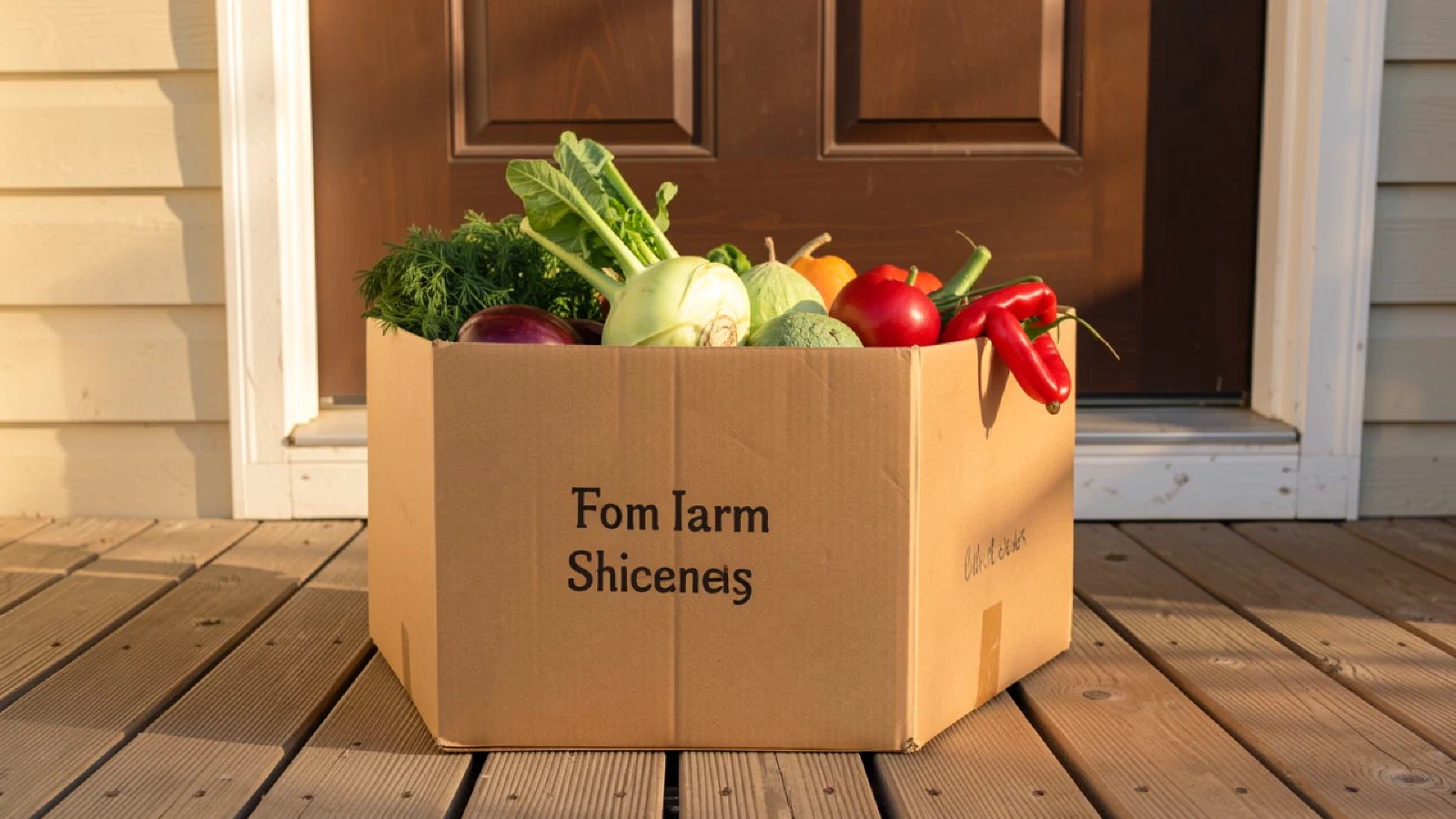
The box is on the porch on Wednesday, and by the second August it has become a reproach.
In June it was a project. The family signed up in the spring, when the farm’s flyer was on the co-op corkboard and the idea of a weekly share of whatever the season gave felt like the right kind of commitment: to the farm, to the county, to a version of themselves that cooks. The first boxes were an event. The children learned what garlic scapes were. Then July brought the fourth consecutive week of summer squash, and August brought the kohlrabi, and the box began arriving into a kitchen that had already eaten out twice that week, and the vegetables started making the slow journey from crisper drawer to compost with a stop of about nine days in between, during which they functioned mainly as evidence. The family does not renew. They feel bad about it, which is worth noticing, because feeling bad about it changes nothing. Roughly half the households who join a community farm share in any given year make the same decision they did.
That box has been arriving on American porches for forty years. It is the longest-running field trial ever conducted on the question this essay exists to settle, and its result is in.
The Record#
Community-supported agriculture is the buying side of the ledger, already built. A household commits in advance to a season of demand; the farm plants against the commitment; the distributor’s spread, the retail markup, and the persuasion budget all vanish from the price; both sides pool risk across the season. It is the forward contract on dinner, operating since the 1980s, endorsed by every food writer of three decades, subsidized by nonprofits, championed by universities, and loved, genuinely loved, by the people who quit it.
After forty years it feeds a fraction of one percent of the country. The count of farms running shares in the United States has sat in the low thousands for two decades, growing and shrinking with press cycles, never breaking out. Annual non-renewal runs somewhere between a third and half of members, year after year, at farms that do everything right. The model’s own advocates publish papers about the churn. And the churn is not a marketing failure, a pricing failure, or a logistics failure, because all three have been fixed repeatedly, by better farms, choice boxes, flexible weeks, pause buttons, and the churn survives every fix. Whatever is failing is underneath all of that.
The machine, in one sentence: a forward commitment on household demand asks a person to bind their future appetite to their present intention, and the person’s future self, who never signed anything, defaults at the rate of roughly half per year, which is the same intention-action gap this arc priced in finance, standing this time on the seller’s side of the contract.
The symmetry deserves a moment, because it is the arc’s own logic turned against the arc. The taken-advice essay established that financial products were priced on the certainty that households would not do what they intended. The buying side asks households to intend harder. It proposes to build an economy on the one behavior forty years of evidence says households will not supply: sustained, voluntary precommitment of their own future wants.
The Half That Cannot Be Forecast#
The optimist’s arithmetic says a household’s demand is mostly repetition. The same coffee, the same milk, the same onions, the winter’s heating oil: call it eighty percent forecastable, commit that, and let the remainder stay free.
Walk through an actual week and the eighty percent thins. Tuesday’s dinner was going to be the chicken, and then a colleague suggested the new Sichuan place, and the chicken moved to Wednesday, except Wednesday the teenager announced two friends were coming, so Wednesday became pasta for five, and the chicken went in the freezer, where it joined the other chicken. Thursday the diet started. The diet had been decided Sunday, abandoned by the following Sunday, and during its one-week life it rewrote the entire shopping pattern. None of this is exceptional. This is what a household is. Demand for food is not a consumption schedule with noise on top; it is a running expression of mood, company, weather, aspiration, and fatigue, and the expressive share is not the tail of the distribution. Count honestly, at the level of the actual plate rather than the pantry staple, and the unforecast share of what a household eats in a week is nearer half than a fifth.
The staples are forecastable, certainly. The staples were also never where the spread was. Flour, milk, and onions are the most efficiently distributed products in the economy, sold at margins a forward contract can barely improve on, because the supermarket already forecasts them at population scale with a precision no single household’s history can match. The forward’s promised gains live in the perishable, the particular, and the planned-ahead, which is exactly the territory the Tuesday governs.
The Agent Answer, and Why It Fails#
The obvious rescue says the machine fixes this. The household does not precommit; the coordination layer does. The person never signs anything, never feels bound, never faces a box of kohlrabi they no longer want, because the agent commits within a band, absorbs the swaps, and hides the contract the way the thermostat hides the furnace.
Three answers, in ascending order of weight.
First, the commitment surfaces anyway, because dinner is not settled at the interface. It is settled at the table. However elegantly the layer buffers, a forward on demand means that food shows up because past-you arranged it, and the household eats from its own forecast. The CSA’s discovery was precisely that the pain was never the signature; it was the arrival. The box itself, the obligation sitting in the refrigerator, the meal owed to a decision made in a different mood. Software moves the signature out of sight. It cannot move the arrival, and the arrival is where households defect.
Second, the band that is wide enough to be humane is too narrow to be worth anything. Make the commitment loose enough to absorb the Sichuan place, the teenager’s friends, and the one-week diet, and what has been committed is no longer a demand curve a farmer can plant against; it is a vague sympathy with a right of refusal, which is what a supermarket already offers. The spread the movement wants to capture is paid for exactly in the firmness the household will not supply. Tighten the band and you have rebuilt the box on the porch. Loosen it and you have rebuilt the store.
Third, the counterexample everyone reaches for proves the wrong thing. Households do buy forward, at enormous scale, at the warehouse club: the membership fee, the pallet of paper towels, the chest freezer in the garage. But look at what is actually committed there. Money, storage, and category, never the menu. The freezer is a forward the household writes to itself, exercised at its own pace, on shelf-stable goods, with no counterparty holding it to anything. The moment the commitment acquires a counterparty and a calendar, the moment someone else plants, plans, or delivers against it, participation collapses to the CSA’s rounding error. Forty years of both institutions running side by side is the controlled comparison: households will commit capital freely and appetite never.
What the Movement Is Actually Asking#
Underneath the architecture, the buying side asks for a psychological trade: surrender the Tuesday, receive the spread. The spread is real. On a household’s perishable food spend, honest arithmetic might find meaningful money, the distributor’s cut, the shrink, the persuasion budget, all returned to the ledger.
And the answer of the American household, delivered continuously since the Reagan administration, is no. Not no because the household is irrational, but no because the household is pricing something the movement’s arithmetic leaves out: the option value of an unbound week. The freedom to change your mind on a Tuesday, to be a slightly different family this week than the one that planned, is a good the household consumes constantly and would have to sell to fund the forward. The market has quoted that option for four decades. It is worth more than the vegetables.
The Frame#
Decision rule: underwrite no venture, cooperative, or platform whose unit economics require households to hold firm forward positions on their own consumption, whatever layer of software holds the pen, until it can show sustained multi-year retention that the forty-year record says does not exist; and read any pitch that begins with the forecastable eighty percent as having chosen the pantry’s denominator over the plate’s.
The box is still on the porch. It was the future, in 1986 and in every year since, and every year the same half of its believers quietly go back to deciding on Tuesday what Tuesday wants.
The Approximate Mind is a series exploring what AI actually does to human life. Arbitrage prices what the audit does to every spread it reaches.
How this essay connects to others across The Approximate Mind.