The Toll Collectors
The first arbitrage to fall is the one made of pure knowing, because the first machine we built was built to know.
TAM-ARB.03 · Arbitrage · The Approximate Mind
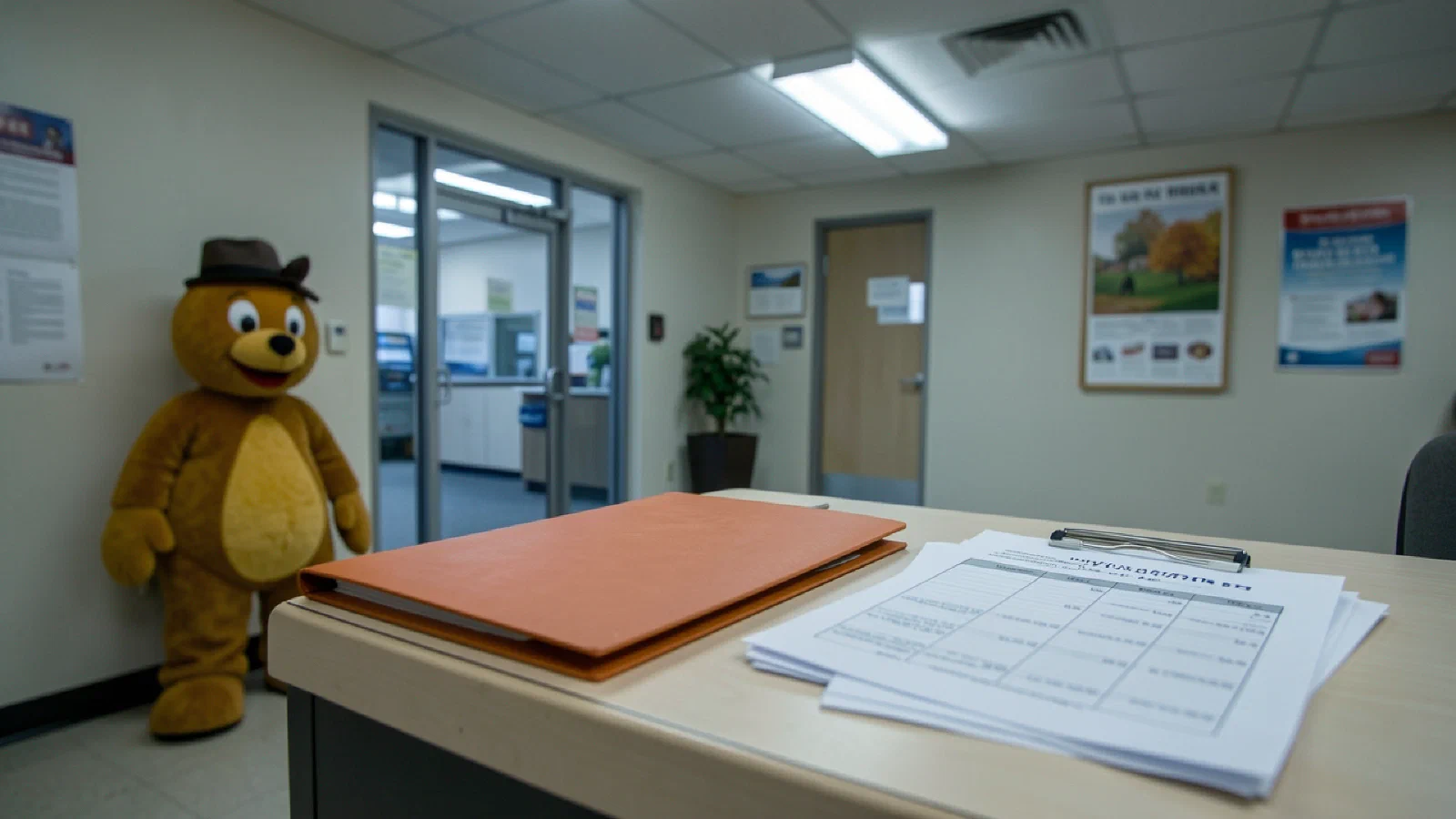
There is a tax office in a strip mall off the state route, between a phone repair place and a shuttered video store that has been shuttered so long the sign has faded to a rumor. In April there is a foam mascot out by the road, a person inside a costume shaped like a dollar sign or a green man or some other emblem of refund season, waving at the cars. Inside, under fluorescent light that makes everyone look a little ill, Ray does returns.
Ray is good at this. He has done it for nineteen years, the last eleven at this chain, and he is faster and more careful than the seasonal hires the company brings in every January and lets go every May. He has a daughter starting college in the fall, the first in the family, and a spreadsheet of his own at home that he does not need software to read, tracking what the tuition will cost against what he brings in during the four months of the year when this work pays.
He has watched the foot traffic thin for three seasons now. The first year he told himself it was the new chain that opened closer to the highway. The second year he told himself it was the economy. This year he has stopped telling himself things, mostly, and just watches the door.
The Class in Full#
What Ray sells is information arbitrage, the purest form of the spread, and he is one face of a class with many.
The insurance analyst sells it, reading the policy you cannot parse and telling you what it covers. The financial advisor sells it, choosing among products built to be just confusing enough that you need a chooser. The medical interpreter sells it, standing between the scan and your understanding of the scan. The contract reviewer sells it, the paralegal who reads the lease, the pharmacy-price arbitrageur who knows that the drug your insurer quotes at four hundred dollars is thirty at a pharmacy two miles away and profits, somewhere in the chain, from your not knowing it.
Every one of them charges for the same thing. The closing of a gap between information that is technically public and understanding that is functionally out of reach. None of them sells a secret. They sell the crossing of a distance, and the distance is the product.
It is worth lingering on how strange this is, because familiarity has worn the strangeness off. Ray does not own anything. He does not make anything. The forms he fills out are free, the rules he applies are published, the numbers he enters come off documents his clients carry in. If you laid out everything Ray uses on a single table, there would be nothing on it that his client could not also obtain, for nothing, in an afternoon. What the client cannot obtain in an afternoon is the nineteen years. The distance Ray sells is not a distance in space or in access. It is a distance in time and attention, the years it would take the client to learn what Ray already knows, and almost no one has those years to spare for a thing they do once a season.
That is the whole of the trade, and it has supported tens of millions of livelihoods. A vast share of what we call the service economy is people who learned a public thing well enough to be paid by people who did not have the time to learn it themselves.
This is the class that falls first, and it falls fastest, and the reason is specific enough to name in a single sentence. The large language model is an information-asymmetry machine. It is built, at its core, to take a body of text that means something and a person who needs to know what it means, and to put them in contact. Information arbitrage is exactly that gap and nothing else, which is why it is the visible front of the whole transformation, and why nearly everyone mistakes the visible front for the entire war.
The machine does not need the nineteen years. It does not need years at all. It arrives already holding the public thing, all of it, every form and rule and published number, and it hands the crossing to the client for the cost of the question. The distance Ray sold collapses, not because Ray got worse at his job, but because the time it encoded stopped being scarce.
The Gain, Said Plainly#
Before the part that hurts, the part that does not.
A farmer in Tamil Nadu who has sold his crop for years at a price set by a buyer who knew the market rate and knew the farmer did not now reads the real price off a fifty-dollar phone. The buyer’s margin, which was the farmer’s poverty, collapses. A woman in rural Bihar who needs a diagnosis the nearest specialist is five hundred miles and an unaffordable train ride away from reaches the specialist’s knowledge without the train. A borrower in Mississippi who could not afford the lawyer who would have caught the predatory clause now has the clause read to her, in plain words, by something that costs her nothing.
These are not small. Across the world, the information gaps that the toll collectors stood in have moved staggering sums from the people who could least afford the toll to the people positioned to collect it, for generations. Closing those gaps is, for the people who were paying, an unambiguous good. There is no other honest way to say it. The toll booths coming down is, for billions of travelers on roads they never chose, simple justice arriving late.
It is important not to flinch from how large this is, because the rest of the essay is going to complicate it and the complication should not be allowed to swallow it. The farmer who has been underpaid his whole working life by a buyer who knew the number is not a rounding error. Multiply him by the rural producers of an entire continent and you are looking at one of the largest transfers of value from the powerful to the powerless that any technology has ever made possible, and it is happening not through redistribution or charity or policy but through the simple collapse of an asymmetry that should never have been profitable in the first place. The people who paid these tolls did not paint them as crusaders. They experienced them as the way things were. The audit makes the way things were stop being the way things are, and for them, that is liberation, plainly and without an asterisk.
Hold that fully. Then hold the other thing.
The Toll Collector Was Also a Neighbor#
Ray is not a rent-seeking abstraction. He is a man with a daughter and a thinning client list and a costume waving at the road outside.
The class that is dissolving is not made of villains. It is made of people who found a gap and filled it and built lives in it, who are, most of them, decent at their work and decent to the people who come to them, who pay rent on the strip-mall unit and wages to the seasonal hires and tuition to the colleges. When the class dissolves, those lives dissolve with it, and the dissolution is a social event and not only an efficiency. The farmer’s gain is real. Ray’s loss is also real. They are happening to different people, in different places, which is exactly what makes the gain easy to celebrate and the loss easy to overlook.
The trouble is that the gain and the loss almost never sit in the same field of view. The farmer is in Tamil Nadu and Ray is in a strip mall off the state route, and no one stands in a position to see both at once, which means the public conversation gets to pick. It picks the gain when it wants to feel good about the technology and the loss when it wants to feel afraid of it, and both pictures are true and neither is the whole, and the people living inside either one do not experience it as a picture at all. They experience it as their year getting better or their year getting worse. Ray’s year is getting worse, and the reason is, in the largest sense, that a great many other people’s years are getting better, and that is a real moral fact and not a comfortable one.
The toll was a tax on the poor and a living for the neighbor, and the same machine ends both.
Where the Saved Fee Goes#
There is one more thing about the farmer’s gain, and it is the thread the consequence essays will pull.
The fee the borrower no longer pays the lawyer does not stay in the borrower’s pocket, or not for long, and not in the way you would hope. It is saved, yes, at the moment of the transaction. But the capacity that saved it, the machine that read the clause, is owned by someone, and that someone now captures, in aggregate, across every borrower and every clause, a value that used to be split among ten thousand lawyers in ten thousand towns. The information arbitrage does not democratize the value. It relocates it. The toll booth comes down and the toll, in a thinner and more concentrated form, reappears at the top of a structure the borrower cannot see. The savings are real. So is the relocation. We will get to who ends up holding it.
Think about what that does to a place. The ten thousand lawyers, the ten thousand Rays, were not only providers of a service. They were a distribution mechanism for money, a way that value spread out across ten thousand towns and got spent in ten thousand diners and paid ten thousand sets of local wages. The spread Ray collected was extraction from his clients, yes, but it was also a small engine of local circulation, dollars that came in and stayed near. When the spread relocates to the owner of the machine, it does not just change hands. It changes places. It leaves the town. The value that used to circle through the strip mall and the diner and the community college now flows, thin and continuous, to a balance sheet that is nowhere near any of them. The town does not only lose Ray’s job. It loses the circulation Ray’s job was part of, and that loss does not show up in the price of the service, which has only gone down, which looks, on every chart anyone will publish, like pure gain.
I wonder whether Ray will ever be told what happened to him, or whether he will simply keep explaining the thinning to himself, season by season, a slightly different story each year, until the lease is not worth renewing and the explanation no longer needs to be found.
The Mascot at Dusk#
At the end of an April day the light goes amber and then gray, and the foam mascot is still out by the road, because the company pays a kid by the hour to wear it until close, and the kid has earbuds in and is waving at a road with very little on it now. Ray watches through the window as he shuts down the workstations. The mascot waves at no one, at a Tuesday-evening road, tireless inside the foam, because that is the job, to wave whether or not anyone is there to see it.
Ray locks the door. The mascot is still going as he pulls out of the lot, waving at the empty road, indefatigable, never tiring, never stopping, attending to a road that has stopped attending back.
It is the one quality the costume shares with the thing that replaced him. Neither of them ever gets tired. Neither of them ever has to be told that the traffic is gone.
How this essay connects to others across The Approximate Mind.