The Thursday
The market's two jobs separate, and what the farm must become is legible to a machine that cannot be charmed.
TAM-ARB.35 · Arbitrage · The Approximate Mind
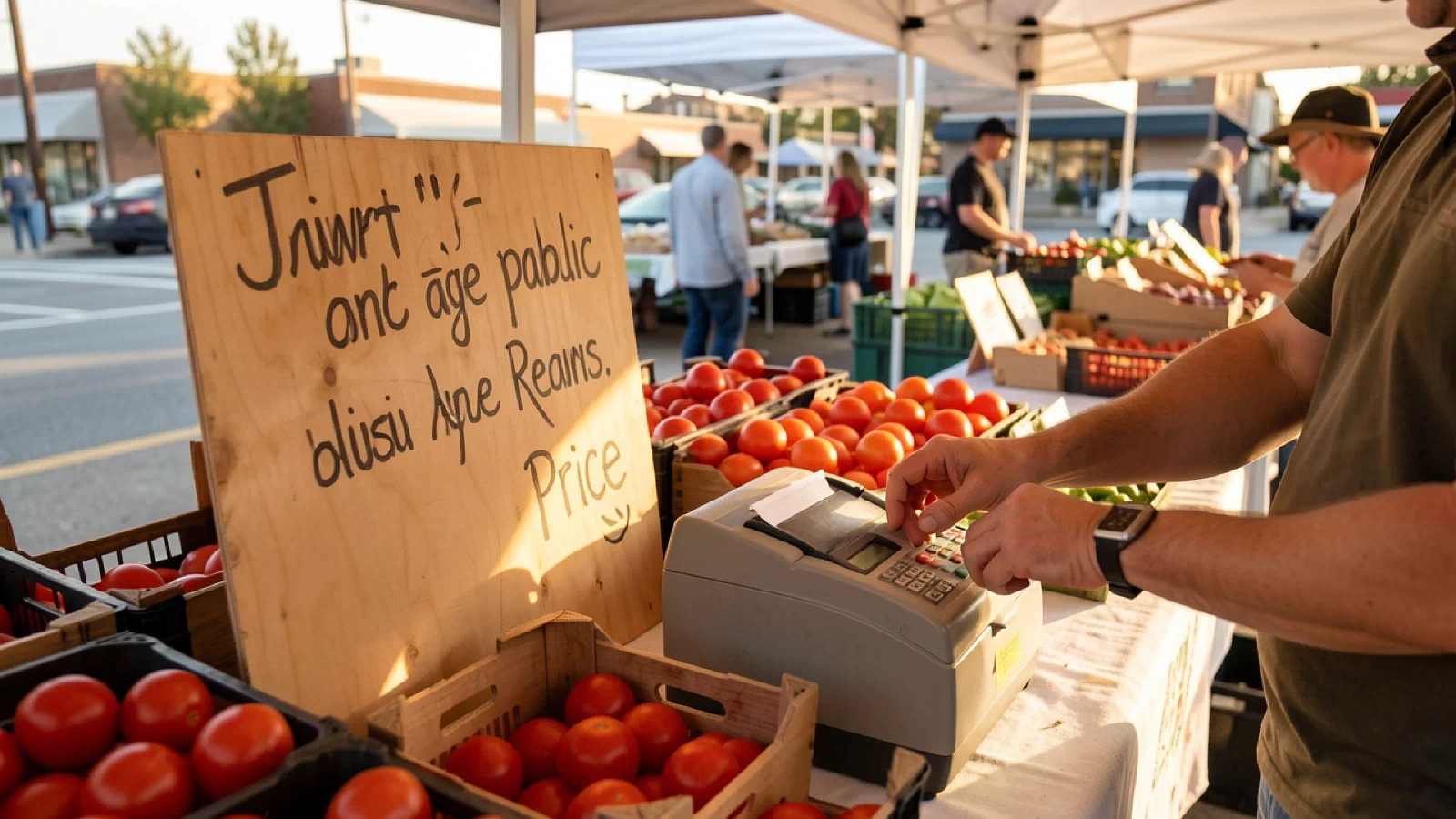
The market sets up on Thursday because it has always set up on Thursday, and by seven the tables are dressed: the tomatoes stacked with their best faces out, the hand-lettered sign about the frost, the farmer’s daughter making change and answering, for the fortieth time, the question about whether the corn is the good kind. It looks like commerce. It is, but not only. Watch the morning honestly and the market is running two operations at once. It is discovering demand, the farmer learning by two o’clock what the county wanted and at what price, and it is hosting an errand, the walk, the greeting, the weekly touch between people and the person who grows their food. Two jobs, one parking lot, and for as long as there have been market days nobody needed to notice they were separable.
The buying side separates them. The pooled forward does demand discovery better than the stall ever could, a season ahead instead of by two o’clock, and the congregation’s Sunday, or the commons the corpus has priced elsewhere, keeps the errand, the touch, the greeting, in rooms built for exactly that. The Thursday’s two jobs each go to a place that does one of them better, and this essay prices what that leaves the farm, because the farm is the counterparty of the whole movement, and a movement that prices only its buyers is a brochure.
The machine, in one sentence: the forward replaces the market’s demand discovery with a committed curve, which hands the farm the distributor’s old spread and a buyer that is not a middleman, and takes from the farm the one service the crowded stall provided free, a continuous public reading of what its goods were worth.
The Position, Both Sides#
What the farm gains is the finding of Agriculture inverted, and stating it plainly matters because the agriculture audit’s central sorrow gets an answer here. That essay found the farm squeezed by concentrated buyers who were also its data lords: a single processor’s price, take it or leave it, informed by information the farm would never see. The pooled forward is a committed buyer that is not a middleman, does not resell, does not hold the farm’s data against it, and pays the spread that the packing house, the distributor, and the shelf used to divide. A ten-acre operation that could never reach a supermarket’s loading dock can plant against a congregation’s curve. On the gaining side, the movement is the best thing to happen to small-scale agriculture since the refrigerated truck, and the essay does not hedge that.
The losing side is quieter and compounds. Price discovery is gone: a farm selling its whole crop forward at a negotiated band no longer learns, week by week, what the open market would have paid, and a seller who stops learning prices drifts toward accepting them. The buyer is singular: the previous essays priced the monopsony from the pool’s side, and from the field it looks like this, three seasons of specialized planting against one counterparty whose agent is loyal, by design, to the other side of the table. And the contract is on a crop that does not exist yet, which means the farm now holds basis risk, weather risk, and counterparty risk in a single document, where the Thursday spread all three across forty small transactions and a cash box. The farm’s position facing the movement is better and more fragile at once: better paid, worse informed, and concentrated. The covenant terms the pool essays demanded, floors, tenure, shared loss, are not charity toward the farm. They are the price of a supply base that does not hollow out.
What the Sell Agent Becomes#
The farm needs an agent too, and what that agent must be is the essay’s second finding, because it settles a question about a profession.
The buyer across the table is a machine reading structure. It does not walk the stall. It cannot be handed the good tomato. It scores the farm the way the corpus’s audits score everything: verifiable claims, checkable at low cost. Certification current, cold chain logged, yields honest against history, defect rates stated with a band, delivery reliability in writing. The farm’s sell agent, the thing standing where its marketing used to stand, becomes an engine of legibility: it makes the farm cheap to verify. Not attractive. Verifiable. The hand-lettered sign about the frost was persuasion for a buyer with a heart; its replacement is a data feed for a buyer with a checklist, and every dollar the farm once spent making its goods desired is respent making its claims checkable.
Marketing, as a profession, has now been walked to the edge it was always going to reach, and the honest finding is that it does not fall whole. It splits. The persuasion share, demand moved by feeling toward goods the buyer would not otherwise have chosen, dies wherever the forecast reaches, because the pooled flow is demand that persuasion can no longer move; that share was the profession’s bulk, and its collapse is real. Two remnants survive on their own economics. Introduction survives, because the forecast is built from history and history contains no new things: the novel crop, the new product, the thing nobody has bought yet still needs a channel to the unforecast remainder, the plate the against essay defended, which remains persuasion’s habitat because it remains free. And legibility survives, grows, in fact, as the discipline just described: the work of making a seller verifiable to buying machines. The profession’s fate is the series’ fourth fate, delamination, its layers pulled apart and priced separately, and the delaminated middle, the persuasion of the predictable, is the layer that goes.
The claim, dated. Horizon: end of 2031. By then, spending that now sits in consumer persuasion will be measurably migrating into structured product data, certification, and machine-readable seller claims, as buying agents at any pool scale become an audience that advertising cannot reach and verification can. Miss condition: if by 2032 persuasion budgets aimed at forecastable staples are intact and no legibility discipline has emerged as a spending category, then buying agents either failed to scale or turned out to be persuadable, and this essay’s split of the profession, along with more of the movement than this essay, was wrong.
The Frame#
Decision rule: on the buying side’s counterparty, hold the farm that pairs a pooled forward with kept optionality, some share of crop held back for open channels, so the price signal survives; require the covenant floors as underwriting, not ethics; and in the professions, back legibility infrastructure over persuasion capacity wherever the buyer is becoming a machine, because a spread built on being charming is short every checklist in the economy.
By two o’clock the market is breaking down, and the farmer counts the box and knows, the way she has known every Thursday of her working life, exactly what the county thought her work was worth. The forward will pay her better. It will never tell her that.
The Approximate Mind is a series exploring what AI actually does to human life. Arbitrage prices what the audit does to every spread it reaches.
How this essay connects to others across The Approximate Mind.