The Steepening
Not every arbitrage is dissolving. Two of them are becoming the steepest advantages in economic history.
TAM-ARB.07 · Arbitrage · The Approximate Mind
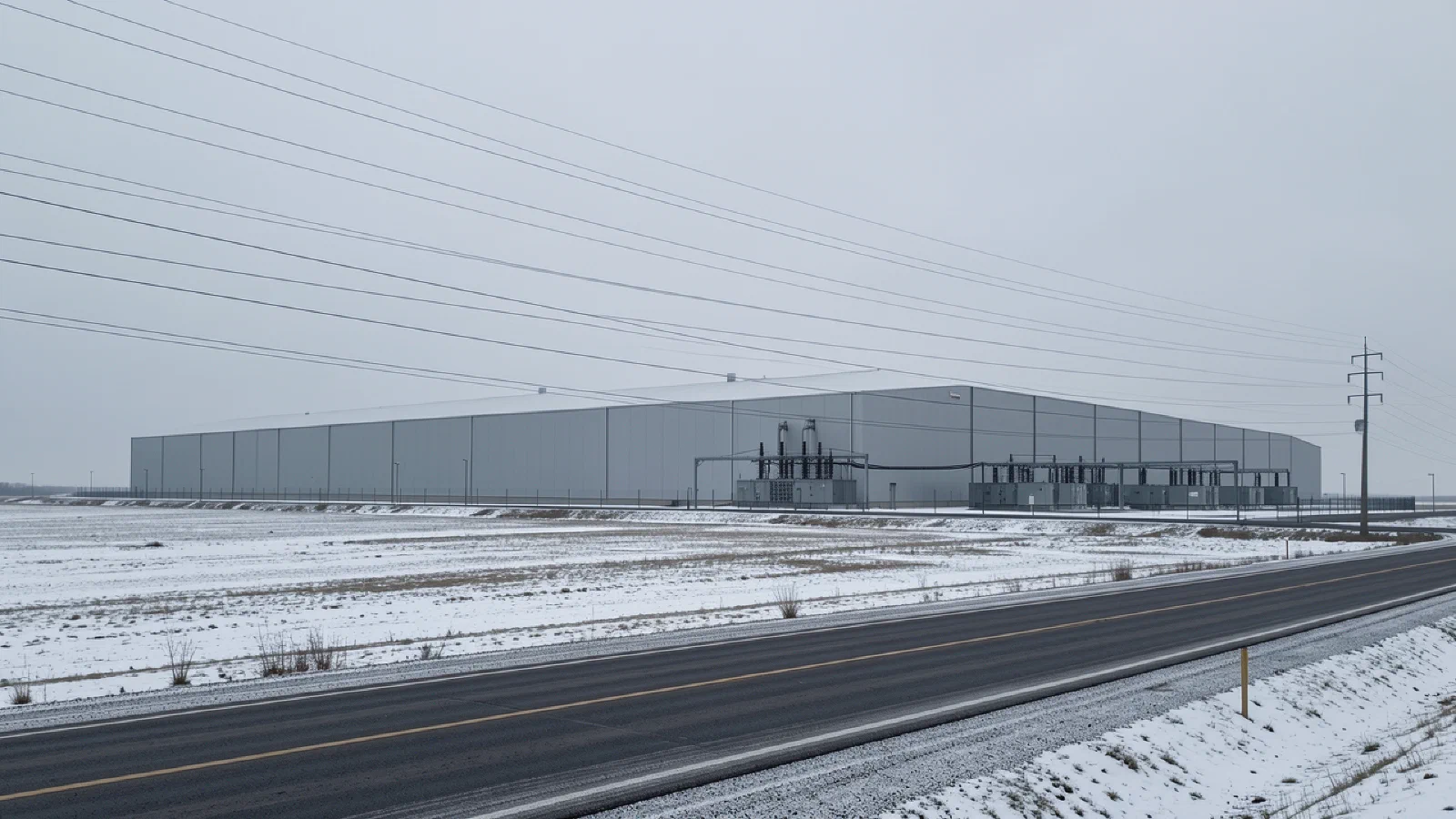
There is a building on a plain where the power is cheap and the air is cold. It is the size of a regional airport. It has almost no one in it.
From the road it reads as a warehouse, low and long and windowless, except for the substations beside it, the transformers and the lines coming in heavy from the grid, drawing the electricity of a small city into a structure where almost no human being works. Inside, in aisles that run longer than a person wants to walk, the machines train. They are dissolving, at this moment, somewhere in the arithmetic, ten thousand of the toll booths the earlier essays described. The tax office off the state route. The broker above the tire shop. The compliance officer’s maze. All of it audited, here, by this.
The building is the largest spread in the series. It is the one that does the auditing, and it is the one no warm sentence can honestly be wrapped around, which is why this essay is cold. The cold is not a choice of tone. It is the temperature of the subject.
The Old Steep Advantage#
Scale arbitrage is the advantage that exists only above a threshold of volume, and it is the oldest steep advantage in the economy.
Some costs fall as you get bigger and do not fall otherwise. The large manufacturer’s per-unit cost is structurally below the small one’s, not because the large manufacturer is smarter but because the fixed cost spreads across more units. The logistics network that covers a continent moves a package for less than the one that covers a county. The advantage compounds. The lower cost funds growth, the growth lowers the cost, and the gap between the large player and the small one widens with every turn of the cycle. This is not an information gap that a machine can close by sharing what it knows. There is nothing to share. The advantage is the size itself.
There is no way to give a small player the cost structure of a large one. You cannot hand it across the way you hand across a tax rule or a market price. The only way to get the large player’s costs is to become large, and becoming large requires capital the small player does not have, which is the capital the large player’s lower costs are busy generating. The cycle feeds itself. This is what makes scale different in kind from the dissolving classes: there is no asymmetry of information to audit away, because the thing of value was never information. It was mass.
For most of economic history, scale was the steepest spread there was, and the audit, when it arrives, does not flatten it. The audit needs scale. It runs on it.
The New and Steeper Form#
Compute-and-data arbitrage is scale raised to a power the prior economy never reached.
The frontier model requires capital, data, and compute assembled at a magnitude only a handful of entities on the planet can reach. The data moat deepens with every use, because use produces more data, and more data trains a better model, and a better model attracts more use. The compute barrier rises with each generation, because each generation costs more to train than the last, and the gap between those who can pay and those who cannot widens at every step. There is no underbrush here, no diversity of small players sustained by friction. There is the frontier, held by the few who can afford it, and everyone else renting access to it on the owners’ terms.
Each piece of the moat reinforces the others, which is what makes it steeper than ordinary scale. The capital buys the compute. The compute trains the model. The model attracts the users. The users generate the data. The data improves the model, which attracts more users and more capital, and the loop closes and tightens with every turn. A new entrant does not face one barrier. It faces four, each feeding the others, each already turning at full speed in the hands of the incumbents. The classical scale advantage at least had a ceiling somewhere, a point past which a bigger factory stopped being cheaper. No one has found the ceiling on this one. Every generation so far has made the leader’s lead larger, and the only thing that reliably catches a frontier model is a more expensive frontier model, which only the already-large can build.
The machine, in one sentence, and it is the sentence the whole series turns on. Here the architecture is not a tool that dissolves an arbitrage. It is the arbitrage. The frontier model is the asset. The compute and the data are the barrier. This is the one class where the engine and the spread are the same object, which is why it intensifies while the others fall.
The Same Technology, Both Directions#
This is the turn against the comfortable story, and it deserves to be stated without softening.
The popular account says AI flattens, democratizes, levels the field. For the dissolving classes, this is true. AI gives the farmer the market price and the borrower the read of the contract, and it lowers those barriers toward zero. But the same technology, in the same motion, raises the scale barrier and the compute-and-data barrier higher than any barrier the economy has known, because the tool that does the leveling at the bottom is itself the steepest advantage at the top, and it is owned by very few.
So the economy does both things at once, in opposite directions. It grows flatter in the middle, where the dissolving spreads used to live, and more vertical at the extremes, where the intensifying spreads concentrate. The Dissolved Middle named this shape, flatter in the middle and vertical at the edges, and the steepening class is the engine of the vertical edge. Every prediction that AI will simply democratize the economy is reading the flat middle and not the vertical edge. Every prediction that AI will simply concentrate power is reading the edge and not the middle. Both motions are real. They are happening to different parts of the same structure, driven by the same machine.
The two motions are not independent. They are the same motion seen from two places, because the leveling of the middle is what feeds the steepening of the top. Every toll booth the machine dissolves sends its released value upward to the owner of the machine, which means the flattening of the middle is not a separate event from the verticalizing of the top. It is the mechanism of it. The middle does not flatten and then, separately, the top rises. The middle flattens by having its value drawn up into the thing at the top, the way a field is leveled by the soil being carried somewhere else. The democratization at the bottom and the concentration at the top are one process wearing two faces, and which face you see depends only on where in the structure you are standing when you look.
The tool that dissolves the small spreads is itself the largest spread, and it is owned by almost no one.
Where It All Flows#
Every dissolved toll from the earlier essays goes somewhere. This is where.
The borrower’s saved fee, the shipper’s recovered margin, the glance no longer sold, all of it, the value released by every dissolving spread across the whole economy, does not settle evenly across the people who were paying the tolls. It flows uphill, to the owners of the scale and the model, because they own the instrument that did the dissolving, and the instrument captures, in aggregate, a thin slice of every gap it closes, multiplied across every gap, everywhere, at once. The toll booths fall, and the value rises, and it comes to rest here, on the plain, in the building, behind the heavy lines coming in from the grid.
This is the quiet rearrangement under all the visible disruption. The headlines record the falling, the jobs ending and the professions thinning and the prices dropping, and the falling is real and it is what everyone can see. What no one can see, because it has no face and makes no announcement, is the rising, the steady accumulation of all that released value at the top of the structure, in a small number of hands, behind walls no toll-payer will ever stand inside. The dissolution looks, from the middle, like loss, and from the bottom, like relief, and from the top, like the largest accumulation of economic value in the history of the species, and all three views are of the same event.
The steepening class is the reason the great dissolution concentrates rather than distributes. It is the reason the savings do not stay with the saved. It is the destination, and the consequence arc will spend itself tracing what it means that this is where everything ends up.
I wonder whether there is any level of capability at which this advantage stops compounding, or whether we have built the first arbitrage in history that gets wider every single time it is used.
The Lit Thing on the Plain#
At night, from a distance, the building is the only lit thing on a dark plain.
There is no one to see it. The nearest town is far enough that its glow is a separate thing on the horizon. The building hums, drawing its city of power out of the dark, training the models that are dissolving the warm storefronts of the early essays, the tax office and the broker’s room and the compliance officer’s bank, all of it audited away by the machines in the long aisles where no one walks.
The warm places had people in them. People who employed assistants and ate at the diner and kept binders of marginalia and waved foam mascots at the road. This place has almost no one. It is lit by nobody. It is attended by a skeleton crew and a great deal of cooling equipment. And it is owned by very few.
That is the whole turn of the series, held in one image. The warm, distributed, human spreads of the old economy, dissolved by a cold, concentrated, nearly empty thing, lit on a dark plain, owned at the top of a structure that the people it dissolved will never see.
How this essay connects to others across The Approximate Mind.