The New Geography of Power
Power follows the durable arbitrages. After the audit, only three of them are durable.
TAM-ARB.11 · Arbitrage · The Approximate Mind
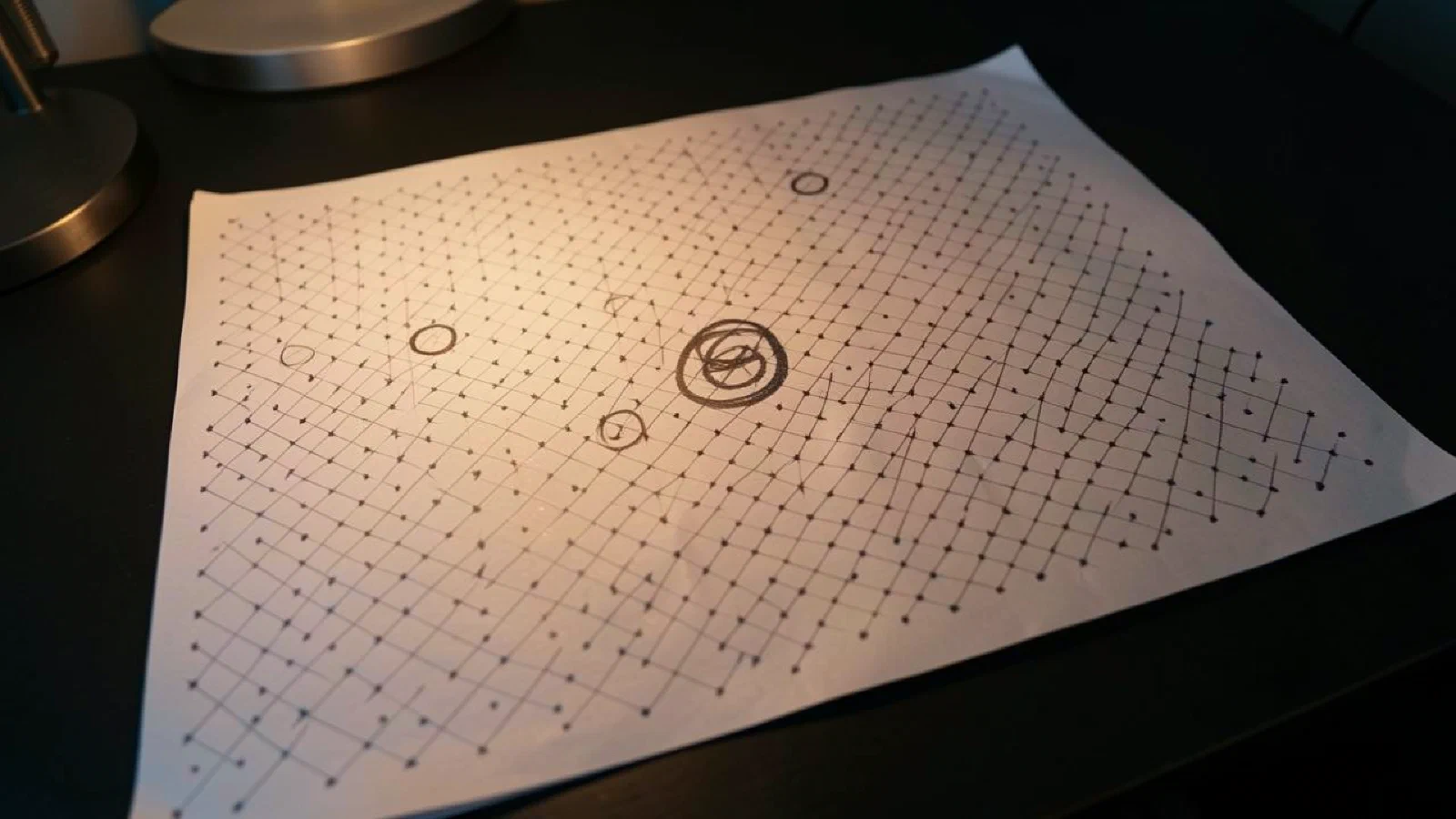
Draw the old economy as a map, and it is a lattice.
A dense field of small nodes, each a toll booth, each a minor concentration of income and the modest local power that income brings. A Linda in every town, a broker above every tire shop, a compliance officer in every regional bank, a recruiter in every city. None of them powerful in the way that word usually means, but each holding a position, a place in the flow of value where being there meant taking a little of it, and the sum of all those small positions was a middle, broad and distributed, the economic substance of the professional class. The lattice was the shape of where money lived, and it lived almost everywhere, thin and spread out, in millions of modest nodes.
Now run the audit across the map and watch what happens to the lattice. Most of the nodes go dark. The value that lit them rises, and pools, into a few towering nodes at the top, and a scattering of small warm points that survive for reasons the towers do not share. The dense middle, the lattice itself, goes out. What is left is a height, a few low warm lights, and a wide darkness between them where the lattice used to be.
That is the new geography. This essay is a walk across it, and it is the last walk in the series that has any warmth in it at all, because the next time we look, the people will be gone from the frame.
Power Follows Durability#
Power, in any economy, accrues to the positions that cannot be competed away. This is the organizing fact, and the audit’s whole effect on power follows from it.
A position that anyone can occupy confers no power, because the moment it pays, someone else occupies it too, and the payment competes down to nothing. Power lives in the positions that resist that, the ones with a moat, the ones a competitor cannot simply step into. For a century, the durable positions were information, complexity, and access. These were hard to compete away, because the knowledge took years to acquire, the maze took a specialist to walk, the chokepoint took capital and time to build. So power pooled in them, and the professional middle class was the political expression of that pooling, millions of people whose leverage came from holding a position the next person could not easily take.
The audit changes which positions are durable, and it changes them fast. Information, complexity, and access stop being moats, because the thing that made them hard, the years and the specialist and the chokepoint, is exactly what the audit dissolves. They become temporary. And power, following durability as it always does, drains out of them, not gradually and not gently, and goes looking for the positions that are still hard to take.
After the audit, three positions remain durable. Scale. The instrument. Relationship. Power relocates to those three, and the shape of the relocation is the new geography.
The Towering Nodes#
At the top of the new map are the owners of scale and the instrument, and they hold a kind of power the prior economy did not produce.
It is not market dominance in the old sense, the biggest firm in one industry holding off its rivals. It is ownership of the auditing instrument itself, the thing that dissolves everyone else’s position across every industry at once. The earlier work described the architecture of a new center, a set of positions on which everything else becomes dependent, and the towering nodes are that center made concrete. They do not dominate a market. They own the tool that prices every market’s spreads, and the value released by every dissolution flows to them, and the flow deepens their advantage because each use feeds the instrument that produces it.
This is power detached from sector, from place, from the old logic of competition. The towering node is not winning a contest within an industry. It sits above all the industries, holding the instrument that audits them, and its power grows not by beating rivals in a market but by the simple operation of the thing it owns, dissolving spread after spread and keeping a slice of each. There have been concentrations of economic power before. There has not been one shaped quite like this, sitting outside and above the activities it profits from, drawing value from the dissolution of the very idea of holding a position.
The Warm Points That Persist#
Scattered across the dark middle are small warm points, and they are the last trace of the human on the map.
These are the relationship-dense positions, the ones the audit cannot reach. The doctor of twenty years. The aide who knows the blue mug. The trusted local figure whose value is an accumulated history with specific people. They survive, truly and for a structural reason, because relationship is the one durable arbitrage that is not scale and not the instrument, the one that lives at human scale and nowhere else.
But notice what they cannot do. They cannot consolidate. A relationship is true of exactly two parties, and it does not aggregate, cannot be rolled up, cannot be scaled into a tower. The aide’s irreplaceability to Barbara does not combine with another aide’s irreplaceability to another client into anything larger than two separate small irreplaceabilities. The warm points stay points. They are real power, the power of being truly necessary to someone, and it is local and it is human and it cannot become structural, because the quality that makes it safe from the audit, its rootedness in the single case, is the same quality that keeps it from ever growing into a tower.
This is their safety and their limit in one. They survive because they cannot scale. They stay small for the same reason. The map will always have warm points, and the warm points will never be the towers.
The Dark Middle#
Between the towers and the warm points is the dark middle, and it is the largest feature of the new map, because it is where the lattice used to be.
The dark middle is the set of positions that lived on the dissolving arbitrages, the professional middle class of the information economy, the people whose leverage came from holding information or complexity or access. When those stopped being durable, this class did not lose only its income. It lost its position, the structural source from which its leverage came. That is the deeper loss, and it is the one the income figures do not capture. A person can lose income and keep their place in the structure, the way the bookkeeper became the accountant. The dark middle loses the place itself. There is no rung above the dissolved rung to climb to, because the audit dissolved the ladder, not just the step.
This is the dissolved middle, generalized from one industry to the shape of the whole map, and it connects to everything the earlier work said about a generation that finds the ladder gone, the position blocked not by competition but by the disappearance of the position. The middle does not move up into the towers, which are few and require capital it does not have. It does not move down into the warm points, which are human and do not scale and cannot absorb a whole displaced class. It goes dark, out of the structure, neither risen nor fallen but removed from the map that used to have a place for it.
The political weight of this is easy to underestimate, because the dark middle was never the poorest part of the map and so attracts the least concern. But it was the part with the most leverage, the part whose position gave it a voice, the broad professional class whose stake in the system was also its stability. A society can sometimes absorb the anger of those who never had a position. It has a harder time absorbing the anger of those who had one and watched it dissolve, who did everything the legitimating story asked, acquired the skill and held the position, and found that the position itself had stopped conferring what it promised. The dark middle is not only an economic feature of the new map. It is the part of the map where the sense of a broken bargain will concentrate, and a broken bargain felt by the class that used to be the system’s ballast is not a small thing for the system to carry.
Power did not redistribute. It relocated, up to a few towers and out to a scatter of warm points, and the broad middle where most of it used to live simply went dark.
The Story That Stops Being True#
Here is the political center of the new geography, and it is not about money. It is about a story.
When the durable positions are scale and the instrument, the entities that capture the most value are not the entities that create the most. The tower does not make more than everyone else. It owns the thing that releases what everyone else was holding, and captures a slice on the way past. Value capture and value creation, which the old economy kept loosely coupled, come fully apart. And an economy in which they have come apart is an economy whose legitimating story no longer describes it.
The story was that reward tracks contribution, that the people with the most have the most because they made the most. It was never exactly true, but it was true enough to hold, true enough that most people could accept the distribution of wealth as something other than a rigged outcome. The post-arbitrage economy makes it false in a way that becomes, slowly, impossible to not feel. The towers hold value that visibly did not come from making more than anyone else. The dark middle, full of people who did real work, holds less every year. The warm points do work that everyone agrees is valuable and are paid least of all. The proportions stop making sense, and everyone can feel that they have stopped making sense, without being able to say precisely when the sense drained out.
I wonder what holds a society together when the story it told about why some have more, that they made more, stops being true, and everyone can feel that it has stopped being true without being able to name the day it stopped.
The Map at Rest#
So the geography settles into its new shape. The towers at the top, few and high, holding the instrument and the value that flows to it. The warm points scattered low and dim, real and human and unable to grow. The dark middle between them, wide, where the lattice used to be.
There is no person in this map. That is deliberate, and it is the thing to sit with as the arc closes. The earlier essays had faces, Ray and Diane and Sal, and the consequence began to abstract them into flows, and now the map has finished the work, and the human is gone from it, present only as those few dim points of light that the eye can barely hold. The next time this series shows anyone, they will not be a person. They will be a variable in a decision made somewhere up in the towers, a cohort to be allocated across, a line in a capital model.
The geography is set. The warmth has nearly drained from the frame. What comes next is capital, moving across this map, and capital does not see the warm points as people. It sees them as positions, durable or melting, to be priced. The cold has arrived because the cold is what the map is made of now.
How this essay connects to others across The Approximate Mind.