The New Ecosystem
Not a flatter world. A more vertical one, with a warm thin edge.
TAM-ARB.SYN · Arbitrage · The Approximate Mind
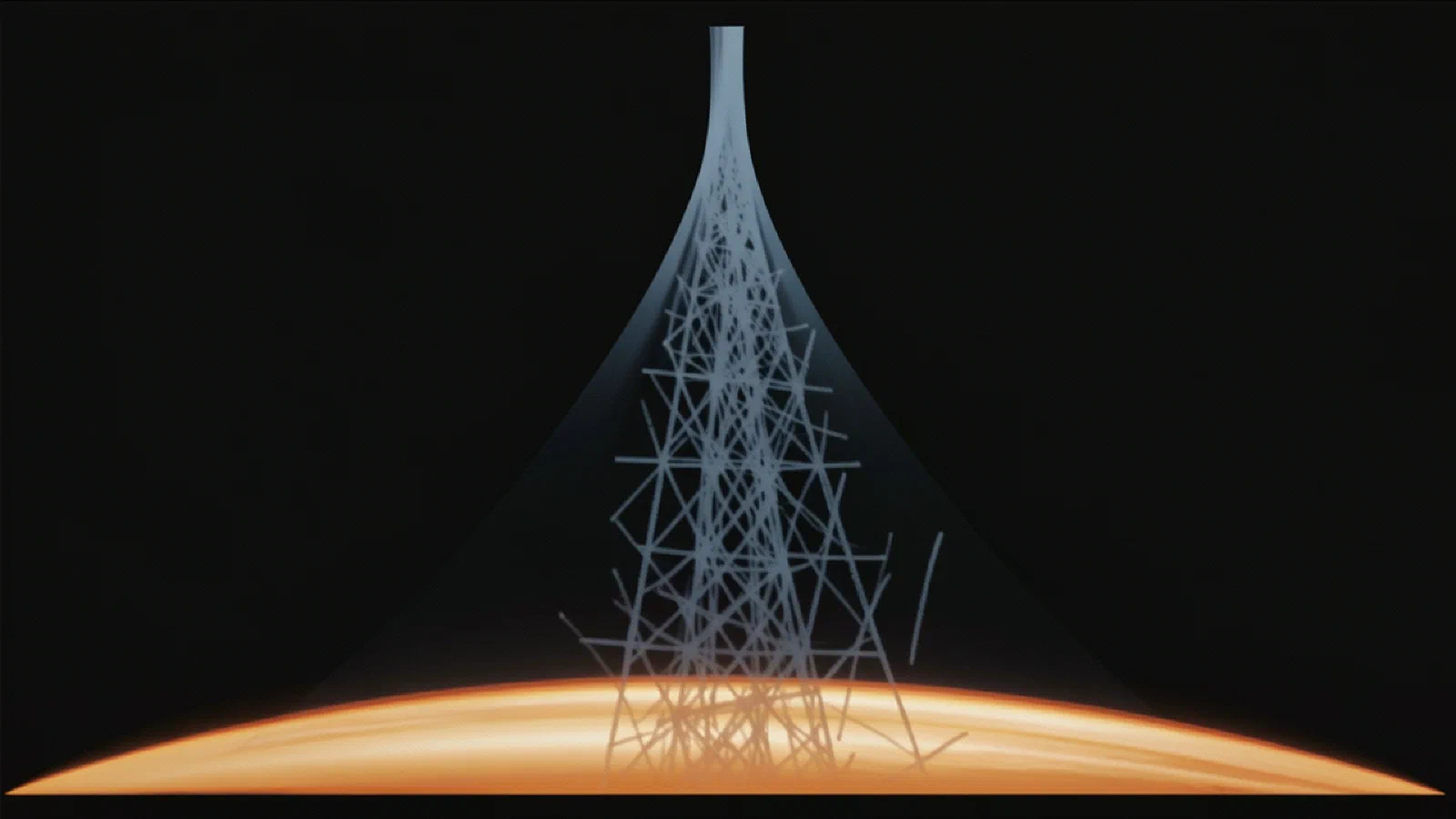
Look at the economy as a shape rather than a story. The old economy was a lattice, dense and broad through the middle, most of its mass concentrated in the layers between the people who made things and the people who used them. That middle was not a flaw in the structure. It was the structure. It held the analysts and the brokers and the advisors and the agents and the navigators, the enormous population whose work was to stand between two parties and price the distance, and the lattice was thick with them because the distances were many and the audit that could close them did not exist. To map the old economy was to map a wide middle, and almost everyone the economy supported lived in it.
The new shape is not flatter. The hope, repeated through every wave of this technology, was that the audit would level the structure, close the spreads, and leave a flatter and fairer field. It does close the spreads. It does not leave a flatter field. It leaves a more vertical one, narrow and tall where the durable positions concentrate at the top, wide and low where the irreproducible human survives at the bottom, and hollow through the middle where the lattice used to carry its greatest mass. The economy does not flatten under the audit. It stretches, and the middle falls out.
The Shape#
Three kinds of position survive the audit, and they do not sit at the same height.
Scale survives, because volume advantages are physical and the audit does not flatten a cost that falls with quantity. The instrument survives, and more than survives, because the thing that performs the audit compounds as everything it audits melts. Relationship survives, because a history specific to two people is not an information gap and cannot be closed, copied, or scaled. These are the only durable arbitrages, and the series walked each of them. What the series could not show from inside any single essay, and what only the height of the whole reveals, is that the three do not distribute evenly across the structure. Scale and the instrument sort upward, into a thin concentrated top, because they reward ownership and consolidate into power. Relationship sorts downward, into a wide distributed bottom, because the quality that makes it durable is the same quality that prevents it from ever becoming large.
The post-arbitrage economy is vertical: a narrow top of scale and instrument, a wide low base of relationship and creation, and a hollow where the middle used to be.
The verticality is the discovery, and no industry essay could prove it, because each industry essay saw only its own column. Agriculture saw a middleman dissolve and a platform concentrate. Finance saw eight layers melt at eight speeds. Healthcare saw a maze dissolve and a relationship survive. Each was a vertical slice, a single industry stretched between its melting and its durable layers. Stack the slices and the shape repeats in every one of them, which means the shape is not a feature of any industry. It is the form the audit imposes on all of them, and the economy that results is the sum of a hundred industries each stretched into the same vertical, with the same thin top, the same wide bottom, the same hollow center.
The mechanism that builds height rather than flatness is the part the leveling hope misreads. When a spread closes, its value does not disperse outward to the many. It relocates upward to the one. The middleman’s margin does not return to the field and stay there as a thousand small gains; it returns to the field for a moment and is then captured, in slices, by whoever owns the platform that closed the spread. The audit takes value out of the middle and the value does not settle evenly across the base. It is drawn up into the instrument, because the instrument is the thing that closed the spread and the thing that keeps a piece of every closing. Closure concentrates. That is the engine of the verticality, and it is why a technology that truly levels access at the point of use produces a structure more unequal than the one it replaced: the leveling is real at the surface and the concentration is real underneath it, and the concentration is the larger force.
The Top#
The top is the owners of the instrument and the scale it runs on, and it is the new center of economic power.
It is thin, because the instrument concentrates. The thing that audits an industry is worth more than any business in it, and tends toward single ownership, because the moat compounds faster than a challenger can close it. It is detached from value creation in the old sense, because its position is not making a better thing but owning the layer that prices everyone else’s spread, capturing a slice of every closing. This is the inversion the origin essay named and the consequence arc traced: value capture coming loose from value creation entirely, the most powerful position in the economy held by the party that owns the audit rather than the party that makes or grows or builds anything. The top is few, concentrated, and powerful in a way the old wide middle never was, because the old middle’s power was distributed across millions of small extractors who competed with and limited one another, and the new top’s power is consolidated into the small number of parties who own the instruments that replaced them.
The old economy concentrated power too, but it concentrated it among many. A million brokers each held a small spread. The new economy concentrates the same total extraction into a position held by few, which is a different kind of concentration, not larger in aggregate necessarily, but immeasurably more consolidated, and consolidation is the thing that converts economic position into political weight.
The Bottom#
The bottom is wide and warm and low, and it is the only place the human survives intact.
It is the relationship and the genuine creation, the irreproducible specific the audit cannot read: the aide who knows the blue mug, the teacher who forms a person, the counsel built over years, the maker whose work is wanted because it is theirs. This layer is real, and valuable, and human, and it survives the audit completely, because there is no gap inside it to close. And it is structurally incapable of consolidating into power, because the quality that protects it from the audit, its attachment to particular people and particular histories, is the same quality that prevents it from scaling. A hundred relationship survivors are a hundred small durabilities, not one large one. The bottom is safe and small for the same reason, and the reason is not an accident the structure could correct. It is the defining property of the layer.
The bottom is wide because the human is various, and there are many kinds of irreproducible specific, many relationships and creations the audit cannot reach. But wide is not the same as powerful. The base holds many people and little leverage, because leverage comes from scale and scale is exactly what the base cannot have. The human survives at the bottom in large numbers and small power, valued and unconsolidated, real and low.
The Hollow#
Between the thin top and the wide bottom is the hollow, where the lattice used to carry its mass, and the hollow is the defining feature of the new shape.
The middle was the arbitrage-navigators: the information professionals, the complexity workers, the access intermediaries, the vast population whose work was to stand in the spreads and price the distance. The audit closes the spreads they stood in, and they do not move up into the top, because the top is scale and instrument and there is room there for very few. They do not move down into the bottom, because the bottom is relationship and creation, a different capability than the navigation they were trained for, and it cannot absorb their numbers even if they could acquire it. They move out of the structure. The dissolved middle the corpus first named in a single industry is the general case: the middle does not relocate, it vacates, and the people who were the middle are displaced not into another layer but out of the vertical entirely.
This is where the woman who opened the series belongs. The tax preparer who experienced her arbitrage as a craft, who was good at standing in the distance between a person and a system they could not read, was the middle, and the middle is the hollow now. She did not fail at her work. Her work was a spread, and the spread closed, and there was no rung above her to climb to and no rung below her she had been trained to reach. The hollow is full of people who were good at something the audit made free.
The middle was not only mass. It was also the ladder. The wide lattice of intermediary work was the path a person climbed from the base toward the top, the sequence of spreads a person could stand in, each a little higher than the last, that let someone begin near the bottom and end somewhere with leverage. When the middle was thick, the climb existed, because there were rungs all the way up. The audit does not only remove the people in the middle. It removes the rungs, and a vertical with a thin top, a wide bottom, and nothing between them is not merely unequal. It is immobile. There is no longer a sequence of positions connecting the base to the height, because the positions that used to connect them were the spreads, and the spreads are gone. The new shape is steep and smooth, and the surviving routes upward, ownership of scale and ownership of the instrument, are reached by capital and by being early, not by climbing. The hollow is the absence of the ladder as much as the absence of the people who were on it.
The Discovery#
The series set out to name the arbitrage classes and trace their fates, and the classes and the fates were the visible work. The shape was the hidden one, and it is the thing only the whole reveals.
AI’s economic effect is not automation, the replacement of labor by machines, though it replaces labor. It is not democratization, the leveling of access, though it levels some access. Both framings keep the old lattice and ask what the technology does to it, and both miss the structural event, which is that the technology does not act on the lattice, it replaces the lattice with a different shape. The effect is a re-sorting of the entire economy by arbitrage fate: every position in the economy re-priced according to whether its spread survives the audit, the survivors sorted by whether they scale, and the result a verticality more extreme than any the prior economy produced, with the human concentrated at a powerful thin top and a powerless wide bottom and absent from the middle that used to hold most of it.
The audit did not flatten the world. It sorted it, and the sorting runs vertically, with the human surviving only at the unscalable edges.
That is the shape the series was mapping without being able to see it whole until the end. A taller economy. A thinner top, holding more consolidated power than the old middle ever distributed. A wider bottom, holding more people and less leverage than the old middle ever did. And between them, where the greatest mass of the old structure lived, a hollow that the people who used to fill it have left, not for somewhere else in the economy, but for outside the shape the economy now takes.
Somewhere in the wide low base, an aide sets down a cup the way one particular person likes it, in a room no audit will ever enter, and is, for one more morning, irreplaceable.
How this essay connects to others across The Approximate Mind.