The Gatekeepers
For some businesses the spread was never knowledge. It was the key to a door you could not reach.
TAM-ARB.05 · Arbitrage · The Approximate Mind
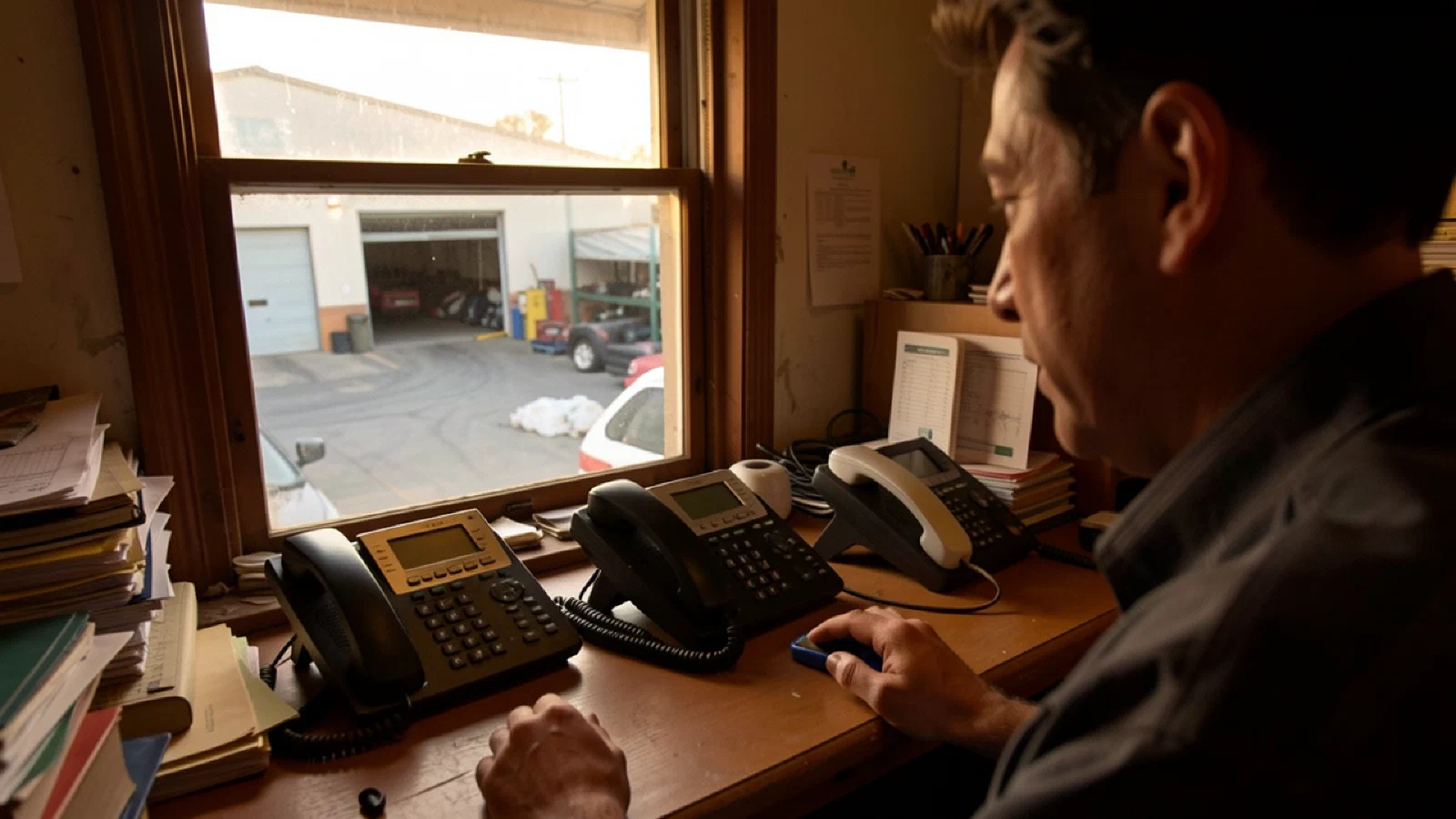
A freight broker named Sal works three phones at once.
He has never moved a pallet in his life. He could not back a trailer into a dock if you paid him. What he can do, what he has done for twenty-two years from a small office above a tire shop, is hold three things in his head at the same time and connect two of them. The shipper in Ohio who needs forty thousand pounds moved by Thursday. The carrier whose truck is coming back empty from a delivery and would rather carry something than nothing. And the price, the spread between what the shipper will pay and what the carrier will accept, which is Sal’s, which is the whole business, which is the reason there is an office above the tire shop at all.
Sal does not know more than the shipper or the carrier. The shipper knows freight. The carrier knows trucks. What Sal knows is that they exist, each to the other, at the moment they need to. He is the only one who can see both sides. That seeing is the product.
The Chokepoint, Not the Gap#
Access arbitrage is different from everything in the last two essays, and the difference is worth getting exactly right.
The toll collector profits from knowing what you do not. The translator profits from a maze you cannot walk. But the gatekeeper does not necessarily know anything you do not. Sal is not smarter than the shipper. He does not understand logistics in some way the carrier cannot. His value is not knowledge. It is position. He sits at the one point both parties have to pass through to find each other, and he charges for the passage. The spread is not an information gap. It is a chokepoint, a place narrow enough that traffic has to slow down, and someone has built a booth there.
The forms of the gate are everywhere once you see the shape. The distributor between the manufacturer and the retailer, who holds the shelf the manufacturer cannot reach. The recruiter between the candidate and the employer, who holds the introduction neither can make alone. The broker between buyer and seller. The platform between the merchant and the customer, who holds the customer hostage to the platform’s terms because the customer arrives through the platform and nowhere else.
Each of them holds a connection the two parties cannot make directly. Each of them charges for being the one who can.
What makes access arbitrage feel so durable from the inside is that the position is invisible to the person holding it. Sal does not experience himself as occupying a chokepoint. He experiences himself as good at his job, and he is, because doing the job well and occupying the position are, from where he sits, the same act. The skill and the spread have fused. He has spent twenty-two years getting better at being in the middle, refining his sense of which carrier to call and how hard to push on price, and every year of refinement has made the middle feel more like a craft and less like a location. This is the trap of the access professions. The better you get, the more the position feels earned, and the harder it becomes to see that the thing you are being paid for is not your skill at standing there but the mere fact that you are the one standing there, in the one spot both sides have to pass.
The Machine That Routes Around#
The machine that dissolves the gate is named in one sentence. Matching and routing systems, increasingly able to act and not only answer, dissolve access arbitrage by making the direct connection the gatekeeper used to monopolize, querying both sides and routing between them without paying the toll in the middle.
When the shipper’s system can describe its load to the world and the carrier’s system can describe its empty truck, and a routing layer can match them in the time it takes Sal to pick up the second phone, the chokepoint stops being narrow. The road widens. The booth Sal built has cars going around it on both sides. He is not outcompeted by a cheaper broker. He is bypassed by the disappearance of the reason brokers existed.
The agent-to-agent version of this is the cold logical end of it, two machines negotiating the match directly, each representing a side, the human middle simply not present in the transaction. The capital arc of the sibling series traced exactly this, the moment the coordination layer stops being a person and becomes a protocol. Picture it fully, because it is where access arbitrage is going. The shipper’s agent posts the need. The carriers’ agents bid. The match is made, the price is set, the paperwork is generated, the pickup is scheduled, and at no point does a voice say to another voice, what have you got coming back from Columbus. The negotiation that was Sal’s whole craft, the reading of how badly each side needs the deal, becomes a calculation that runs in milliseconds between parties that never tire and never bluff and never need to be the one in the middle, because there is no middle anymore. There is just the match.
The Gate That Was Load-Bearing#
Here is the complication that keeps this from being a clean story of rent destroyed.
Not every gate was pure rent. Some gatekeepers did real work. The distributor who held the shelf also vouched for the goods on it, screened the suppliers, absorbed the risk of the bad batch, reduced the buyer’s search cost from impossible to manageable. The recruiter who held the introduction also filtered the thousand applicants down to the five worth meeting, which is genuine labor, the kind of judgment that saves the employer weeks. Some of the gate’s value was the toll, and some of the gate’s value was the service the toll happened to bundle with itself, and from the outside, before the audit, you could not tell which was which, because they arrived together in a single invoice and no one had any reason to separate them.
The machine does not separate them either. It dissolves the rent-seeking gate and the value-adding gate with the same motion, routes around both, and only afterward does the market discover, sometimes painfully, which gates were holding something up. A retailer who routes around the distributor saves the toll and then learns, the first time a bad batch arrives unscreened, what the distributor was quietly doing all along. The employer whose system matches candidates directly saves the recruiter’s fee and then learns, after the third bad hire, that the filtering was not a formality. The value was real. It was just invisible, folded into a position everyone resented paying for, and you do not find out what a wall was holding up until you have already pulled it down.
The Monoculture called friction a habitat, the thing that sustained a diversity of small producers the way underbrush sustains a forest. The gate was sometimes friction of that kind. Removing it can clear the underbrush and the toll booth in a single pass, and the forest finds out later what it lost.
Some gates were tolls and some gates were load-bearing, and the audit pulls them all at once, leaving the market to learn afterward which walls it needed.
The Margin Moves, It Does Not Vanish#
And the toll itself does not return to the two parties it stood between. This is the pattern by now, the thread that runs under every essay in this arc.
Sal’s margin, the spread between what the shipper paid and what the carrier accepted, does not get split between the shipper and the carrier when Sal is gone. It goes, in a thinner and far more concentrated form, to whoever owns the routing layer that replaced him. The chokepoint did not disappear. It moved. It relocated from a thousand small offices above a thousand tire shops to the owner of the matching system, who now sits at every chokepoint at once, collecting a smaller toll from each and a vastly larger toll in sum.
There is a hard irony in this that the consequence essays will keep returning to. The thing that bypasses the gatekeeper becomes the largest gatekeeper there has ever been. A thousand brokers, each holding one small chokepoint, were a kind of distributed power, annoying and extractive but spread thin, no one of them able to set the terms for an entire market. The routing layer that replaces all thousand holds every chokepoint they held put together, and it can set terms none of them ever could, because there is no longer a competing broker down the street, only the one layer that everyone routes through. The gate was destroyed and rebuilt a thousand times larger, owned now by one party instead of a thousand, and the shipper and the carrier, who were told the middleman was being cut out, find themselves passing through a middle more total than any Sal ever was.
I wonder whether Sal knows that the thing he sells, the being in the middle, is the exact thing the machine was built to make unnecessary, or whether being in the middle has felt for so long like a skill that he can no longer see it as a position, a place he is standing rather than a thing he can do.
Three Phones in a Row#
Sal hangs up the third phone. For a moment the office above the tire shop is quiet, the particular quiet of a room that is usually full of one man’s voice negotiating.
He straightens the three phones into a row on the desk. He does this without thinking, the way you square a stack of papers, a small ordering gesture at the end of a call. It is the habit of a man whose entire value was holding three things in connection at once, performed now, idly, on three objects that will sit there whether or not anyone connects anything.
The phones will outlast the function. So will the gesture. Sal will go on straightening them for a while, the muscle memory of a chokepoint, after the road has already widened around him and the traffic has found the way through on its own.
He built something here, over twenty-two years. Not a thing you can point to, no product, no inventory, nothing that will be on the books when the office is cleared. He built a position, a place in the flow of goods where his being there made the flow work, and the tragedy of the access professions is that a position is the one kind of thing that vanishes completely when it ends. The maker leaves behind the thing he made. The grower leaves a field. Sal leaves three phones in a row on a desk above a tire shop, and the knowledge of which carrier runs empty out of Columbus on a Thursday, which was worth a living for twenty-two years and is worth nothing the morning the road goes around him.
How this essay connects to others across The Approximate Mind.