The Displaced
Linda's office is closed now. This is the last time we will look at a person directly.
TAM-ARB.12 · Arbitrage · The Approximate Mind
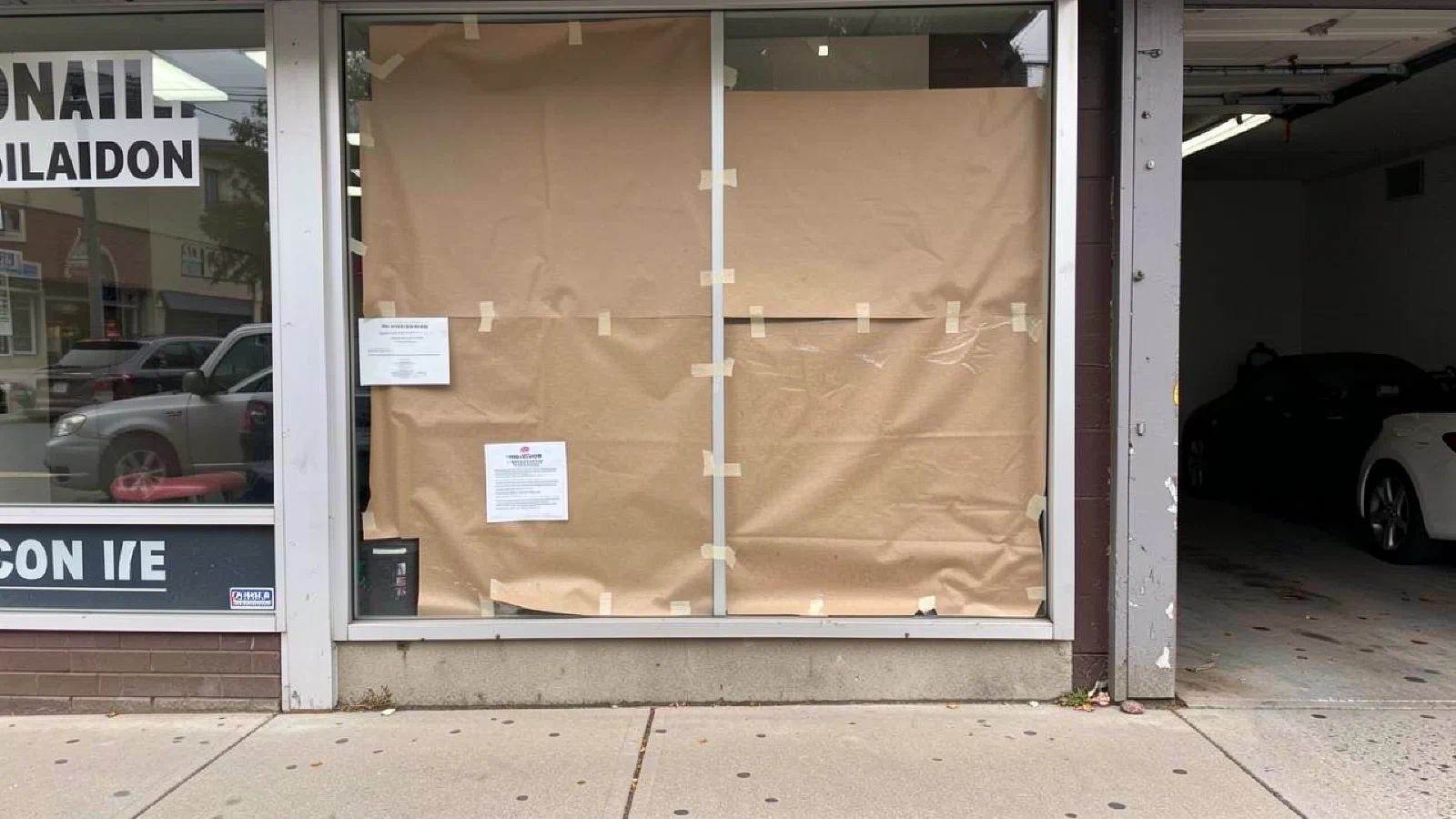
The window is papered over from the inside.
Brown kraft paper, taped up unevenly, the way you do it when you are not planning to come back and make it neat. There is a small printed sign in the corner of the door, a phone number for the landlord, the unit available, inquire within, except there is no within to inquire at anymore. The space heater is gone. The lamp is gone. The desk, presumably, hauled out by whoever hauls out the desks. Thirty years of a working life took about a season to disappear from Route 9, and now it is a papered window between a nail salon and a place that does oil changes, indistinguishable from any other unit that did not make it.
Linda is the woman we met in The Spread, sorting folders before the good light, proud of a skill it took her thirty years to build. The office is hers, or was. This is the last time the series will look at a person directly, and it is going to look at Linda, because she is the one we started with, and you do not leave without saying goodbye to the one you started with.
What Closed#
It was not dramatic. That is the first thing to understand about how this happened.
There was no single morning when the clients stopped coming. There was a thinning, season over season, the kind Ray watched at the strip mall, the foot traffic going light and then lighter. The simple returns went first, the green-folder people, the ones with a W-2 and a standard deduction, because they were the ones an app could do without breaking a sweat, and they were also, though Linda never thought of them this way, the ones whose fees paid the rent while the complicated returns paid her. Then the red folders thinned too, as the apps got better and the complications got smaller. By the last season, Linda was doing the work of a full practice for the fees of a part-time one, and the math that had held for thirty years stopped holding, quietly, the way a math problem stops working when one of the numbers you were counting on turns to a fraction of itself.
She held on longer than she should have. People do. The office was not only income. It was the place she had been every February for three decades, the place where she was the person who knew the answer, and you do not give that up at the first bad year, or the second. She gave it up when the lease came due and renewing it meant betting another year of savings on a recovery she had finally stopped believing in. She did the arithmetic on her own situation, the way she had done it for other people for thirty years, and the arithmetic said close. So she closed.
Refuse the Easy Frames#
There are two stories available about Linda, and both of them are lies of a kind, and the discipline this whole series asked for comes due right here.
The first story says her displacement is fine. The gaps closing was good for the farmer and the patient and the borrower, the tolls were extraction, Linda was a toll collector, and the end of the toll is justice. Everything in that story is true except the word fine. The gaps closing was good. It does not follow that Linda losing her life’s work was fine, and the speed with which we reach for that word, fine, is the speed of a person who would rather not look at the cost.
The second story says her displacement is a tragedy, a craftswoman undone by a cold machine, a noble trade destroyed. Everything in that story is sentiment except the loss. The loss is real. But the trade was not noble in the way the story wants. Linda did charge for a gap she did not create and could have, in a more honest system, never been needed to cross. Calling her a victim of the machine erases that she was also, in the frame that pulls back far enough, a small tax on her neighbors’ incomprehension.
Both stories are evasions, and they are evasions in opposite directions, and the truth is the thing neither will hold. The gap closing was good, and Linda losing her life’s work was a real cost, and these are both true at once, about the same woman, and a society that cannot hold both of them in one frame will mishandle the transition, because it will either celebrate the saving and abandon the displaced, or mourn the displaced and resent the saving, and the actual situation requires holding the saving and the cost together, which is harder, and which almost no one will do.
The gap closing was good and Linda’s loss was real, and the refusal to collapse those into one story is the whole of what this series asked.
The Neighbor#
Here is what the efficiency accounting leaves out, because it was never built to count it.
Linda employed two assistants. One of them was putting a kid through community college on the wages, and that arrangement is over now, and the kid’s arithmetic got harder. Linda ate lunch at the diner three doors down, three or four times a week, for thirty years, which is several thousand lunches, which is a non-trivial fraction of why the diner stayed open. She sponsored a Little League team. When the widow could not say the word jointly, Linda waited, and did not bill her, and walked her to her car. None of this was the tax code. All of it was the texture of a place, the small circulation of money and attention and care that a person rooted in a town for thirty years generates just by being rooted there.
When Linda’s office closes, the town does not only lose a tax preparer, a function that has been replaced by something cheaper and better. It loses a node, a point where money and attention circulated and stayed local. The assistant’s wages, gone. The diner lunches, gone. The thousand small acts of being a known person in a known place, gone, or scattered, or moved online to a platform that employs no one in the town and eats no lunches there. The audit priced the function and found it replaceable. It did not price the node, because efficiency was never built to see that a node is more than its function. Linda’s displacement is a social event, and the social costs are real, and they appear on no balance sheet because no balance sheet was ever designed to hold them.
And the costs do not stay put. The assistant whose wages paid the tuition does not simply find another job in a town that is losing nodes faster than it makes them; she leaves, maybe, for a city, and the town is one family lighter. The diner that loses Linda’s lunches and Ray’s and a dozen others’ does not fail in a season, but it runs thinner, and thinner, and one year it does not reopen after the holidays, and that is another node gone, and the people who ate there scatter to wherever is left. This is how a place comes apart, not in a collapse but in a slow loss of nodes, each one taking with it the small circulation it sustained, until the town is a place people are from rather than a place people are. The audit did this without meaning to, without malice, simply by pricing functions one at a time and never once being asked what the functions were holding together.
What She Keeps#
There is one thing the audit could not take, and it is the thing she always did best, and it is not enough.
The blue folder. The clients who cried. The widow, the man whose business failed, the people who came to Linda not because she knew the tax code but because she would sit with them at a hard moment and be a steady presence while the hard thing got done. That part of Linda’s work was never arbitrage. It did not depend on a gap. It would be worth something in a world where every gap had closed, because it was relationship, the one thing the machine cannot reach, the blue mug in a different room. The audit dissolved everything Linda did that was information. It could not touch the thing she did that was care.
But a person cannot always live on the surviving fragment. This is the hard hinge of the whole consequence, and it is why relationship surviving is not the consolation it first appears to be. The blue folder was four or five returns a year. It was the best of what Linda did and the least of what she was paid for, and you cannot run an office, or pay an assistant, or make the lease, on four or five returns a year and a great deal of unbilled sitting-with-people. The market never knew how to pay for the blue folder. It paid Linda for the gap, and threw the care in for free, and now the gap is gone and the care remains, valued at exactly what the market always valued it at, which was nothing.
So Linda keeps the thing that was always hers and was never quite a living. The survival of relationship is real. It is also, by itself, not a livelihood, and the gap between those two facts is where a great many displaced people are about to find themselves standing.
I wonder whether Linda will find the part of her work that was never arbitrage and build something smaller and truer on it, or whether the market will simply have no way to pay her for the only thing she ever did that the machine could not do.
The Empty Stool#
The diner across from Linda’s old office is still open. The coffee still gets poured. The regulars still come, most of them, and the place runs about as it always did, a little quieter on the revenue side, the kind of quiet a diner can absorb for a while before it cannot.
There is one stool at the counter that is empty now, on the mornings when it used to not be. Linda came in early, before the February rush, on the mornings she wanted the quiet hour to get her head right before the folders. She sat at the end, near the register, and the server knew her order and her name. That stool is just empty now. No one mourns it out loud. No one at the counter says, this is the seat where the transition happened, because no one experiences the transition that way, as a seat. They experience it, if they notice at all, as one fewer familiar face, a small thinning, the kind of thing a town absorbs without quite registering what it is absorbing.
That is the shape of it. Not a catastrophe, not a crisis, not a single loud collapse. One empty stool, in one diner, in one town, and the same empty stool in a thousand towns, while everywhere else the saving feels like progress and the revenue line climbs in a report no one at the counter will ever read. The displacement happens at the scale of a stool. The saving happens at the scale of a species. And the two never sit in the same frame, except here, for this one essay, before the series turns cold and stops looking at people at all.
The coffee is still hot. The stool is still empty. The warmth ends here.
How this essay connects to others across The Approximate Mind.