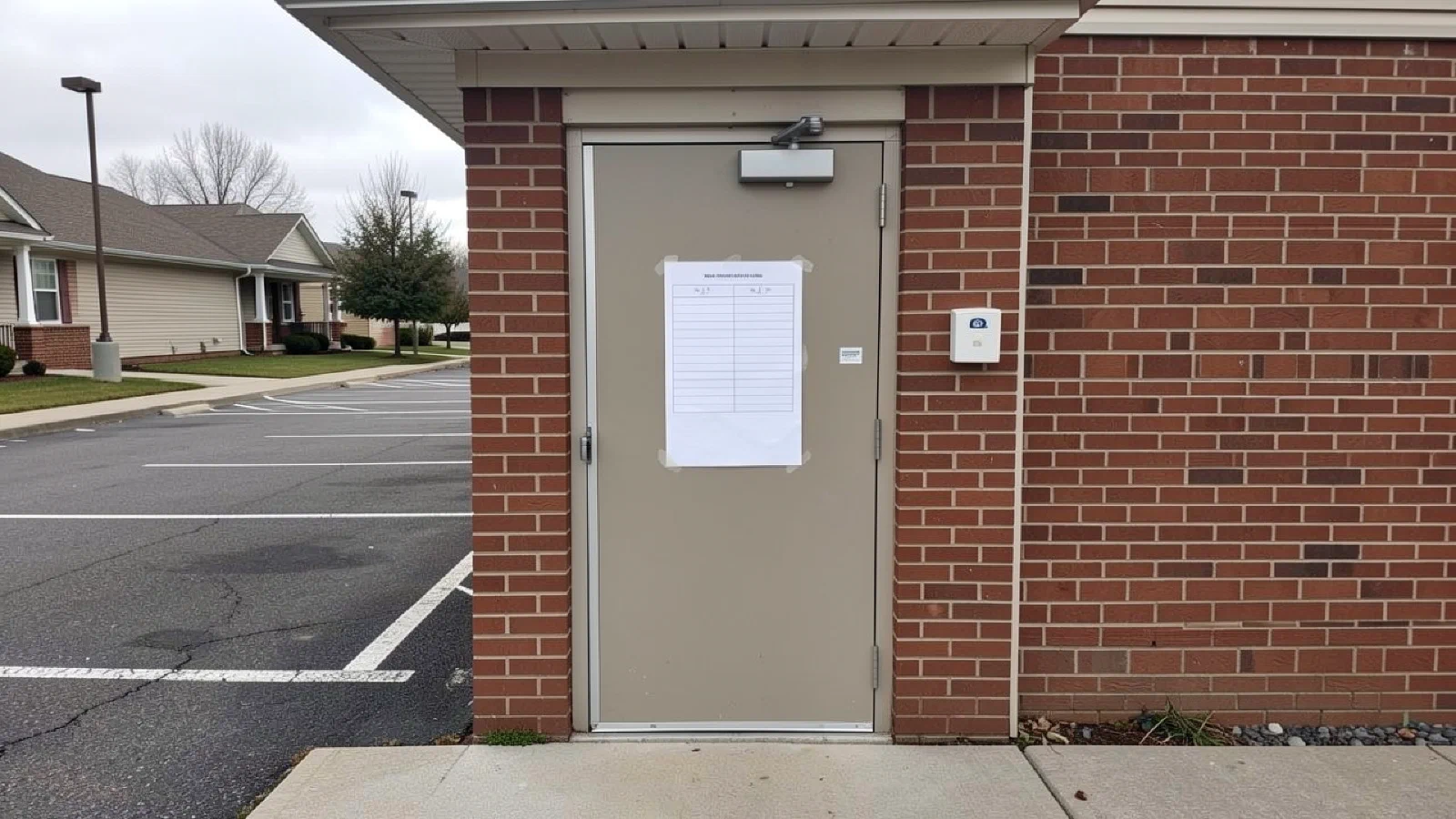
The Cooler
Three hundred pooled households are a demand curve a farmer can plant against, and the cooler at the clubhouse is the new middle.
TAM-ARB.33 · Arbitrage · The Approximate Mind
The unit that survives the case against precommitment is not the household. It is the pool, and the smallest pool with a legal name, a balance sheet, and a building is the subdivision.
The against essay’s second objection was arithmetic: a band wide enough to spare one family the box on the porch is too loose to be worth a farmer’s planting. At one kitchen that objection holds. At three hundred kitchens it dissolves, because the Tuesdays cancel. The family that skipped the chicken for the Sichuan place is offset by the family whose teenager brought friends; the abandoned diet in one house is begun in another; the variance that makes a single household’s demand an expression makes three hundred households’ demand a statistic. The pool commits firmly to the farmer precisely because no member has committed firmly to anything. The band each family lives in stays humane. The curve the pool presents stays hard. That trade, individual looseness purchased with aggregate firmness, is the whole invention, and it is not a software invention. Insurance found it three centuries ago. The software only makes it cheap enough to run on onions.
The machine, in one sentence: a coordination layer pooling the declared flows of a few hundred households converts their individually revocable intentions into a collectively bankable forward, and the homeowners’ association, which already owns a legal entity, a bank account, and a building with a parking lot, becomes a buying entity, the community version of the firm distilled to a wallet with a name.
What the pooled forward removes is the middle. A farmer planting against a subdivision’s committed curve does not need the packing house that aggregated demand he could not see, the distributor whose spread paid for holding inventory against uncertainty, or the stall fee that bought him an audience. The crop is sold before it is seeded. What the movement’s arithmetic saves is everything that stood between a field and three hundred tables because neither end could see the other, and the essay’s remaining work is to price the four things the clubhouse arrangement creates, because none of them is free.
Risk Runs Both Ways#
The forward is not a discount program. It is a risk instrument, and the subdivision is now on both sides of weather.
When the crop fails, the pool absorbs it: the summer’s tomatoes do not arrive, the prepaid position is a loss, and three hundred households discover they hold agricultural risk that the supermarket used to hold for them, invisibly, inside the retail price. When the demand fails, the farm absorbs the mirror image: the subdivision that emptied for August, the neighborhood fashion for a diet, the year the pool’s families simply cooked less, and a farmer who planted against a curve finds the curve was softer than its signature. Priced honestly, the forward’s spread is partly a real efficiency and partly a risk premium changing hands, and a pool that books the whole spread as savings has mistaken its new insurance liability for income. The mature version carries reserves, laid crops across several farms, and a rule for the bad year, which is to say the mature version has rediscovered why the middle existed, and chosen to rebuild its risk function without rebuilding its margin.
The Only Buyer#
To a ten-acre farm, a three-hundred-household pool is not a customer. It is the market.
The movement’s language is cooperative, but the structure it builds is a monopsony at exactly the scale where monopsony bites hardest. A farm that has planted three seasons against the subdivision’s curve has specialized its fields, its varieties, and its schedule to a single counterparty, and the counterparty’s agent, loyal to the households by design, negotiates each renewal against a seller whose alternative is to rebuild a retail presence that no longer exists. The agent does not need to be predatory for the position to be extractive; it only needs to be good at its job. The audit’s oldest pattern arrives on schedule: the spread between what the pooled buyer could pay and what the specialized seller must accept is a new gap, created by the closing of the old ones, and it sits inside an arrangement everyone involved describes as community. Whether the pool’s covenant with its farms prices this, with floors, tenure, and shared-risk terms, or harvests it, is the character question of the whole movement, and it will be answered subdivision by subdivision, in bylaws nobody reads.
Who Gets to Be a Subdivision#
The capability does not attach to need. It attaches to structure.
Running a pooled forward requires a legal entity that can sign, a treasury that can hold prepayments, governance that can bind members, and a building where the physical flow lands. The households that already have all four are the households inside a homeowners’ association, which is to say the arrangement’s natural early adopters are the neighborhoods that needed its savings least, and the renter, the apartment block with an absentee landlord, the unincorporated road, stand outside not because their demand is less forecastable but because no entity exists to hold their pool. The pattern is the corpus’s standing one: a new capability lands first where complementary structure already stands, and reads as a reward for the structure rather than the geography of it. The gap this creates is not the unenrolled household’s gap, absence of an instrument, but its collective cousin, absence of a unit, and it is worth naming now because the next essay prices the one institution that dissolves it.
Where the Refrigerator Lives#
The last constraint is physics. A forward on perishables is a promise with a half-life, and somewhere between the field and three hundred kitchens the goods must sit cold.
So the movement’s real capital asset is not the software. It is the walk-in cooler at the clubhouse, the pool’s shared cold storage, sized to the curve, staffed by rotation or fee, the physical address at which the demand pool becomes a place. Where the corpus asked, of computation, where the machine that serves a community should physically live, the buying side asks it of the refrigerator, and the answer carries the same politics: whoever’s building holds the cooler holds the arrangement’s chokepoint, sets its hours, and inherits its disputes. A subdivision that thinks it has adopted an app discovers it has acquired a small piece of civic infrastructure, with maintenance, insurance, and a committee. Some will discover they like this. It is the most durable thing the movement builds, and the only part a failure leaves behind.
The Frame#
Decision rule: price a buying pool on four lines, never one. Its aggregate firmness net of member churn; its risk reserves against the seasons it now insures; its covenant terms with the farms it has made captive, because an extractive pool is short its own supply base; and its title to the cooler. A pool that shows only the grocery savings has not done the accounting; it has done the marketing.
The distributor’s warehouse was forty feet high and served a region. Its replacement is eight feet high, behind the clubhouse, with a sign-up sheet on the door, and the distance between those two buildings is where a layer of the economy used to be.
The Approximate Mind is a series exploring what AI actually does to human life. Arbitrage prices what the audit does to every spread it reaches.
How this essay connects to others across The Approximate Mind.