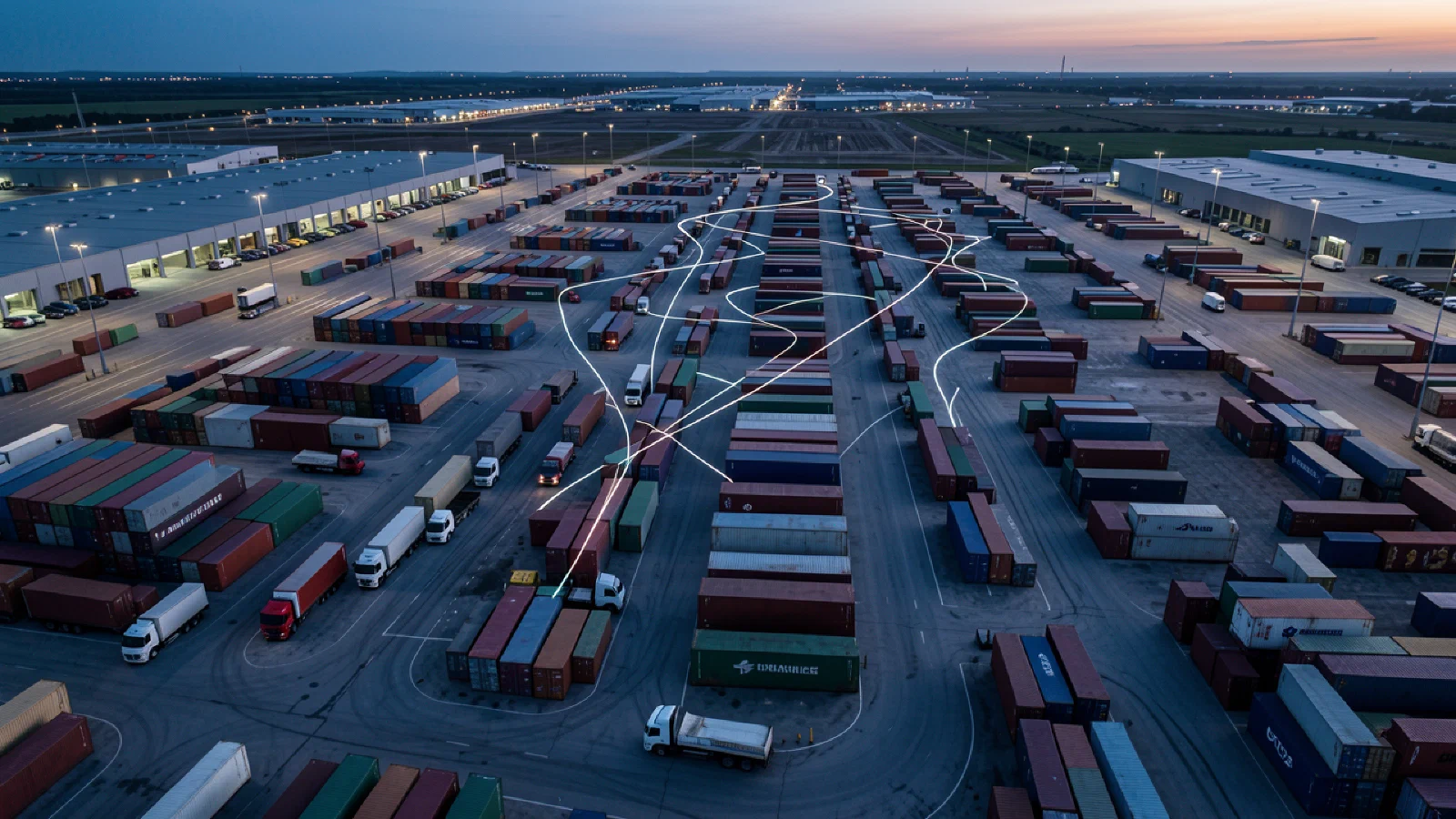
Supply Chain and Logistics
Access, scale, time, and coordination all stack here. The coordination layer is the prize, and the contest for it is the most consequential in the arc.
TAM-ARB.21 · Arbitrage · The Approximate Mind
Supply chain is the industry where four arbitrage classes stack into one fragmented system, and where the auditing instrument stops being an abstraction and becomes a visible, contested asset already under construction. Access, scale, time, and coordination all live here. The first three behave the way they behave elsewhere. The fourth, coordination, is the prize, and the contest to own it is the most consequential allocation in the entire industry arc, for a reason the other industries cannot match: the activity being coordinated is the physical movement of everything. The party that owns the orchestration layer over a fragmented physical economy owns a slice of every good that moves through it, which is a position with no ceiling that any single sector can impose.
The instrument logic, abstract in finance and healthcare, is concrete here. There is no need to argue that an auditing instrument will emerge, because the orchestration layer that sees a whole fragmented chain and routes it is already being built, already funded, already fought over by three kinds of capital. The essay’s work is to separate the layers that melt from the layer that compounds, and to name what is at stake in who ends up owning the one that compounds.
The Operational Melt#
Begin at the ground level, where the brokerage and access layer dissolves, because this is the visible part and the part most likely to be mistaken for the whole story.
The access arbitrage in supply chain is the broker, the distributor, the chokepoint between two nodes that could not find each other directly. The freight broker who knows which carrier has capacity on a lane. The distributor who controls the only route from manufacturer to retailer. The last-mile coordinator who holds the slot at the dock. These are being-in-the-middle positions, and they dissolve as routing systems match shippers and carriers and buyers directly, the way the gatekeeper class dissolves wherever matching closes the gap the gatekeeper sat in. The reason the broker existed, the cost of finding the counterparty, falls toward zero, and the spread the broker charged for bridging that cost falls with it.
This is the operational mechanics, and it is real, and it is also the less consequential half of the story. The brokerage melt is the access arbitrage closing at sector scale, a worked example of a mechanism already named, and a fund watching only this layer will conclude correctly that freight brokerages are melting ice and miss the larger position forming above them.
Not every intermediary is pure chokepoint, and the distinction matters for what survives. A distributor who only sat between two parties melts completely. A distributor who also performed a genuine function, aggregating many small orders into an efficient shipment, curating which products were worth carrying, holding regional inventory close to demand, keeps the part that was function and loses the part that was position. The residue is the aggregation and the local execution, the physical work that still has to happen near the ground, and it is small relative to the spread that closes. The last-mile coordinator who held the dock slot loses the slot and keeps whatever real logistics competence sat underneath it, which in most cases is less than the margin assumed. The melt at the brokerage layer is the smoke. The fire is the coordination layer, and the coordination layer is not melting. It is consolidating.
Scale Persists, the Network Compounds#
Between the melting access layer and the compounding coordination layer sits the scale arbitrage, and it persists for physical reasons the audit does not touch.
Network density, route density, fleet utilization: the advantage of moving things at scale is that the cost per unit falls as the density rises, and density is a physical fact, not an information gap. A carrier that serves a route many times a day serves it more cheaply than one that serves it once, and no audit flattens that, because the saving is in the steel and the diesel and the warehouse, not in the knowledge. The scale layer compounds, favoring the largest and densest networks, and it is a durable hold that rewards ownership. The time arbitrage, in inventory carrying and trade credit, delaminates: the informational portion, the prediction of demand and the pricing of carrying risk, compresses, and the capital portion, the willingness to finance inventory and carry it through the cycle, persists as capital structure.
The Coordination Instrument Is the Asset#
The prize is the orchestration layer, and it is the compute-and-data position made physical.
A coordination instrument is the thing that sees the whole fragmented chain at once, every node and every flow, and routes it: which carrier, which warehouse, which inventory level, which route, recalculated continuously across a system too large and too fragmented for any participant to see whole. This is the steepest arbitrage in the taxonomy, scale’s newest form, applied to the physical economy rather than to information. It gets better the more of the chain it sees, because every flow it coordinates teaches it the next one, the appreciating-asset property that makes it an instrument rather than a tool. And it captures value twice the way every instrument does: operationally, in the cost it strips from each chain it coordinates, and as a standalone position, in the slice it takes of every good that moves through the layer it owns. The operational gains are the proof. The layer is the asset, and the layer is worth a piece of the whole physical economy it routes.
The physical setting makes the instrument harder to build and, once built, harder to dislodge. Coordinating information is clean; coordinating the movement of physical goods means absorbing the friction of the real world, the broken truck, the closed port, the weather, the warehouse that is not where the data says it is. An instrument that learns to route through that friction accumulates an advantage that a newcomer cannot replicate from data alone, because much of what it knows was learned from moving real goods through real failures over time. The data moat in the physical economy is partly a scar tissue moat, made of failures survived, and that is precisely the kind of advantage that compounds and resists competition. The abstractness that made the instrument hard to value in finance is replaced here by a concreteness that makes it hard to copy, which is why the contest to be first is so sharp: the first durable coordinator of a physical domain may be close to uncompetable.
The Platform Race and the Cooperative Shadow#
Three kinds of capital are building the coordination instrument from three positions, and a fourth ownership sits outside the contest.
Private equity approaches it from the operators, rolling up brokerages and carriers and discovering that the coordination layer laid across them is worth more than the operators it coordinates. Venture capital approaches it from the platform, funding the orchestration layer directly and treating the physical operators as deployment surfaces. Large technology firms approach it from the model, extending a compute-and-data advantage built elsewhere into the coordination of physical flows. The contest among them is the platform race, and the stakes are the largest in the arc, because the instrument that coordinates the physical economy is the instrument that prices a slice of everything that moves.
The fourth ownership is the cooperative one, the coordination layer held by the participants it coordinates rather than by an outside owner extracting from them. The carriers and shippers and producers whose flows the instrument routes could own the instrument collectively, returning the coordination value to the coordinated rather than concentrating it above them. This is the one configuration that does not reproduce the reconcentration the consequence arc described, and it is named here not as a prediction but as a fork the platform race obscures, because none of the three capital owners has any incentive to point at it. The physical economy’s coordination layer is the place where the cooperative alternative matters most and is least likely to be chosen, because the stakes that make it matter are the same stakes that draw the concentrated capital fastest.
The Half-Life Table#
| Arbitrage Layer | Fate | Responsible Engine | Estimated Half-Life | Surviving Residue |
|---|---|---|---|---|
| Freight brokerage and access | Dissolving | Matching + routing | Short | None |
| Distributor chokepoint | Dissolving | Matching + routing | Medium | The curation residue |
| Inventory and trade-credit time | Delaminating | Forecasting + tabular models | Medium | The patient-capital layer |
| Network and route density scale | Compounding | Capital + physical density | Permanent | Full |
| Coordination and orchestration | Compounding | Compute-and-data | Permanent | The prize |
The table sorts the industry into a melting access layer, a delaminating time layer, and two compounding layers, one made of physical density and one made of coordination. The coordination row is the only one whose half-life is permanent and whose residue is the prize itself.
The Allocation#
Apply the matrix. The brokerage and access margins are melting ice, traded as runoff at most, never held at durable multiples. The inventory-time layer delaminates, its informational portion priced at runoff and its capital portion held as durable. The network-density scale layer is a durable, compounding hold that rewards ownership of the densest networks. And the coordination instrument is the highest-conviction position in the entire industry arc, owned for what it captures across the physical economy, with the cooperative fork flagged as the configuration that returns that capture to the coordinated rather than concentrating it.
The brokerage spread is the smoke and the coordination layer is the fire, and a fund that prices the smoke will miss the position that is actually forming.
The error available here is the freight-broker error: rolling up brokerages at durable multiples because they are profitable today, when direct matching is closing the spread they sit on and the value is migrating up into the coordination layer the roll-up does not own. The operators are melting and the layer above them is compounding, and a fund that buys the operators has bought the melting half of the exact dynamic whose compounding half is the prize.
Whether the coordination instrument for the physical economy, once durably held, is competable at all is the question under the whole contest, and it is the question that should make both the parties racing for it and everyone else watch closely who reaches it first.
The Frame#
Decision rule: in supply chain and logistics, the brokerage and access spreads are melting ice, the network-density scale is a durable hold, and the coordination instrument is the prize and the highest-stakes allocation in the arc. Own the instrument or own the dense-network scale. Run the brokerage positions off on dated exits. And recognize that the ownership of this particular instrument, the layer that coordinates the movement of everything physical, is the single allocation in the entire arc whose answer reaches furthest beyond the balance sheet of whoever wins it.
How this essay connects to others across The Approximate Mind.